
Why the 2026 PMP Exam Is the Biggest Change in a Decade
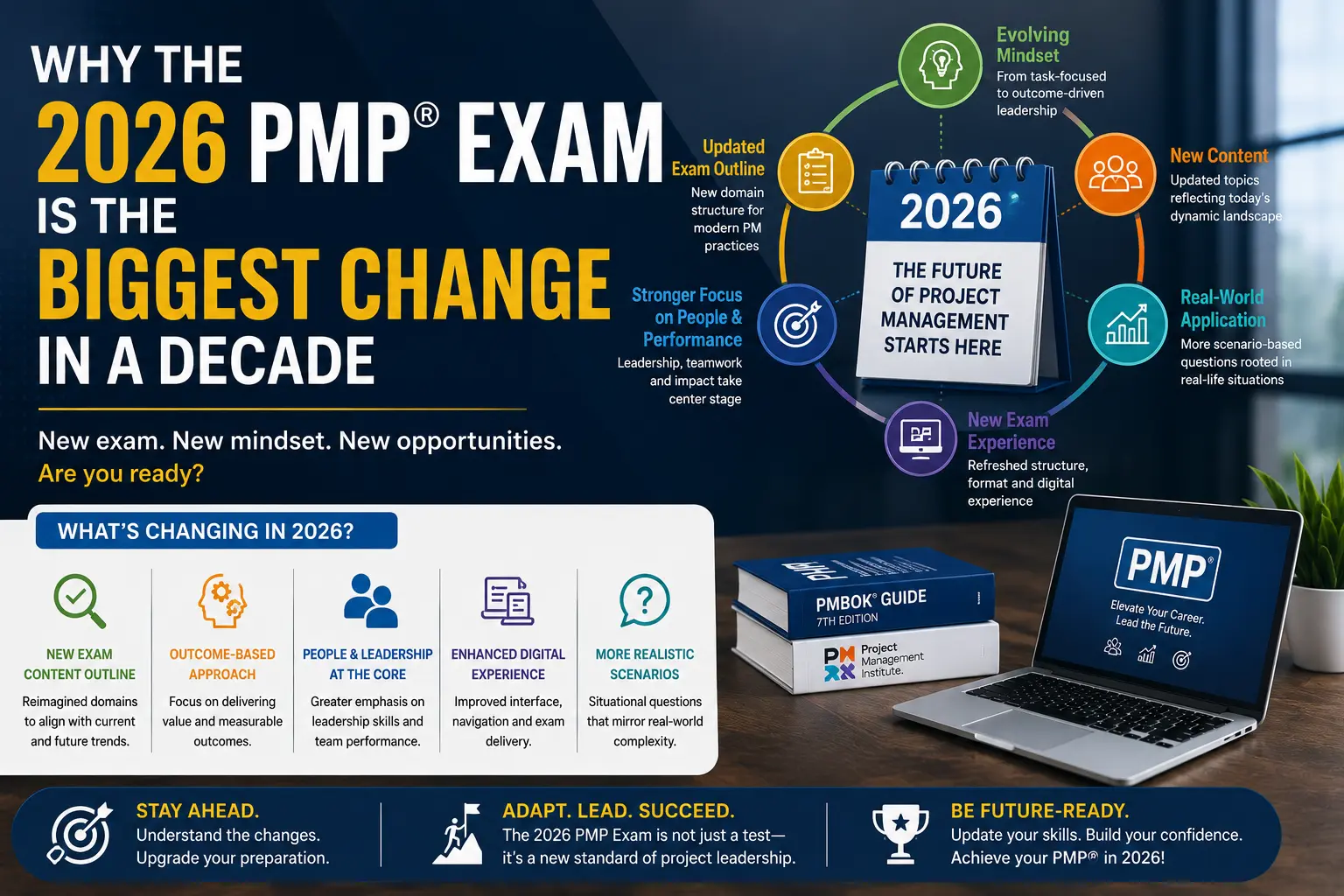
If you have taken the PMP exam any time in the last several years, forget most of what you think you know about it. The PMP 2026 changes rolling out this year are not a minor content refresh. They represent the most significant overhaul of the certification since the shift from PMBOK 6 to PMBOK 7, touching the domain weightings, the question formats, and the underlying standard the exam is built around.
For working professionals in India weighing whether to sit the current exam or wait for the updated version, understanding exactly what is changing, and why, is the difference between walking in prepared and walking in guessing. This article breaks down the PMP exam changes 2026 PMBOK 8 transition in full, from the new Examination Content Outline to what it means for how you should be studying right now.
The Timeline: What Is Actually Changing and When
PMI has confirmed a firm rollout schedule, and it leaves no ambiguity about the cutover date. The current version of the PMP exam remains available through July 8, 2026. Starting July 9, 2026, every PMP candidate worldwide, including in India, will sit the updated exam built on the new Examination Content Outline.
A few key milestones worth knowing:
Updated learning materials became available to Authorized Training Partners ahead of the general market, with PMI walking ATPs through the full change set at a dedicated webinar in mid-April 2026
The PMBOK Guide 8th Edition was released in November 2025, with the print edition following in January 2026
PMI members can now download PMBOK 8 free in ten languages
From July 9, 2026 onward, there is no option to sit the legacy version of the exam
If you are still deciding which version to target, our detailed breakdown on whether you should rush your PMP before July 8, 2026 walks through the decision in more depth.
PMBOK 7 to PMBOK 8: What Actually Changed
The PMBOK 7 to PMBOK 8 differences are substantial enough that PMI describes this as the most community-driven edition in the guide's history. Here is what shifted:
Fewer, Sharper Principles
PMBOK 7 organized its guidance around twelve principles. PMBOK 8 consolidates these into six: Adopt a Holistic View, Focus on Value, Embed Quality Into Processes and Deliverables, Be an Accountable Leader, Integrate Sustainability, and Build an Empowered Culture. The reduction is not a simplification for its own sake. It reflects PMI narrowing in on the behaviors that its global job task analysis found actually predict project success.
Seven Performance Domains, Five Focus Areas
PMBOK 8 keeps the performance-domain structure but adds five new Focus Areas built around 40 non-prescriptive processes. This is a deliberate middle ground between the process-heavy PMBOK 6 and the highly abstract, principles-only PMBOK 7. Candidates get back some practical structure without a return to rigid step-by-step processes.
A Blended Philosophy
Where PMBOK 6 told you exactly which inputs, tools, and outputs to use, and PMBOK 7 stepped back into pure principles, PMBOK 8 blends both. It gives project managers a practical scaffold while still expecting them to apply judgment based on context. For a task-by-task look at how this plays out inside the exam itself, see our companion piece on PMBOK 8th Edition vs 7th Edition and what it means for your PMP exam.
Business Environment Jumps From 8% to 26%: The Real Headline
If there is one number that captures why this is being called the biggest PMP shift in a decade, it is this: the Business Environment domain has more than tripled its weight on the exam, moving from 8% to 26%.
The revised domain split now looks like this:
People: 33%
Process: 41%
Business Environment: 26%
This is not PMI adding trivia questions about compliance and governance. It reflects a genuine repositioning of what the certification validates. PMI's own research reframed project success around stakeholder value and business outcomes, not just schedule, budget, and scope. In practice, this means far more questions on strategic alignment, organizational governance, external market influences, and how a project connects to business value realization. We cover the full domain-by-domain shift, including specific task counts, in PMP 2026 Domain Weights Explained.
The New PMP Exam Content Outline (ECO) 2026
It is worth being precise here, because a lot of confusion is circulating in study groups: the exam is not built directly from PMBOK 8. It is built from the PMI exam content outline 2026, officially called the Examination Content Outline, or ECO. PMBOK 8 is a reference that supports the ECO, but the ECO is the controlling blueprint PMI uses to write every question.
The 2026 ECO restructures the exam into 26 tasks across the three domains, roughly split as 8 People tasks, 10 Process tasks, and 8 Business Environment tasks, each with defined enablers describing the specific work a competent PMP holder is expected to perform. If you want the complete task-by-task view rather than a summary, our full walkthrough of the PMP Exam Content Outline 2026 covers every domain in detail.
New Question Formats and a Heavier Agile Tilt
Beyond content, the format of the exam itself is changing. The 2026 version introduces:
More scenario-based and case-study style questions that test applied judgment rather than recall
Graphic-based items alongside the traditional multiple-choice format
A continued 180-question structure, delivered with two scheduled breaks
Perhaps the most consequential shift for exam prep is the balance between delivery approaches. A significant share of the exam, commonly cited at around 60%, now touches agile and hybrid concepts rather than purely predictive, waterfall-style project management. If hybrid delivery is not yet a strong area for you, our dedicated guide on hybrid project management in PMP 2026 is worth working through before exam day.
AI and Sustainability Are Now Testable Topics
Two themes that barely existed in earlier versions of the exam are now formally part of the blueprint: artificial intelligence in project delivery, and sustainability. PMI's own framing is that these topics reflect changing ways project leaders think, collaborate, and deliver results, and both were validated through PMI's job task analysis before being written into the ECO.
You do not need deep technical AI expertise to pass. What the exam expects is an understanding of how AI tools support risk management, scheduling, reporting, and everyday project decisions. We go deeper into exactly how this is tested in AI in Project Management: How the 2026 PMP Exam Tests It.
What Is Not Changing
Amid all this, a few fundamentals stay exactly where they were:
The three-domain structure of People, Process, and Business Environment remains intact
The exam is still delivered through Pearson VUE testing centers, with the same day-of requirements
PMI's core emphasis on applied, real-world judgment over rote memorization continues, arguably intensified rather than reduced
The credential itself is identical regardless of which exam version you sit; your certificate will never indicate old or new format
If you are prepping for exam day itself, our PMP exam day checklist for Pearson VUE testing centers remains fully relevant under the new format.
How to Prepare for the New PMP Exam
Given how much has shifted, a study plan built for the old exam will leave real gaps. Here is what actually works for the updated version:
Start with the 2026 ECO, not PMBOK 8, as your primary study document. The ECO tells you exactly what will be tested; PMBOK 8 gives you the context to understand why.
Weight your study time to match the new domain split. Process still carries the most marks at 41%, but do not under-invest in Business Environment given its jump to 26%.
Practice scenario and case-study questions specifically, since recall-based practice questions built for the old format will not train you for the new question style.
Build comfort with agile and hybrid scenarios early, given how much of the exam now leans in that direction.
Treat AI and sustainability as testable content, not background reading. Even a working-level understanding of how these show up in project decisions will cover most of what is asked.
For a broader, syllabus-first view of what changed and why it actually benefits working professionals over textbook learners, our piece on why the 2026 PMP syllabus change is good news for working professionals is a useful next read.
Frequently Asked Questions
Is the PMP exam changing in 2026? Yes. PMI is launching an updated PMP exam on July 9, 2026, built on a revised Examination Content Outline and aligned with the newly released PMBOK Guide 8th Edition. The current exam version remains available only through July 8, 2026.
Do I need to study PMBOK 8 to pass the new exam? PMBOK 8 provides valuable context and philosophy, but the exam itself is built from the 2026 Examination Content Outline. Prioritize the ECO as your primary study document and use PMBOK 8 to understand the reasoning behind it.
Why did the Business Environment domain weight increase so much? PMI's global job task analysis found that today's project managers are expected to connect project work to broader business strategy, governance, and value realization far more than in the past. The domain weight increase from 8% to 26% reflects that shift in real-world responsibility.
Will my PMP certificate look different if I take the new exam? No. The credential itself is identical regardless of which exam version you sit. Your certificate will not indicate whether you took the current or updated format.
Should I rush to take the exam before July 8, 2026, or wait for the new version? This depends entirely on your current preparation stage. Both paths lead to the same certification, and neither is inherently better. If you are close to exam-ready under the current syllabus, sitting before the deadline can save you from relearning content under the new domain weights.
Final Thoughts
The scale of the PMP certification changes 2026 brings goes well beyond a syllabus update. Between the new domain weightings, the PMBOK 8 philosophy, the revised question formats, and the addition of AI and sustainability as core content, this is a genuine reset in what the certification measures. Preparing for it deliberately, with the 2026 ECO as your anchor, is what separates candidates who pass comfortably from those who get caught off guard by a format they did not train for.
If you want a structured, mentor-led path through the new syllabus rather than piecing it together from scattered resources, you can learn more about Visakh RJ's PMP coaching approach or reach out directly through the contact page to discuss where you currently stand.