
Why the 2026 PMP Syllabus Change is Actually Good News for Working Professionals
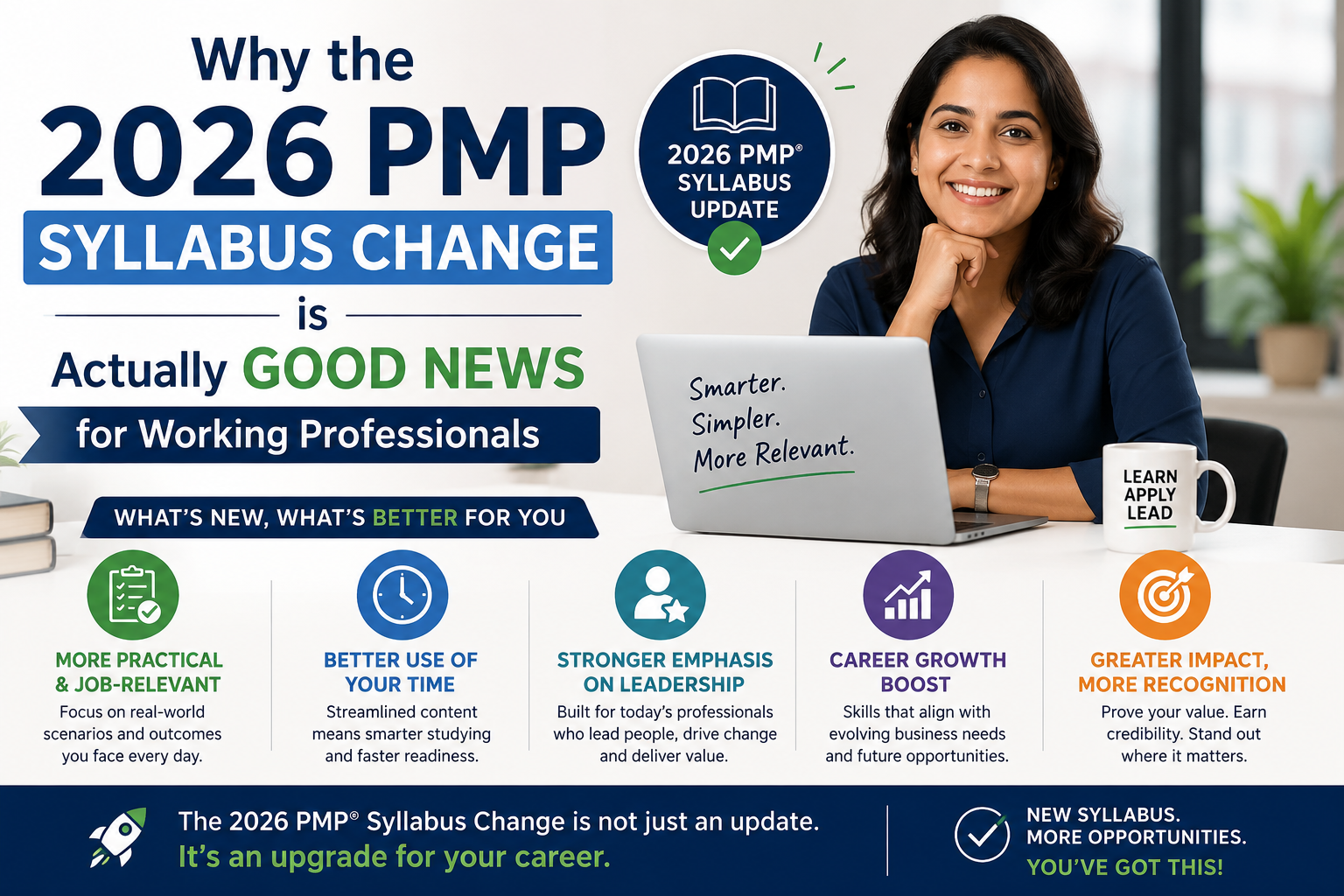
You have been managing projects, leading teams, and solving real problems for years. But the PMP certification has been sitting on your to-do list, waiting for the "right time" that never seems to arrive.
Here is something no one tells you: the 2026 PMP syllabus changes are the best thing that could have happened to someone in your position.
PMI has completely overhauled the exam with the release of the PMBOK Guide 8th Edition. And when you look closely at what actually changed, you will find that the updated exam does not reward candidates who can memorise a textbook. It rewards candidates who have been living and breathing project leadership on the job, every single week.
If that sounds like you, keep reading. This blog breaks down every significant change, why it matters for working professionals in India, and exactly how to use your experience as your biggest competitive advantage.
What Are the 2026 PMP Syllabus Changes and Why Do They Matter?
The most important thing to understand upfront is that the 2026 PMP syllabus changes are not a minor update. They represent the most significant overhaul of the PMP exam in years.
The updated exam goes live on 9 July 2026. Everything before that date runs on the current format. Everything from 9 July onward reflects the new PMP Exam Content Outline, anchored by PMBOK 8th Edition principles.
The Three Domains Have Been Rebalanced
The exam still tests across three domains: People, Process, and Business Environment. But the weights have shifted meaningfully.
People: 33% — Leadership, conflict resolution, coaching, stakeholder influence, team collaboration
Process: 41% — Value delivery, planning, risk, quality, scope, schedule, cost, procurement, governance
Business Environment: 26% — Strategic alignment, compliance, benefits realisation, external change, governance frameworks
The headline shift is the expanded Business Environment domain. This section now formally tests whether you understand how your project connects to organisational strategy, business outcomes, and long-term value. This is no longer a section you can skim through. It is a major part of your preparation.
New Content Areas in the 2026 Exam
Beyond the domain rebalancing, the updated PMP exam content outline 2026 introduces content that simply was not part of earlier versions of the exam.
These include:
Artificial intelligence tools within project environments
Sustainability considerations in project planning and delivery
Adaptive and hybrid delivery models embedded throughout all three domains
Stakeholder engagement as a cross-cutting competency, not just a task area
None of this is theoretical. These are realities that experienced project managers in IT, infrastructure, engineering, and consulting in India deal with every working day.
The Shift From Memorisation to Judgment: Why Experience Wins
This is the change that matters most for working professionals, and it rarely gets the attention it deserves.
The Old Exam Favoured Textbook Learners
The traditional PMP exam was notorious for testing process knowledge. You needed to know the 49 processes, memorise inputs, tools, outputs, and recall which knowledge area a particular activity belonged to. A fresh graduate with six months of dedicated study time and a good memory could outperform a senior project manager who had been running multi-crore programmes for a decade.
That is not a great certification system. PMI recognised it too.
The New Exam Tests Real Decision-Making
The 2026 format is built around scenario-based questions. Every question places you inside a realistic project situation and asks you to decide what the most appropriate next step is.
Think about questions like these:
A key stakeholder withdraws support for your project midway through execution. What do you do first?
Your hybrid team completes the sprint but the deliverable does not meet the business acceptance criteria. How do you respond?
A regulatory change in your operating environment threatens the business case for the project. What is the right next step as the project manager?
These are not textbook scenarios. They are actual situations that working professionals navigate in real projects. And the 2026 PMP exam is now explicitly designed to test whether you can navigate them well.
If you have been working in project leadership roles, you have been building this judgment for years. The exam is finally catching up to how project management actually works.
How the Business Environment Domain Plays to Your Strengths
The expanded Business Environment domain deserves its own focused attention because it is where the 2026 exam most directly rewards professional experience.
What This Domain Now Tests
PMI has significantly increased the depth of this domain to reflect how the project manager's role has evolved. The modern PM is not just a coordinator of tasks and timelines. They are expected to:
Ensure the project remains aligned to organisational strategy throughout its lifecycle
Demonstrate how project outcomes translate into measurable business value
Manage external factors like regulatory shifts, market changes, and ESG considerations
Contribute to governance frameworks and benefits realisation planning
If you have had to defend a project's ROI to leadership, manage scope changes driven by a policy shift, or navigate procurement compliance in a regulated sector, you already understand this domain. The exam is now testing what you do, not what you studied.
Why This Is a Major Advantage for Indian Professionals
India's project management landscape spans IT services delivery, infrastructure development, banking technology, manufacturing, and consulting. Professionals in these sectors routinely manage complex business environments, global stakeholders, and shifting organisational priorities.
The expanded Business Environment domain reflects exactly this complexity. Indian project managers who have worked on cross-border IT programmes, infrastructure rollouts aligned to government mandates, or product launches tied to corporate OKRs are well-prepared to handle this section, often better than candidates who have only studied it from a book.
To understand how the PMP training programme at rjvisakh.com prepares you specifically for this domain, explore the full PMP certification coaching programme here.
The Agile and Hybrid Shift: What It Means for Traditional Project Managers
One of the most discussed aspects of the 2026 PMP exam changes is the integration of agile and hybrid thinking across all three domains. This is not a separate agile section. Agile scenarios appear throughout the People, Process, and Business Environment domains.
What the Exam Expects You to Know
You do not need to be a Scrum Master or a certified Agile coach to pass the PMP. But you do need to understand:
Core Scrum events: Sprint Planning, Daily Standups, Sprint Reviews, Sprint Retrospectives
Kanban principles: visualising work, limiting WIP, managing flow
How to select between predictive, agile, and hybrid approaches based on project context
How agile teams define value and adapt based on feedback loops
The Practical Challenge for Experienced Managers
Many senior project managers in India have deep experience in predictive project management but limited formal exposure to agile frameworks. This is particularly common in construction, manufacturing, and government-aligned projects where waterfall approaches still dominate.
This gap is real, but it is also the most predictable gap to close. Dedicating focused preparation time to agile concepts will give you high returns on the exam because the scenarios are testable and the logic is consistent once you understand the PMI mindset.
Visakh R J's free ACE and Crack sessions cover exactly this transition for experienced professionals who have strong predictive foundations but need to build agile fluency before sitting the exam.
Updated Eligibility Requirements: The Gate Is Now Wider
The 2026 update also brings changes on the eligibility side that many professionals have not noticed yet. And these changes are significant.
What Has Changed in Eligibility
PMI has formally expanded the range of educational pathways that qualify a candidate to apply for the PMP. Associate-level degrees, advanced technical diplomas, and vocational qualifications now have a clearer route to eligibility than they did previously.
For candidates qualifying through these expanded pathways, four years of verified project leadership experience meets the experience requirement.
Why This Matters for Indian Professionals
A large percentage of skilled project managers in India built their careers through polytechnic programmes, diploma-to-degree pathways, or professional technical certifications rather than conventional four-year undergraduate degrees. The previous eligibility structure created ambiguity for many of these candidates.
The 2026 update removes much of that ambiguity. If you have led projects, managed teams, and delivered outcomes in a professional capacity for four or more years, the path to applying is now more clearly open to you regardless of how your education was structured.
If you are unsure whether your profile meets the current eligibility criteria, book a one-on-one clarity session here to get a direct answer based on your specific background.
How to Prepare Smart for the 2026 PMP Exam as a Working Professional
Preparing for the PMP while holding a full-time job is genuinely demanding. But it is absolutely achievable with the right approach. The key is strategy over volume.
Step 1: Download and Study the New ECO First
Before you open any study book or take any mock test, download the updated Exam Content Outline directly from PMI's website. This is the authoritative document that defines what the exam tests. Read through every domain and task, and map your own professional experience to each area. You will quickly see where your strengths are and where your gaps lie.
Step 2: Build a Study Schedule Around Your Work Calendar
Most working professionals can realistically commit one to two hours of focused study time per day on weekdays and three to four hours on weekends. That gives you a realistic preparation window of eight to twelve weeks if you are consistent.
Do not try to study in long exhaustive sessions over weekends. The research on learning retention is clear: spaced, consistent sessions outperform cramming. Build the habit, not the marathon.
Step 3: Prioritise Scenario Practice Over Concept Review
Given how the 2026 exam is structured, your most valuable preparation time is spent on scenario-based practice questions, not re-reading theory you already understand from your work experience.
Aim to complete at least 200 to 300 practice questions before your exam date. For every question you get wrong, do not just note the right answer. Understand why the PMI-preferred answer is what it is. PMI has a specific mindset about how project managers should act. Learning that mindset is more important than memorising facts.
Step 4: Close the Agile Gap Intentionally
If your project experience is primarily predictive, block dedicated time to build your agile knowledge. Focus on understanding how and why agile approaches are chosen, not just what the ceremonies are called.
Step 5: Meet the 35-Hour Education Requirement
The PMP application requires 35 hours of formal project management education. A structured training programme aligned to the new ECO is the most efficient way to meet this requirement while also building your exam readiness.
The PMP coaching programme at rjvisakh.com is built specifically for working professionals who need a focused, practical pathway that does not assume you have unlimited study time.
The Career Case for Getting PMP Certified in India Right Now
Beyond the exam changes, there is a broader career argument for why now is the right time to pursue your PMP certification in India.
The Indian project management job market has been expanding steadily across IT services, infrastructure, BFSI, manufacturing, and consulting. PMP-certified professionals are consistently preferred for senior project and program management roles. The salary premium is real and documented.
More importantly, the 2026 PMP exam is designed to certify the kind of capability that organisations actually need from their senior project professionals. Strategic thinking. Business outcome orientation. Leadership under ambiguity. Adaptive decision-making. These are not soft skills listed on a job description. They are the competencies that determine who gets promoted into program management and portfolio leadership roles.
Getting certified before the updated exam becomes the market norm puts you ahead of the next wave of candidates. And because the new format rewards experience, professionals who are already practising these skills have a genuine edge over those who are studying for it from scratch.
To understand the broader career outcomes that PMP certification enables for professionals in India, read more about the leadership development pathway here.
Frequently Asked Questions About the 2026 PMP Syllabus Changes
Q1. Do I need to buy the PMBOK 8th Edition to prepare for the 2026 PMP exam?
The PMBOK Guide is a reference material, not the exam syllabus itself. PMI's Exam Content Outline is the primary document that defines what the exam tests. PMBOK 8 provides conceptual depth that supports your understanding of the ECO, but you do not need to read it cover to cover. Focus on the ECO first, and use PMBOK 8 to deepen your understanding of specific areas where you need clarity.
Q2. Is the 2026 PMP exam harder than the current version?
The 2026 exam is different, not necessarily harder. It is more scenario-driven and places greater emphasis on judgment and decision-making rather than process recall. For working professionals with real project leadership experience, many find this format more intuitive than the older knowledge-heavy version. The key shift is that understanding the PMI mindset becomes more important than memorising frameworks.
Q3. Can I still take the current PMP exam before the July 2026 change?
Yes. The current exam remains available until 8 July 2026. If you are already significantly into your preparation with current materials, it may make sense to sit before the change. If you are just starting out, preparing for the updated exam is likely the better strategy since the new format better rewards the real-world experience you already have.
Q4. How many hours of study are typically needed for the 2026 PMP exam?
Most working professionals require between 150 and 250 hours of total preparation time. This varies based on your existing project management knowledge, your familiarity with agile methodologies, and how much hands-on scenario practice you put in. A structured 35-hour training programme accounts for a portion of this, with the balance spread across self-study and mock exams over eight to twelve weeks.
Q5. Does the 2026 PMP exam cover sustainability and AI topics in depth?
These topics are integrated throughout the updated exam rather than tested as standalone sections. Sustainability awareness in project decision-making and the use of AI tools within project environments appear as contextual elements in scenario questions. You do not need to be a sustainability expert or an AI specialist. You need to understand how these factors influence project planning, risk management, and stakeholder decisions at a professional level.
Final Thoughts
The 2026 PMP syllabus changes are not a burden for working professionals. They are a formal recognition that real project leadership experience has value, that judgment matters more than memorisation, and that the certification should reflect what excellent project managers actually do in the real world.
If you have been waiting for the right reason to finally go for your PMP, this is it. The exam has moved in your direction. Your experience is now your study material. Your professional judgment is now what the exam is testing.
The only question left is when you decide to start.
If you want a focused, practical preparation pathway built for working professionals in India, start here with the PMP training programme at rjvisakh.com and take the first step toward the certification your career has been ready for.