
Hybrid Project Management in PMP 2026: Why 60% of Questions Now Cover Agile and Hybrid
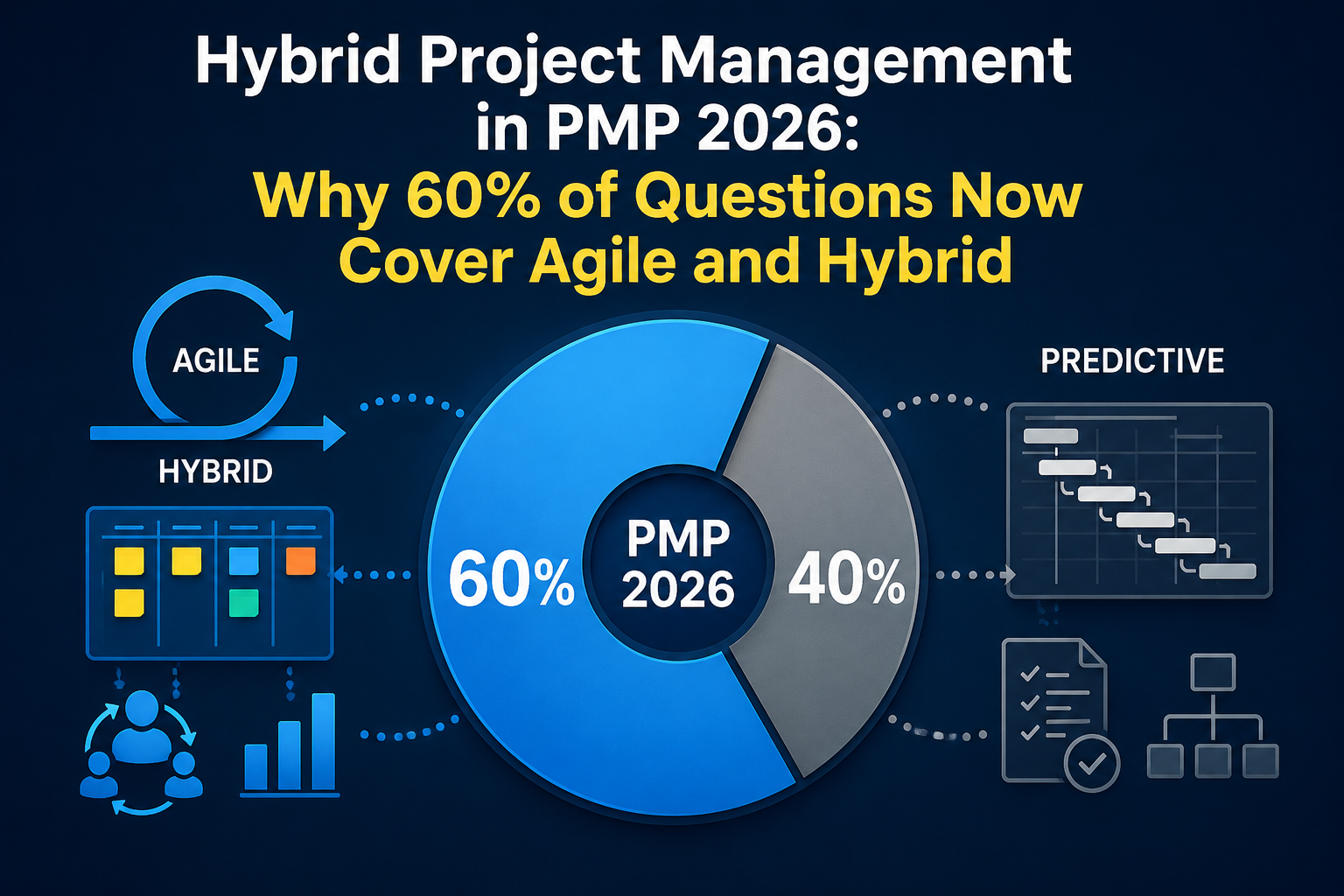
If you are preparing for the exam this year, here is the single most important thing to understand about Hybrid Project Management in PMP 2026: the test is no longer built around traditional, plan-driven projects. PMI has confirmed that roughly 60% of the exam now covers agile and hybrid delivery, with only about 40% dedicated to predictive approaches. For working professionals, project managers, and aspiring PMP candidates across India, this is not a minor tweak. It is a fundamental shift in how you must think, study, and answer questions.
Many candidates still walk into the exam expecting Gantt charts and rigid process groups. They walk out shocked. The 2026 exam rewards judgment in messy, blended environments, not memorization of waterfall steps. This article breaks down exactly what changed, why it changed, and how to prepare the right way.
What "Hybrid Project Management PMP 2026" Actually Means
Hybrid project management is the practice of combining predictive (waterfall) and adaptive (agile) methods within a single project. Instead of choosing one rigid framework, a hybrid project manager selects the right approach for each phase, deliverable, or team.
A simple example: a banking software rollout in Mumbai might use predictive planning for regulatory compliance and fixed budgeting, while the development team works in agile sprints. That blend is hybrid delivery, and it is now the default reality in most Indian IT, BFSI, and engineering organizations.
The 2026 exam reflects this reality. PMI's Job Task Analysis confirmed that more organizations use adaptive or blended delivery than ever before, so the certification had to follow real-world practice. This is the same execution-gap problem we explore in our breakdown of why 90% of projects fail — strategy collapses when the delivery approach does not match the actual project.
The 60% Agile and Hybrid Split: What the Numbers Say
The official July 2026 Examination Content Outline (ECO) sets the balance clearly. Approximately 60% of the 2026 PMP exam reflects agile or hybrid approaches, while the remaining 40% represents predictive approaches. This is the headline change driving every other update. Scrum Master
Here is how the exam is now weighted across its three domains:
People — leadership, team dynamics, and stakeholder engagement, with heavier emphasis on leading distributed and hybrid teams.
Process — 41% — still the largest domain, covering planning, executing, monitoring, and closing.
Business Environment — 26% — significantly expanded, now folding in AI, sustainability, and organizational strategy.
A critical detail many candidates miss: the predictive, agile, and hybrid approaches are now integrated within single scenarios rather than tested separately. You will not get a neat "agile section." Instead, one scenario may blend a team conflict, a schedule compression problem, and a budget constraint tied to quarterly reporting — and expect you to prioritize across all three. PMP Guide
Why PMI Made This Change
The shift is a response to how project managers actually work today. AI-augmented planning, remote and cross-time-zone teams, and continuous delivery have made pure waterfall rare. The certification is catching up to the profession, not leading it. Understanding this "tool, not leader" mindset around emerging tech is exactly what we cover in our piece on the AI revolution and common-sense leadership.
New Question Formats You Must Prepare For
The 2026 exam does not just change content weighting. It changes how questions are asked. The addition of case/scenario and graphic-based question types is particularly significant — scenario questions present a detailed situation, sometimes with charts or graphs, and require candidates to answer a series of related questions. SPOTO
This means:
Scenario-based questions test integrated, applied thinking instead of isolated recall.
Graphic-based questions require you to read burndown charts, velocity data, or network diagrams.
Longer setups give you one rich situation followed by several linked questions.
The lesson is clear: rote learning of definitions will not pass this exam. You need decision-making judgment — the ability to look at a hybrid scenario and choose the right approach, then defend why.
How to Prepare for the Agile-Hybrid PMP Exam in 2026
Effective PMP exam preparation in 2026 looks very different from older study plans. Here is a structured approach built around the new reality of agile and hybrid domain questions.
1. Master the "When and Why," Not Just the "What"
Do not memorize Scrum ceremonies or SAFe frameworks in isolation. Instead, learn why a project manager would choose predictive, agile, or hybrid in a given scenario. The exam wants reasoning, not recitation.
2. Train on Integrated Scenarios
Practice questions that mix People, Process, and Business Environment in one situation. Standalone topic quizzes will not build the muscle the exam tests. This is where mentorship matters — a structured program will drill you on the exact decision patterns PMI now rewards.
3. Build the Right Mindset
Passing PMP 2026 is as much psychological as it is technical. Staying calm and decisive under ambiguous, scenario-heavy pressure is a learnable skill. We unpack this in detail in Leadership vs Administration: decoding calmness and in Mind Over Management, both of which directly apply to exam-day composure.
4. Learn From People Who Have Done It
Theory only takes you so far. Seeing how real candidates navigated the new format is invaluable — our PMP success stories and testimonials show how professionals across India cracked the exam with the right preparation strategy.
Hybrid Project Management Best Practices Beyond the Exam
The PMP certification is the beginning of your career, not the destination. Once certified, applying hybrid thinking on real projects is what builds your reputation and earning power. A few best practices:
Tailor the approach to the project, never force one methodology onto every initiative.
Keep governance light but visible so stakeholders trust the blended process.
Use predictive planning for fixed constraints (compliance, budget) and agile cycles for evolving scope.
Invest in your professional network, because hybrid leadership thrives on cross-functional relationships — a theme we expand in strategic networking for the modern PMP.
Certified hybrid project managers in India are commanding noticeably higher salaries and broader role mobility, precisely because they can lead in any delivery environment. To understand the mentorship philosophy behind this kind of transformation, you can learn more about Visakh RJ's approach to PMP training.
Frequently Asked Questions
1. Is the PMP exam really 60% agile and hybrid in 2026?
Yes. PMI's July 2026 Examination Content Outline confirms roughly 60% of questions cover agile and hybrid approaches, with about 40% on predictive methods. The agile and hybrid content is also integrated across all three domains rather than tested in a separate section.
2. Do I need to learn Scrum or SAFe to pass PMP 2026?
Not in isolation. The exam tests your ability to choose between predictive, agile, and hybrid approaches and to justify the choice in a given scenario. Deep framework memorization matters less than situational judgment.
3. What are the new question formats in the 2026 PMP exam?
The biggest additions are case/scenario questions and graphic-based questions. You will face longer situations, sometimes with charts, followed by several linked questions that test applied, integrated thinking.
4. Are my current PMP study materials still valid?
Most foundational content carries over, but materials must align with the 2026 ECO to cover the expanded Business Environment domain, AI, sustainability, and the new question formats. Studying from an outdated outline is the most common avoidable mistake.
5. How should working professionals in India prepare for the agile-hybrid PMP exam?
Focus on scenario-based practice, decision-making over memorization, and mindset training for exam-day composure. Structured mentorship that mirrors the integrated 2026 format gives the strongest results. You can get in touch to discuss exam preparation and upcoming cohorts.
Final Thoughts
The move toward hybrid project management in PMP 2026 is not a hurdle to fear — it is the profession finally aligning with how projects truly run. Candidates who understand the 60% agile and hybrid weighting, train on integrated scenarios, and build genuine decision-making judgment will not just pass. They will lead.