
PMBOK 8th Edition vs 7th Edition: What Changed and What It Means for Your PMP Exam
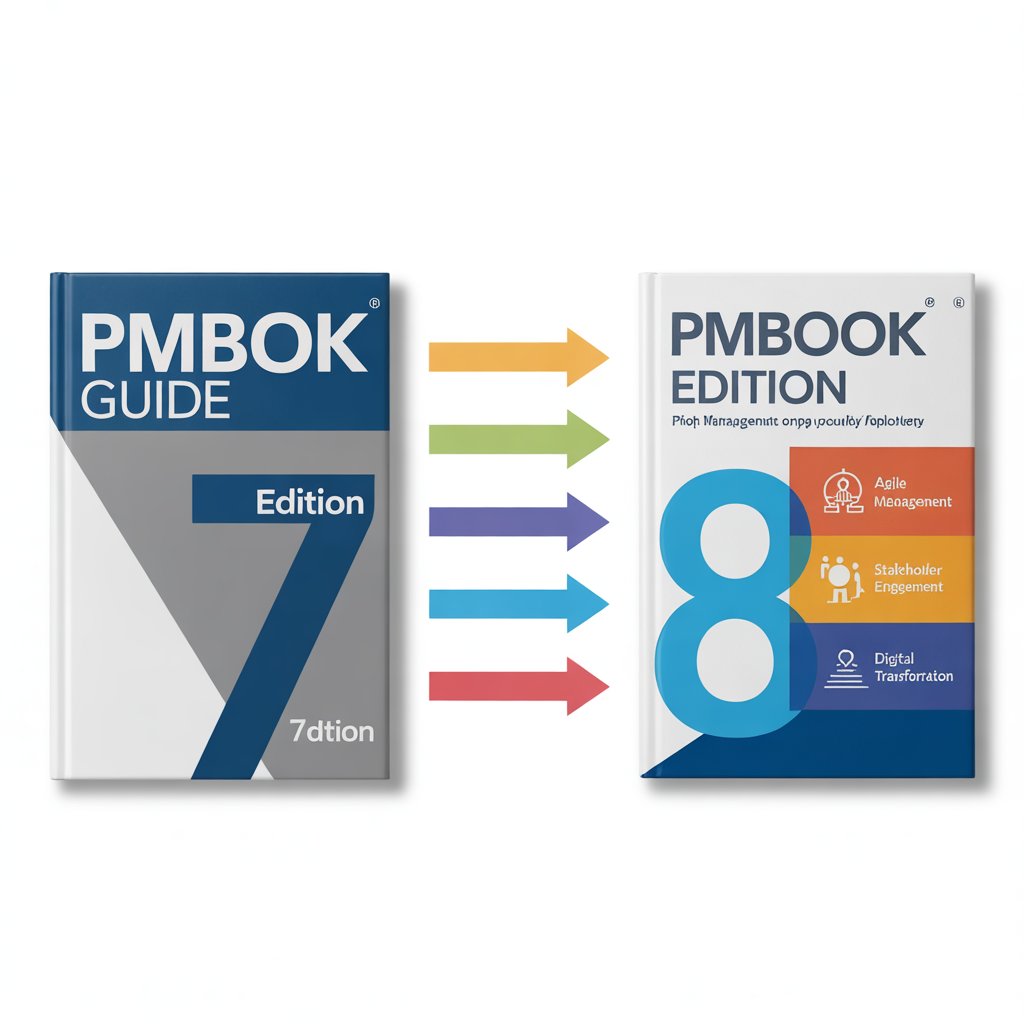
PMP exam changes 2026 are the most significant shift in project management certification in years — and if you are preparing for your PMP right now, understanding what changed between PMBOK 8th and 7th Edition is not optional. It is essential.
Whether you are a working professional in India, the Middle East, the United States, or anywhere else in the world, the same updated standard applies to every PMP candidate globally. This guide breaks down exactly what changed, what stayed the same, and what you need to do before or after July 9, 2026.
Why the PMP Exam Is Changing in 2026
The Project Management Institute released the PMBOK Guide 8th Edition in November 2025, marking its most data-driven update ever, built from over 48,000 data points and feedback from thousands of practitioners worldwide.
The PMP exam changes 2026 take effect on July 9, 2026. Until July 8, 2026, candidates can still sit the current exam based on the 7th Edition framework. From July 9 onward, only the updated exam is available.
This matters because the study materials, question formats, and domain weightings all change. Knowing the difference helps you choose the right preparation path.
PMBOK 7th Edition: What It Introduced
When PMI released the 7th Edition in 2021, it was a major philosophical shift. The guide moved away from the process-heavy approach of the 6th Edition and introduced a principle-based framework focused on delivering outcomes rather than following rigid steps.
Key features of PMBOK 7th Edition included 12 guiding principles centred on adaptability, stakeholder engagement, and value delivery, along with 8 performance domains replacing the traditional 10 Knowledge Areas. It also removed the familiar Process Groups structure covering Initiating, Planning, Executing, Monitoring and Controlling, and Closing, and placed equal focus on hybrid, agile, and predictive project environments.
While widely respected, many practitioners and candidates found the 7th Edition too abstract. The removal of Process Groups left a practical gap that the 8th Edition directly addresses.
PMBOK 8th Edition: What Changed and Why It Matters
PMBOK 8 principles and performance domains have been restructured to balance the modern, value-driven philosophy of the 7th Edition with the practical clarity that practitioners demanded.
The structural changes are as follows. Guiding principles went from 12 in the 7th Edition to 6 consolidated ones in the 8th. Performance domains moved from 8 to 7. Process Groups that were removed in the 7th Edition have been reintroduced as 5 Focus Areas in the 8th. Processes went from 49 in a companion guide to 40 embedded directly within the domains. The two-book model has been unified into a single publication. AI and sustainability coverage that was minimal before is now fully integrated throughout.
The 6 Core Principles in PMBOK 8
One of the most discussed PMP exam changes 2026 is the consolidation of 12 principles into 6 actionable ones. PMI streamlined them because practitioners found 12 abstract principles difficult to apply consistently in real projects.
The PMBOK 8 six core principles explained are as follows.
Focus on Value means every project decision should tie back to measurable business value. Engage Stakeholders calls for proactive, ongoing stakeholder involvement throughout the project lifecycle. Adopt a Holistic View recognises that projects operate within broader systems and environments. Lead with Humility reflects that effective project leadership is collaborative, not command-and-control. Navigate Complexity means applying judgment and adaptability rather than fixed rules when facing uncertainty. Optimise for Outcomes prioritises results and impacts over outputs and deliverables.
These six principles are practical decision-making tools, not just philosophical statements. Expect PMP exam scenario based questions 2026 to test how you apply them in realistic project situations.
The 7 Performance Domains in PMBOK 8
PMBOK 8 seven performance domains project management replaces the 8 from the previous edition. The updated domains are Governance, Stakeholders, Scope, Schedule, Finance, Resources, and Risk.
These domains now include embedded processes, making the guide self-contained without needing a separate companion publication. PMBOK 8 principles and performance domains work together as an integrated framework rather than separate layers.
What the PMP Exam Looks Like After July 2026
The PMI exam content outline 2026 changes affect both the content tested and the format of the questions themselves.
The updated PMP exam domain weightings 2026 are People at 33 percent, Process at 41 percent, and Business Environment at 26 percent.
New question formats include scenario sets with multiple related questions based on a single project situation, graphic interpretation items requiring candidates to read charts, dashboards, or project data, and decision-focused questions testing judgment rather than knowledge recall.
The exam also places significantly greater emphasis on PMP exam AI and sustainability topics 2026. For the first time, artificial intelligence use in project management, including AI-assisted scheduling, decision support, and risk analysis, is formally tested. Sustainability as a project decision filter is also embedded across domains.
Process Groups Are Back as Focus Areas
One of the most welcomed changes is the return of the project lifecycle structure. The 7th Edition removed Process Groups entirely, which created confusion for practitioners who relied on Initiating, Planning, Executing, Monitoring and Controlling, and Closing as a communication framework.
The 8th Edition reintroduces this structure through five Focus Areas. They are not rigid sequential steps but flexible reference points that work across predictive, agile, and hybrid project approaches. This change directly shapes PMP exam scenario based questions 2026, which will test how candidates move between these focus areas based on project context rather than following a fixed process order.
PMP Eligibility and Certification Requirements in 2026
For candidates navigating certification for the first time, it is important to confirm that PMI PMP eligibility requirements 2026 have not changed with the edition update.
You still need a secondary degree with 60 months of project leadership experience and 35 hours of project management education, or a four-year degree with 36 months of project leadership experience and 35 hours of project management education.
The PMP certification requirements 2026 remain consistent globally, whether you are applying from India, Nigeria, Brazil, Germany, or Canada.
Should You Take the PMP Before or After July 9, 2026?
Take the exam before July 8, 2026 if you are already well into your preparation using 7th Edition materials, you have completed most of your study hours, or you prefer the current question format.
Take the exam after July 9, 2026 if you are early in your preparation, you prefer studying a single unified guide, or your organisation prioritises AI and sustainability knowledge.
Both paths lead to the same globally recognised PMP credential. The updated exam aligns more closely with how project management is actually practised today, particularly in technology-driven and cross-functional environments.
Key Takeaways for PMP Candidates Worldwide
PMP exam changes 2026 take effect July 9, 2026 and the current exam closes July 8, 2026. PMBOK 8th edition vs 7th edition differences centre on fewer principles at 6 versus 12, fewer domains at 7 versus 8, and the return of Process Groups as 5 Focus Areas. PMBOK 8 principles and performance domains now work as a single integrated framework with 40 embedded processes. AI and sustainability are no longer optional topics but formally tested content areas. PMP certification requirements 2026 for eligibility remain unchanged globally. Updated learning materials from PMI are available from April 14, 2026.
Ready to Master the PMP Exam Changes 2026?
The shift from PMBOK 8th to 7th Edition is significant, but with the right guidance it is completely manageable. Whether you are sitting the exam before July 8, 2026 or preparing for the updated version from July 9 onward, expert support makes the difference between guessing and passing with confidence.
At RJ Visakh, we help working professionals and first-time candidates worldwide navigate every stage of PMP certification, from understanding the new PMBOK 8 principles and performance domains to cracking scenario-based questions on exam day.
Do not let the 2026 changes catch you off guard. Get the clarity, structure, and expert mentorship you need to pass the first time.
Start your PMP journey today at https://www.rjvisakh.com/
This article is written for educational purposes and reflects PMI's publicly available guidance as of May 2026. Always verify current exam details at pmi.org before registering.