
PMP Exam Content Outline 2026: A Complete Task-by-Task Breakdown
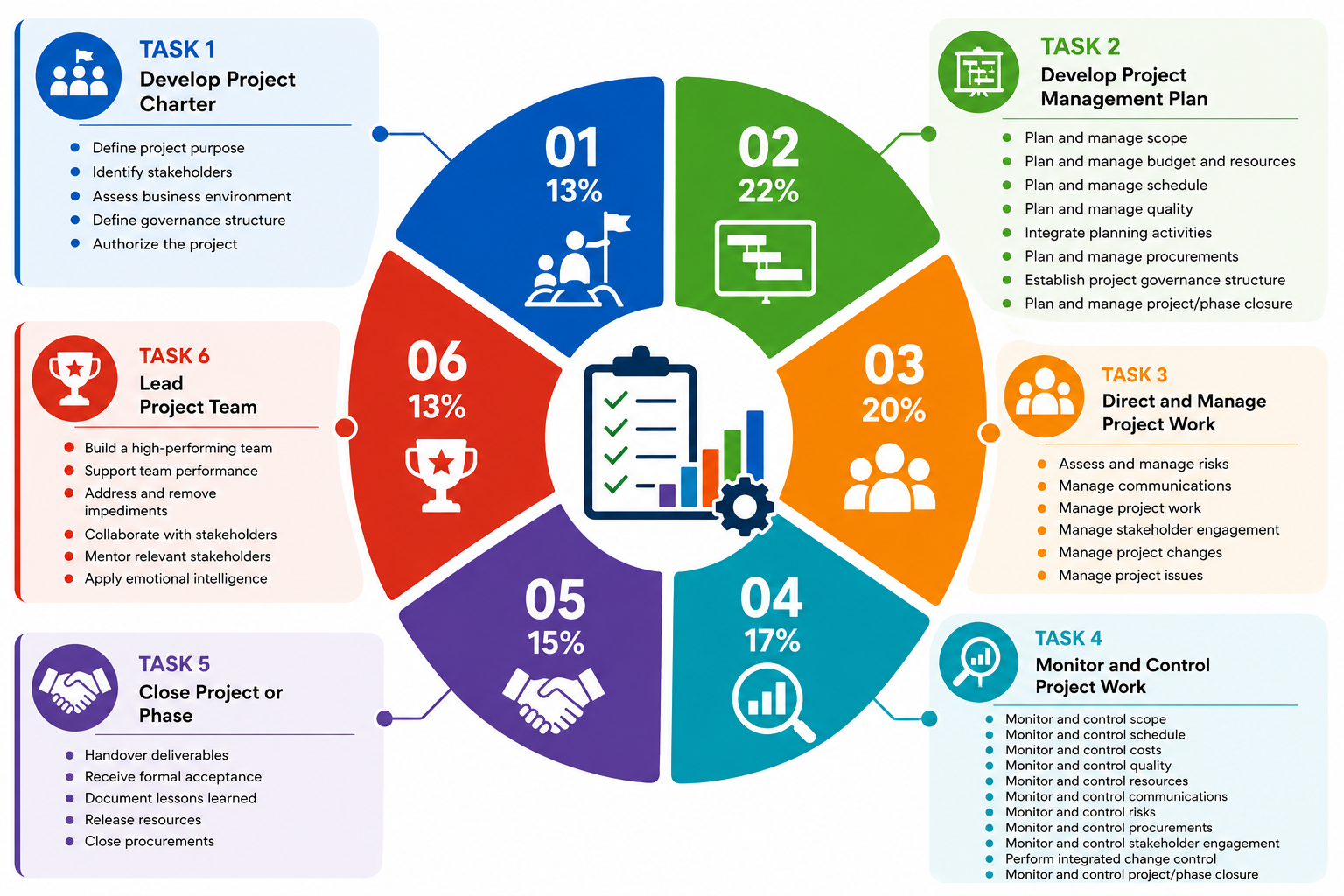
PMP Exam Content Outline 2026 is here, and it changes everything about how project managers prepare for one of the world's most respected certifications. Whether you are based in India, the UAE, the US, the UK, or anywhere else globally, this update affects every candidate sitting the PMP exam from July 2026 onward.
This guide breaks down every domain, every task, and every key shift so you walk into your exam fully prepared.
What Is the PMP Exam Content Outline 2026?
The PMP Exam Content Outline 2026 is the official blueprint published by the Project Management Institute (PMI) that defines what is tested on the PMP certification exam. Think of it as your exam syllabus. It tells you the domains, the tasks under each domain, and the enablers that support those tasks.
PMI updates this outline roughly every four years. The last version was released in January 2021. The 2026 version took effect in July 2026 and is built on a fresh Job Task Analysis (JTA) that reflects how project management has truly evolved in today's world.
What Has Changed in 2026?
The three core domains remain the same: People, Process, and Business Environment. However, the domain weightings, task statements, and question formats have all been significantly updated.
The biggest additions are artificial intelligence and sustainability. For the first time in PMP history, AI-related decision-making and sustainable project practices are formally woven into the exam across all three domains. Agile and hybrid delivery methods continue to be emphasized throughout, not just in one section.
PMP Exam Domains and Tasks 2026: A Full Breakdown
Understanding the PMP exam domains and tasks 2026 is the most critical step in your preparation. Here is a clear breakdown of each domain and its core tasks.
Domain I: People (42%)
This domain carries the highest weight on the exam. It focuses on the skills and behaviors needed to effectively lead a project team.
Key Tasks Under Domain I
Task 1 — Manage conflict among team members and stakeholders
Task 2 — Lead a team by building trust, coaching individuals, and supporting collaboration
Task 3 — Support team performance through continuous feedback and development
Task 4 — Empower team members by assigning clear ownership and accountability
Task 5 — Ensure team members have the necessary training and skills
Task 6 — Build a team culture that embraces diversity, inclusion, and shared goals
Task 7 — Address and resolve team blockers by collaborating with stakeholders
Task 8 — Negotiate project agreements to achieve a fair and workable outcome
Task 9 — Collaborate with stakeholders by building strong professional relationships
Task 10 — Build shared understanding of the project among all team members
Task 11 — Engage and support virtual or distributed teams across different geographies
Task 12 — Define team ground rules to create a productive and respectful environment
Task 13 — Mentor relevant stakeholders using coaching techniques
Task 14 — Promote team performance through the application of emotional intelligence
Domain II: Process (32%)
This domain focuses on the technical aspects of managing a project from initiation through closure.
Key Tasks Under Domain II
Task 1 — Execute the project with urgency and manage competing priorities
Task 2 — Manage communication plans and ensure timely, effective information sharing
Task 3 — Assess and manage risks, including the creation and execution of a risk register
Task 4 — Engage stakeholders by understanding and addressing their needs and interests
Task 5 — Plan and manage the project budget and financial reporting
Task 6 — Plan and manage the project schedule using appropriate tools and techniques
Task 7 — Plan and manage the quality of deliverables throughout the project
Task 8 — Plan and manage scope while controlling scope creep
Task 9 — Integrate project planning activities across all knowledge areas
Task 10 — Manage project changes through a structured change control process
Task 11 — Plan and manage procurement activities with vendors and suppliers
Task 12 — Manage project artifacts and ensure documentation is accurate and current
Task 13 — Determine the appropriate project methodology (predictive, agile, or hybrid)
Task 14 — Establish a project governance structure that supports decision-making
Task 15 — Manage project issues and remove impediments that block team progress
Task 16 — Ensure knowledge transfer across the team, especially at project close
Domain III: Business Environment (26%)
This domain has received a significant weight increase in 2026 and now demands deeper strategic thinking from candidates.
Key Tasks Under Domain III
Task 1 — Define and establish project governance including policies, ethics, and reporting structures
Task 2 — Evaluate and deliver benefits and value by aligning project outcomes to organizational strategy
Task 3 — Evaluate and address external business environment changes impacting the project scope
Task 4 — Support organizational change management by preparing teams and stakeholders for transitions
Task 5 — Integrate sustainability considerations into project planning and execution
Task 6 — Apply AI-assisted tools and decision-making where appropriate within the project lifecycle
The PMP ECO 2026 Task Breakdown: What Candidates Must Focus On
The PMP ECO 2026 task breakdown reveals three major focus areas that will shape your exam experience.
First, leadership and people skills dominate the exam at 42 percent. If you have been focusing only on schedules and budgets, you need to shift your mindset. PMI wants strategic leaders, not just task coordinators.
Second, AI and sustainability are no longer optional knowledge. They are embedded across all domains. Candidates who understand how AI tools support planning, risk management, and resource allocation will have a clear advantage.
Third, the Business Environment domain has grown in weight and complexity. Governance, benefits realization, and organizational change are now central exam topics that require real understanding, not memorization.
How Professional Coaching Accelerates Your PMP Success
Studying the PMP Exam Content Outline 2026 alone is one thing. Understanding how to apply it under exam conditions is another. This is where professional coaching makes the difference.
A qualified PMP coach helps you map each task to your actual work experience, identify your weak domains early, practice scenario-based questions that mirror the real exam format, and build the strategic thinking PMI expects from a certified project manager.
Coaching also keeps you accountable. With a 35-task exam blueprint, self-study without structure often leads to important gaps. A coach ensures you cover every domain systematically and with confidence.
Final Thoughts
The PMP Exam Content Outline 2026 is a major evolution in project management certification. It reflects the real demands of leading projects in a world shaped by AI, sustainability, and complex stakeholder environments. Whether you are preparing from Mumbai, Dubai, London, or New York, this updated framework applies equally to you.
Master the PMP exam domains and tasks 2026, understand the PMP ECO 2026 task breakdown, and approach your preparation with the same strategic mindset PMI now expects on exam day.
Ready to pass your PMP exam on the first attempt?
Get expert, personalized PMP coaching that is fully aligned with the 2026 ECO. Visit www.rjvisakh.com today and take the first step toward your certification with confidence.