
How to Study for the New 2026 PMP Syllabus | India Guide
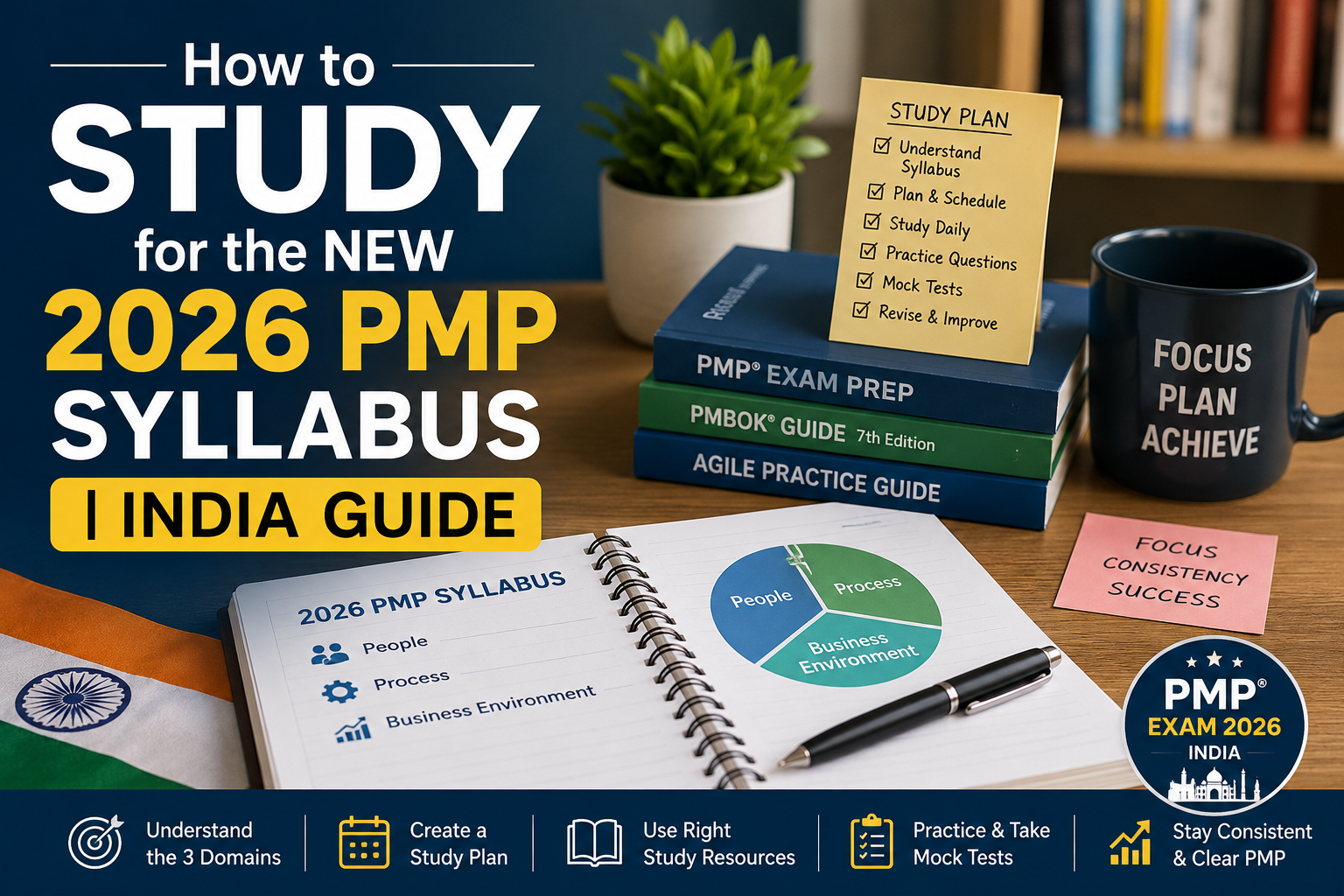
The Project Management Institute introduced significant changes to the PMP certification examination in 2026. If you're a working professional, engineer, or IT specialist in India pursuing PMP certification, understanding how to study for the new 2026 PMP syllabus is essential to passing on your first attempt. The new PMP exam content outline 2026 reflects modern project delivery, expanded domain weights across People, Process, and Business Environment, and fresh assessment methods. This guide walks you through a structured PMP 2026 study plan tailored for professionals balancing work and certification goals.
Understanding the New PMP Syllabus Changes
The 2026 PMP syllabus represents the most significant update since PMBOK 8 was released. The exam now allocates domain weights differently than previous versions. The People domain expanded to 42 percent of the exam, emphasizing leadership, team dynamics, and stakeholder engagement. The Process domain accounts for 50 percent, covering project execution, monitoring, and closing activities. The Business Environment domain comprises 8 percent, focusing on organizational strategy and regulatory compliance.
These PMP domain weights People Process Business Environment changes demand a shift in how you approach study materials. Traditional PMBOK memorization no longer suffices. Instead, you must understand how these domains interact in real project scenarios. For a complete breakdown of each domain's specific tasks, review the PMP exam content outline 2026 with task-by-task details, which provides granular insight into what the exam actually tests.
Why the 2026 Changes Matter for Indian Professionals
Working professionals preparing for PMP certification in India face unique challenges. Most are juggling full-time jobs, team responsibilities, and tight deadlines. The PMP syllabus changes July 2026 introduced more scenario-based content, making traditional cramming ineffective. Instead, a strategic PMP 2026 study plan structured around your daily schedule produces better results.
The exam now emphasizes practical application over theoretical knowledge. This means your study approach should mirror how you actually manage projects at work. If you're managing teams remotely, handling distributed stakeholders, or navigating cultural complexities in your organization, the new exam directly tests these competencies. The good news? The 2026 PMP syllabus changes actually favor working professionals over those who rely purely on textbook learning.
Building Your PMP Exam Prep India 2026 Strategy
A structured PMP study schedule for working professionals begins with assessing your baseline knowledge. If you have five years of project management experience, you already possess domain expertise. What you need is exam-specific preparation. If you're newer to project management, allocate more time to PMBOK 8 study guide fundamentals before moving to practice questions.
Start by reviewing the PMP exam content outline 2026 directly from PMI. This document specifies exactly what the exam covers. Align your study materials with this official outline, not outdated guides from 2023 or earlier. Many candidates waste weeks studying retired content.
Next, choose your study format. Online courses, instructor-led training, self-study with books, or a hybrid approach all work. The best way to study for PMP 2026 depends on your learning style and available time. Working professionals often benefit from structured courses offering flexibility, such as weekend cohorts or self-paced modules you complete during commutes.
Structuring Your PMP 2026 Study Plan
Allocate three to four months for comprehensive preparation. If you study five hours weekly, that's 60-80 hours total—the standard recommendation for PMP certification. For professionals in India managing higher workloads, six months with three to four hours weekly is realistic.
Month One: Foundation and Domain Mastery
Spend your first month understanding the three domains. Read PMBOK 8 study guide chapters on People, Process, and Business Environment. Don't memorize; focus on comprehension. Map how these domains relate to your current projects. When reading about stakeholder engagement, connect it to a recent team situation you managed. This contextual learning accelerates retention.
Use flashcards for terminology, but don't rely solely on them. Flash cards work for definitions, not for understanding process interactions or decision trees. Combine them with active recall exercises: teach someone else what you learned, write summaries, or explain concepts in your own words.
Month Two: Case Studies and Scenario Analysis
The PMP mock exam strategy 2026 centers on case-based questions. These present multi-step scenarios where your decision in Step One affects Step Three. Study materials must include case study questions. Read real-world project narratives, identify the problem, determine the process group, and predict the correct response based on PMBOK principles.
It's critical to understand that hybrid project management now dominates 60% of PMP exam questions. This means your case study practice should include both predictive and agile scenarios, as well as hybrid delivery models that blend both approaches. Join study groups. Many professionals in India connect through platforms like LinkedIn or local PMI chapters. Discussing case scenarios with peers solidifies understanding. You'll encounter perspectives you hadn't considered, strengthening your decision-making framework.
Month Three: Focused Practice and Weak Areas
Take full-length PMP mock exams under timed conditions. Simulate the actual exam environment: sit at a desk, use only allowed materials, and complete 180 questions in four hours. This builds stamina and reveals knowledge gaps. After each mock exam, analyze incorrect answers. Don't just read the correct response; understand why the other options were wrong. This analytical approach reveals patterns in your reasoning errors.
Dedicate this month to your weakest domains. If you scored 65 percent on People domain questions but 85 percent on Process, focus your remaining study time on People. Targeted practice beats broad review at this stage.
Maximizing Your PMP Certification Study Tips
Tip One: Create a study schedule integrated with your work calendar. Block specific days and times for PMP study, treating it like client meetings you cannot reschedule.
Tip Two: Use active learning techniques. Passive reading doesn't stick. Write notes, create concept maps, explain concepts aloud, and solve practice questions daily.
Tip Three: Join a PMP study group. Discussing difficult concepts with peers clarifies understanding faster than solo study. Many professionals in India find value in cohort-based courses where you progress with classmates.
Tip Four: Distinguish between knowledge and exam skills. You might understand a concept perfectly but misread an exam question. Practice reading questions carefully, identifying the core problem, and eliminating obviously wrong answers.
Tip Five: Manage test anxiety. The 2026 exam is challenging, but passing is achievable with disciplined three-to-four-month study plans. Many working professionals in India pass on their first attempt with disciplined three-to-four-month study plans. For a concrete roadmap, follow this proven 90-day strategy for Indian IT professionals preparing for the 2026 exam.
Leveraging Professional Coaching
While self-study works, many professionals benefit from a PMP coach in India. Experienced coaches understand the exam format, identify your knowledge gaps, and provide personalized strategies. They accelerate your preparation timeline and increase first-attempt success rates. A coach is especially valuable if you're working full-time and need to optimize your limited study hours.
The coaching approach becomes increasingly important as you progress. For a detailed look at how modern PMP coaching has evolved, review how leading coaches are updating their programs from PMBOK 7 to PMBOK 8. For structured guidance tailored to the 2026 syllabus, connect with a PMP coach in India who specializes in current exam changes and working professional schedules.
FAQs on the New PMP Syllabus
Q: How much time should I study for the new 2026 PMP exam?
A: Allocate 60-80 hours across three to four months. Working professionals in India often spread this over six months at 3-4 hours weekly.
Q: Is PMBOK 8 study guide sufficient?
A: PMBOK 8 is foundational but not sufficient alone. Add case study practice, mock exams, and scenario-based materials to master the new exam format.
Q: What's the best way to study for PMP 2026 if I'm working full-time?
A: Use a structured PMP 2026 study plan with dedicated time blocks, leverage study groups, and consider a coach. Focus on active learning over passive reading.
Q: How do the new domain weights affect my study priority?
A: Spend 42 percent of your study time on People domain, 50 percent on Process, and 8 percent on Business Environment, roughly matching exam weights.
Q: Should I retake the exam if I fail?
A: Analyze your performance, identify knowledge gaps, review weak sections for 3-4 weeks, then retake. Most professionals pass within two attempts.
Conclusion
The path to PMP certification in 2026 requires understanding the new syllabus changes and adapting your study approach accordingly. By building a structured PMP 2026 study plan, focusing on case study scenarios, and dedicating consistent effort, you'll position yourself for success. Whether you pursue self-study, coursework, or professional coaching, the foundation remains the same: understand domains deeply, practice with current exam formats, and apply knowledge to real project scenarios.
Your investment in PMP certification advances your career globally. Working professionals in India increasingly recognize that PMP validation opens doors to leadership roles, higher compensation, and international project opportunities. Start your preparation today with a clear strategy, and you'll join thousands of Indian professionals who've successfully passed the new 2026 exam.