
From PMBOK 7 to PMBOK 8: How I'm Updating My PMP Coaching Program for 2026
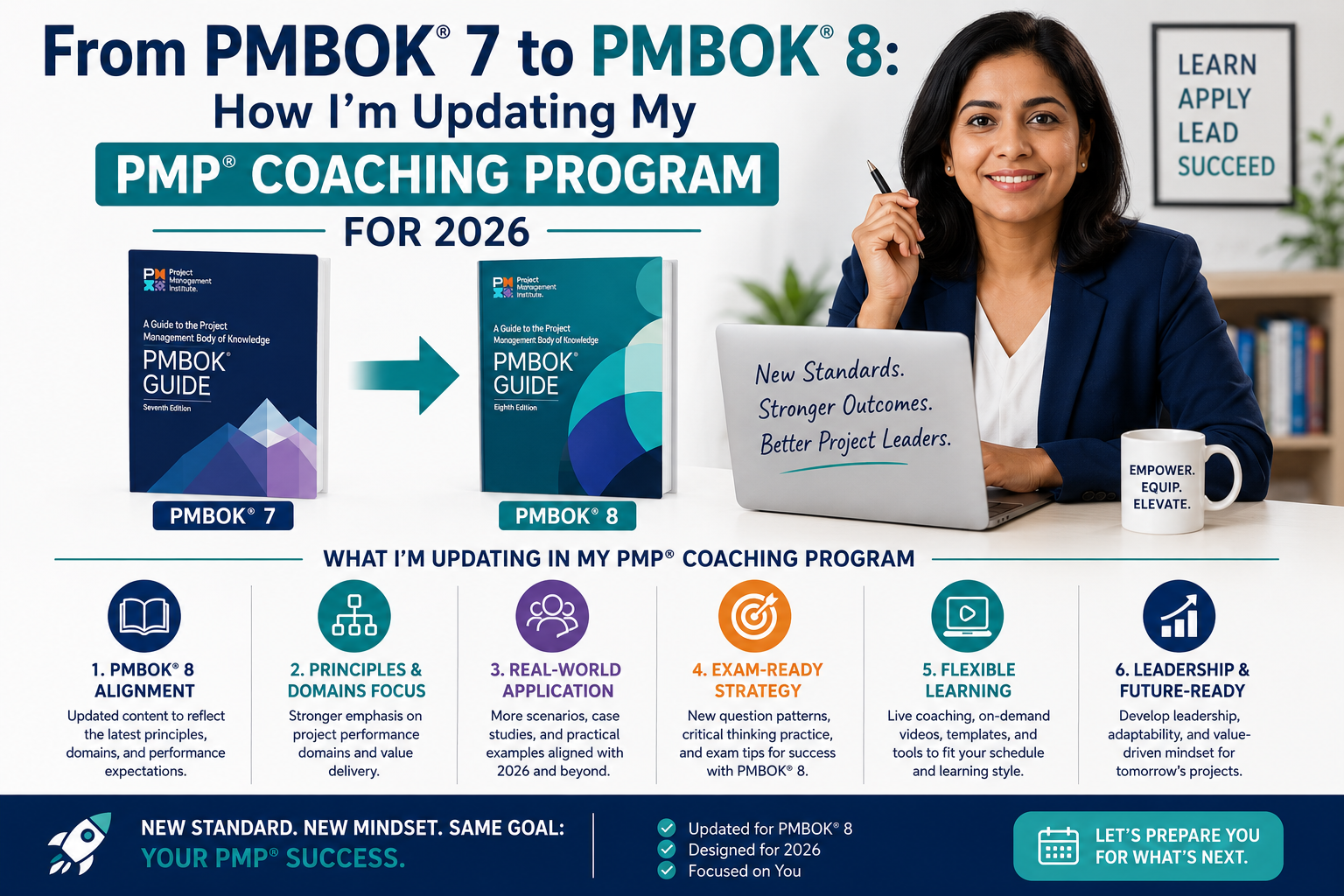
When PMI released PMBOK 8 in November 2025, the first thing I did was not celebrate. I sat down with the new guide, opened my existing coaching materials beside it, and started marking what needed to change.
The shift from PMBOK 7 to PMBOK 8 is the most significant structural update to the project management standard since PMBOK 7 itself arrived in 2021. And as someone who has spent over a decade coaching professionals across India to pass the PMP exam, I cannot in good conscience hand a student old materials and call it preparation.
This blog is my honest account of what changed in the standard, what I found when I audited my own program against it, and what I rebuilt from scratch. If you are preparing for the PMP exam after July 9, 2026, this is the context you need before you study a single page.
Why the PMBOK 7 to PMBOK 8 Shift Matters More Than You Think
Most update announcements get softened with reassuring language. "The core hasn't changed." "It's just a refinement." I am not going to do that here because it would not be accurate.
The transition from PMBOK 7 to PMBOK 8 touches the structure, the principles, the performance domains, the process framework, the content emphasis, and the exam weighting — all at once.
PMBOK 7 arrived in 2021 as a bold philosophical pivot. It moved away from prescriptive process lists and introduced 12 guiding principles alongside 8 performance domains. The intention was sound: project management is contextual, so the guide should focus on mindset rather than mechanics.
In practice, many professionals and trainers found PMBOK 7 too abstract. You could understand the principles thoroughly and still not know how to respond to a specific scenario on the exam or in a real project situation.
PMBOK 8 addresses that directly. It keeps the principle-based foundation but adds practical, actionable structure back in. The result is a standard that is both philosophically modern and operationally useful — and that changes how I teach, not just what I teach.
PMBOK 8 vs PMBOK 7 Differences: What Actually Changed
Let me walk through the most important PMBOK 8 vs PMBOK 7 differences the way I explain them in a coaching session — in plain language, with the implications made explicit.
Principles: Consolidated From 12 to 6
PMBOK 7 introduced 12 broad principles covering stewardship, leadership, systems thinking, tailoring, collaboration, complexity, value, and adaptability. They were well-structured in theory. In coaching practice, they were difficult to make exam-ready because they were conceptually overlapping and hard to distinguish in scenario questions.
PMBOK 8 consolidates them into 6 sharper, more actionable principles:
Adopt a Holistic View — see the project within its full organisational and environmental context
Focus on Value — define, measure, and protect the value the project is meant to deliver
Embed Quality Into Processes and Deliverables — quality is not a closing activity; it is continuous
Be an Accountable Leader — own decisions, outcomes, and team culture
Integrate Sustainability Within All Project Areas — ESG is now a core competency, not a footnote
Build an Empowered Culture — create the conditions for teams to do their best work
Each of these starts with a verb. Each tells you what to do, not just what to believe. That is a fundamental coaching improvement. My students now have 6 clear anchors rather than 12 overlapping ideals.
Performance Domains: Restructured From 8 to 7
PMBOK 7 organised project work across 8 performance domains: Stakeholders, Team, Development Approach and Life Cycle, Planning, Project Work, Delivery, Measurement, and Uncertainty.
PMBOK 8 reduces this to 7 domains, tightens the boundaries between them, and reorients each domain more explicitly toward governance, outcomes, and value delivery rather than internal project mechanics.
For coaching purposes, this makes domain mapping cleaner. Candidates no longer spend time debating which domain a scenario belongs to — the updated structure is more intuitive and more aligned with how organisations actually define project management accountability.
Focus Areas: The Most Important Structural Addition
This is what I get asked about most when I discuss PMBOK 8 with students.
PMBOK 8 introduces 5 Focus Areas that house 40 non-prescriptive processes. These processes bring back structured, actionable guidance that many practitioners and candidates genuinely missed from PMBOK 6. Each process includes updated inputs, tools, techniques, and outputs — but with the explicit expectation that project managers will tailor them to context rather than follow them rigidly.
Think of the three layers this way: Principles shape your mindset. Performance Domains define your context. Focus Areas and their processes tell you how to execute. Once my students understand how these three layers work together, the entire PMBOK 8 framework clicks into place.
One Book Instead of Two
PMBOK 7 was published alongside a separate document called The Standard for Project Management. Together they formed the complete framework, but in practice they created constant cross-referencing during preparation.
PMBOK 8 merges both into a single unified publication. This sounds like a small convenience, but for candidates managing a packed preparation schedule alongside a full-time job in India, removing that source of structural confusion is genuinely meaningful.
The PMBOK 8th Edition Changes That Forced Me to Rebuild Modules
When I audited my coaching materials against the PMBOK 8th edition changes, I identified three areas where incremental updates were not enough. These modules needed to be rebuilt.
Sustainability Is Now a Core Principle
In my previous program, sustainability appeared as context in certain Business Environment questions. I covered it because it showed up occasionally, not because it was foundational.
In PMBOK 8, sustainability is one of the six core principles. It is embedded across performance domains and woven into the Exam Content Outline as a cross-cutting consideration. This means a candidate who does not understand how sustainability thinking influences project selection, planning priorities, stakeholder engagement, and value measurement will encounter blind spots on the July 2026 exam.
I have added a dedicated sustainability module and rebuilt the scenario question sets to integrate ESG considerations naturally, the way the exam itself will.
Artificial Intelligence in Project Environments
PMBOK 8 is the first edition of the guide to formally address AI within the project management standard. This does not mean the exam tests your ability to build AI systems. It means project managers are now expected to work competently in environments where AI tools are used for forecasting, risk identification, resource planning, and decision support.
My updated program includes a module on AI-assisted project environments: what questions to ask when AI tools are providing outputs, how PMI frames human judgment in relation to AI recommendations, and how to approach exam scenarios involving technology-driven project decisions.
For IT professionals and engineers in India preparing for the 2026 PMP exam, this content should feel immediately relevant. Many of you are already navigating these dynamics in your teams. The exam is now formally testing whether you can lead in that context.
Value Delivery as a Thread, Not a Topic
PMBOK 7 introduced value delivery as the central concept of modern project management. PMBOK 8 goes further by providing specific guidance on how to measure and communicate project value, how to connect project outcomes to organisational strategy across the lifecycle, and how benefits management frameworks should operate from initiation through closure.
In my earlier program, value delivery was a Business Environment domain topic. In the updated program, it runs as a connecting thread through every section because that is precisely how PMBOK 8 treats it. Projects do not suddenly create value at the end. They build toward it, or undermine it, from the first planning conversation.
You can see this approach in action in the free ACE and Crack preparation sessions, where I walk through how PMI frames value-driven decision-making across scenario types.
How I Have Restructured the Coaching Program for 2026
Beyond individual module updates, the overall architecture of my coaching program has changed. Here is what that looks like in practice.
A Three-Layer Teaching Model
The core teaching model now follows the three layers that mirror PMBOK 8's structure:
Layer 1 — Mindset: Built through the 6 revised principles. This is where we establish how PMI wants project managers to think before we touch any scenario or process.
Layer 2 — Context: Built through the 7 updated performance domains. This is where we understand the environment in which project decisions are made.
Layer 3 — Execution: Built through the 5 Focus Areas and 40 processes. This is where we develop the practical ability to select the right response to a specific scenario.
Working professionals in India find this model immediately practical because it matches how they already approach real projects — you think about values and context before you choose a course of action. The coaching program makes that instinct exam-ready.
Scenario Practice Rebuilt From the Ground Up
Every practice question in my coaching program has been reviewed against the new ECO and updated or replaced where necessary. The July 2026 exam is significantly more scenario-driven than its predecessors. Practicing with PMBOK 7-era questions will leave candidates underprepared for the format they will actually face.
My scenario sets now reflect the updated emphasis on hybrid environments, AI-adjacent decisions, sustainability trade-offs, stakeholder influence at leadership level, and value-focused governance.
Agile and Hybrid Thinking Integrated Throughout
One of the most common pieces of feedback I received from students during the PMBOK 7 period was that agile content felt like a separate subject layered onto the main coaching. You studied predictive project management, then studied agile, and then hoped you could blend them naturally in the exam.
PMBOK 8 integrates agile, hybrid, and predictive thinking across all domains and principles. My updated program mirrors this directly. There is no dedicated agile module sitting at the end of the course. Agile reasoning appears in every session, every domain, and every scenario set, because that is the reality of the 2026 exam.
For engineers and project managers in India with strong predictive backgrounds but limited formal agile exposure, this integrated approach closes the gap far more effectively than studying agile as an isolated topic.
The Business Environment Domain Is Now a Priority
Here is the most consequential structural change in the 2026 exam that many candidates preparing with older materials are not aware of: the Business Environment domain has grown from 8% to 26% of total marks.
This single change means that a preparation strategy that allocates minimal time to Business Environment because it was historically the smallest domain is now seriously misaligned. In my updated program, Business Environment receives time allocation proportionate to its weight, with dedicated attention to strategic alignment, governance, value realisation, compliance, and external change management.
If you are already preparing and you have not yet adjusted for this, it is worth reviewing your study plan now. The blog on 2026 PMP syllabus changes and what they mean for working professionals covers the domain weighting shift in more detail.
What This Means if You Are Preparing for the PMP Right Now
The PMBOK 7 to PMBOK 8 transition creates three distinct situations for candidates currently in the market.
Situation 1: You Are Sitting Before July 8, 2026
Stay with your current preparation path. Your existing materials are valid for the current exam and they lead to exactly the same PMP credential. Switching frameworks weeks before an exam scheduled before the cutoff date will cost you more than it gains you.
Complete your preparation with your current materials and book your exam date before July 8.
Situation 2: You Are Sitting After July 9, 2026
Start fresh with PMBOK 8-aligned materials. The structural differences between PMBOK 7 and PMBOK 8 are significant enough that layering new information onto old frameworks creates more confusion than starting clean. This is especially true for the Focus Areas, the new principles, and the Business Environment domain weighting.
Situation 3: You Are Still Deciding Whether to Get Certified
The 2026 exam is the most professionally relevant version of the PMP that has ever existed. It rewards experience, judgment, and contextual decision-making over textbook recall. If you are a project manager, IT professional, team leader, or engineer in India with three or more years of hands-on project work, the updated exam format is designed to test what you already know how to do.
To understand whether your experience and education meet the current eligibility requirements for the 2026 exam, book a personalised eligibility and clarity session. I will give you a direct, honest answer based on your specific profile.
The Coaching Philosophy Behind the Updated Program
I want to be transparent about something that goes beyond curriculum updates.
Over a decade of coaching project managers across India, the Middle East, Singapore, and Canada, I have seen what separates candidates who pass from candidates who do not. It is almost never about how much they studied. It is about how clearly they understand the way PMI thinks.
PMBOK 8 makes that thinking more explicit and more teachable. The six principles are direct. The three-layer framework is logical. The scenario-based exam format rewards the same kind of judgment that experienced professionals exercise in real projects every day.
My updated coaching program is built to help you see the PMP exam not as a test of memorisation but as a structured conversation with PMI about how you approach project leadership. Once you understand that conversation, passing is a natural result.
If you want to experience that approach firsthand before committing to the full program, start with the free preparation sessions to get a direct feel for how I coach.
For professionals who want to go deeper on both PMP certification and broader project leadership capability, the leadership coaching program builds on the same foundations and extends them into career advancement strategy.
Frequently Asked Questions: PMBOK 7 to PMBOK 8
Q1. Do I need to read the full PMBOK 8 guide to pass the 2026 PMP exam?
No. The PMP exam is based on the Exam Content Outline, not the PMBOK Guide alone. PMBOK 8 is a reference that deepens your understanding of what the ECO tests. A well-structured coaching program built around the new ECO will cover the PMBOK 8 content you actually need in an exam-ready format without requiring you to read the guide from cover to cover.
Q2. What happened to the 49 processes from PMBOK 6?
PMBOK 7 removed detailed processes entirely. PMBOK 8 reintroduces process guidance as 40 non-prescriptive processes embedded within the 5 Focus Areas. Each process includes updated inputs, tools, techniques, and outputs, but the expectation is tailoring to project context rather than rigid application. These 40 processes are a practical evolution, not a return to the prescriptive structure of PMBOK 6.
Q3. How different will the 2026 exam feel from the current version?
The domain structure remains the same: People, Process, and Business Environment. But the weighting has shifted significantly, the Business Environment domain has nearly tripled in exam share, and the question format is more scenario-driven throughout. Candidates who prepare for the current exam and then sit for the July 2026 version without updated preparation will notice meaningful differences, particularly in Business Environment and in how AI and sustainability appear as contextual factors in scenarios.
Q4. Are the PMBOK 8 principles tested directly on the exam?
The six principles are not tested as standalone knowledge questions. They provide the reasoning framework behind PMI's preferred answers in scenario questions. Understanding the principles deeply helps you identify the right answer in ambiguous situations because you understand why PMI considers a particular response to be the most appropriate. This is why I teach principles as reasoning anchors, not as memorisation content.
Q5. I have been preparing with PMBOK 7 resources. Do I need to start over for the 2026 exam?
Not entirely, but you need to do more than note the differences. The Focus Areas, the revised principles, the expanded Business Environment content, the sustainability module, and the AI integration are all new enough to require dedicated preparation time. If you are targeting the post-July 2026 exam, a structured transition with a coach who has already rebuilt their program around PMBOK 8 is the most efficient path forward. Starting over completely is not necessary. Starting fresh with the right materials and guidance is.
Conclusion
The full coaching program at rjvisakh.com has been rebuilt around every significant change in this transition. If you are ready to prepare for the 2026 PMP exam with a program that reflects where the standard actually is, explore the updated PMP coaching program here.
If you want to understand how this preparation connects to your broader career goals in project and program leadership, read about the leadership development pathway that runs alongside the certification track.