
Scenario-Based PMP Questions 2026: A Step-by-Step Approach
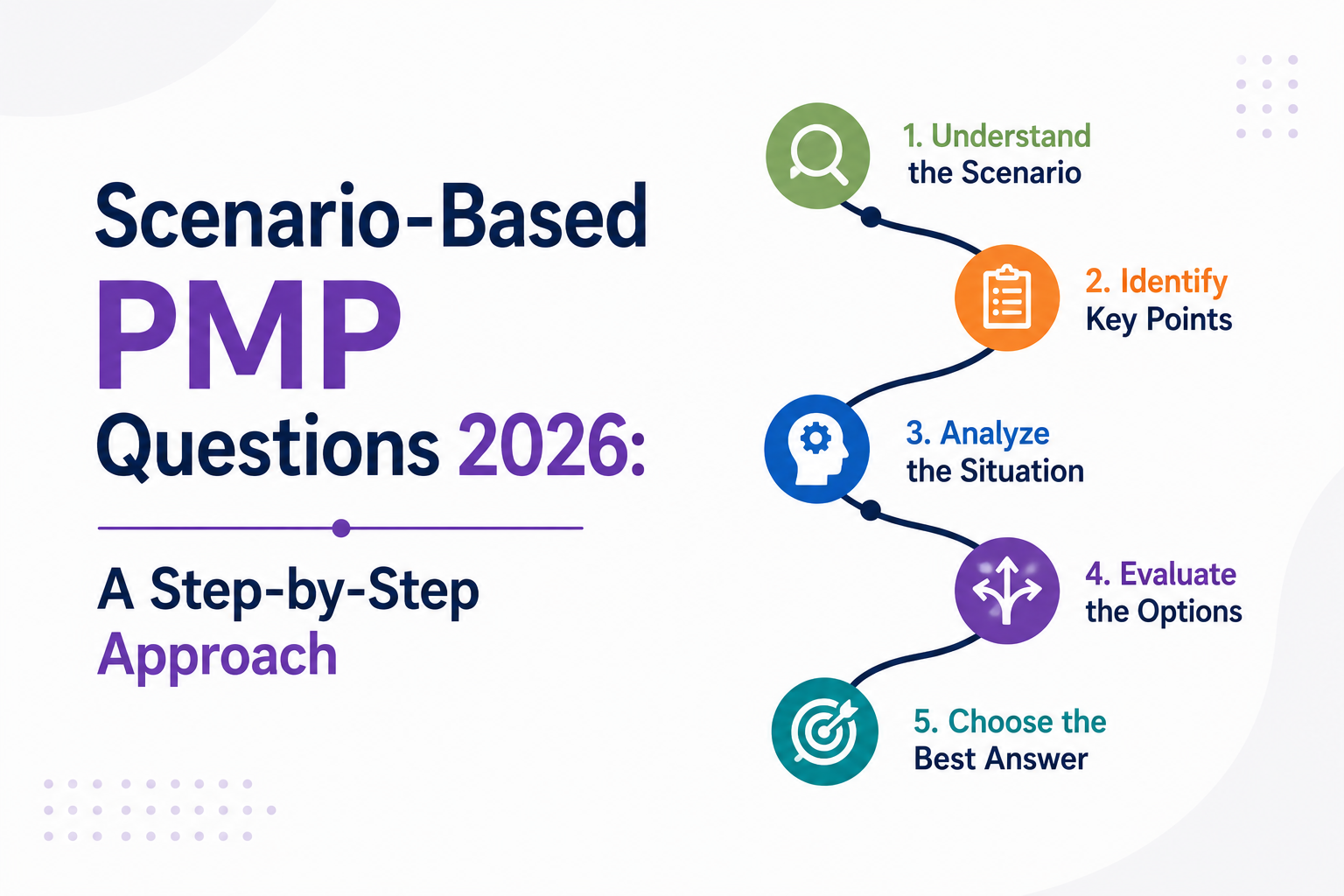
Scenario-based PMP questions 2026 are no longer a small part of the exam — they are the exam. If you have opened a recent mock test and felt like you were reading a mini case study instead of a simple multiple-choice question, you are not imagining things. PMI has rebuilt the PMP exam around real project situations, and this shift catches thousands of aspirants off guard every testing window.
This guide breaks down exactly what scenario-based PMP questions 2026 look like, why they matter more than ever under the updated Exam Content Outline, and a clear step-by-step method to answer them correctly — even under time pressure.
What Are Scenario-Based PMP Questions in the 2026 Exam?
A scenario-based question presents a short project situation — a stakeholder conflict, a schedule slip, a scope disagreement, a risk event — and asks what you, as the project manager, should do next. Unlike older definition-based questions, there is rarely one obviously "correct" answer. Instead, every option looks plausible, and only one aligns with PMI's preferred mindset of proactive, servant, ethical leadership.
If you have already read our breakdown of PMP case set questions, you know these situational formats now appear as standalone items and as linked case sets, where multiple questions reference the same extended scenario.
Why Scenario-Based PMP Questions 2026 Dominate the New ECO
The 2026 Exam Content Outline was rewritten to reflect how project managers actually work today — juggling predictive, agile, and hybrid delivery models simultaneously. PMI has said clearly that memorizing formulas is no longer enough.
The Shift From Recall to Applied Judgment
Under the previous syllabus, a large share of questions tested definitions and calculations. In 2026, the majority of items test applied judgment: what would a competent, ethical PM actually do in this exact moment? This is why scenario-based PMP questions 2026 now touch every domain — People, Process, and the expanded Business Environment — instead of sitting only inside a "situational" category.
For a full picture of how the exam itself has changed, see our earlier post on the PMP 2026 exam format and question types.
The Step-by-Step Approach to Answering Scenario-Based PMP Questions
Here is the exact five-step method I teach my students to consistently identify the right answer, even when several options look tempting.
Step 1: Read the Scenario Twice
The first read is for context. The second read is for the trigger words — "immediately," "root cause," "first," "escalate" — that quietly change what PMI is really asking. Rushing this step is the single biggest reason aspirants misread scenario-based PMP questions 2026 during the actual exam.
Step 2: Identify the Project Phase and Domain
Ask yourself: is this happening during planning, execution, or closing? Is this a People issue, a Process issue, or a Business Environment issue? This narrows your options fast, because PMI expects phase-appropriate responses, not generic advice.
Step 3: Eliminate the "Textbook Trap" Options
Most scenario-based PMP questions 2026 include one option that sounds correct from a textbook perspective but ignores the human or ethical dimension of the situation. Cross these out first — they are designed to catch aspirants who memorize processes without understanding intent.
Step 4: Apply the PMI Mindset
PMI consistently rewards options that are proactive, collaborative, and transparent over options that are reactive, authoritative, or that escalate prematurely. When two answers seem equally valid, choose the one that resolves the issue at its lowest, most collaborative level first.
Step 5: Practice With Timed Mock Sets
Reading strategy alone is not enough. You need repetition under real exam conditions. Our PMP 2026 mock exam questions built around the new ECO are designed specifically to simulate this pressure with authentic scenario-based practice questions.
Common Types of Scenario-Based PMP Questions 2026 Aspirants Face
Stakeholder conflict scenarios — competing priorities between a sponsor and a team lead
Risk response scenarios — an unplanned event requiring immediate judgment
Schedule and scope trade-off scenarios — testing your grasp of the triple constraint under pressure
Team performance scenarios — addressing underperformance or conflict without damaging trust
Hybrid delivery scenarios — choosing between predictive and agile responses mid-project
If you want a deeper dive into how PMI now tests delivery-model judgment specifically, our guide on choosing the right development approach for the 2026 PMP exam covers this in detail, alongside the broader shift toward new PMP question types like case sets and drag-and-drop items.
How to Practice Scenario-Based PMP Questions Effectively
Practicing scenario-based PMP questions 2026 is different from memorizing flashcards. Here is what actually moves your score:
Time yourself on every practice set — real exam pressure changes decision-making
Review wrong answers slowly — understand why the "obvious" choice was wrong
Group questions by domain so you can spot your weak areas early
Simulate case sets, not just single questions, since linked scenarios test consistency of judgment
Revisit your study plan weekly — if you're balancing a full-time job, our guide on studying for PMP while working full time can help you structure this realistically
Consistent, structured practice with scenario-based PMP questions 2026 builds pattern recognition, so on exam day you're not solving each situation from scratch — you're recognizing a familiar shape and applying a method you've already rehearsed dozens of times.
Mistakes Indian PMP Aspirants Make With Scenario Questions
Working with thousands of PMP aspirants across India, a few patterns repeat constantly:
Choosing the option that solves the problem fastest, instead of the one that solves it correctly
Ignoring the project phase mentioned in the scenario
Overthinking simple situations and underthinking complex ones
Practicing only definition-based questions instead of full scenario-based PMP practice sets
Skipping structured coaching and relying only on self-study forums with inconsistent quality
A guided approach, built around real ECO scenario questions, closes this gap far faster than self-study alone.
FAQs on Scenario-Based PMP Questions 2026
1. What percentage of the 2026 PMP exam is scenario-based? The majority of questions across all three domains now use a situational or scenario-based format, reflecting PMI's shift toward testing applied judgment rather than recall.
2. Are scenario-based PMP questions harder than traditional questions? They test a different skill — judgment over memorization — so aspirants who only memorize definitions often find them harder, while those who practice applied scenarios adapt quickly.
3. How many scenario-based practice questions should I attempt before the exam? Most successful candidates complete several hundred scenario-based practice questions across multiple timed mock sets before sitting the real exam.
4. Do scenario-based questions appear in case sets too? Yes. In 2026, scenario-based questions appear both as standalone items and within linked case sets that reference one extended situation.
5. What is the best way to start practicing scenario-based PMP questions 2026? Start with domain-specific mock sets, review every wrong answer in detail, and gradually move to timed, mixed-domain practice that mirrors real exam conditions.
Scenario-based PMP questions 2026 reward candidates who think like project managers, not test-takers. With the right step-by-step method and consistent, guided practice, you can walk into the exam recognizing patterns instead of guessing.
Ready to master scenario-based PMP questions 2026 with a 99% pass-rate coach? 👉 Book Your Free PMP Strategy Call
Learn more about Visakh RJ, India's leading PMP trainer, at rjvisakh.com.
Address: Visakh RJ, Mumbai, India Phone: +91 62825 40905