
Choosing the Right Development Approach on the 2026 PMP Exam
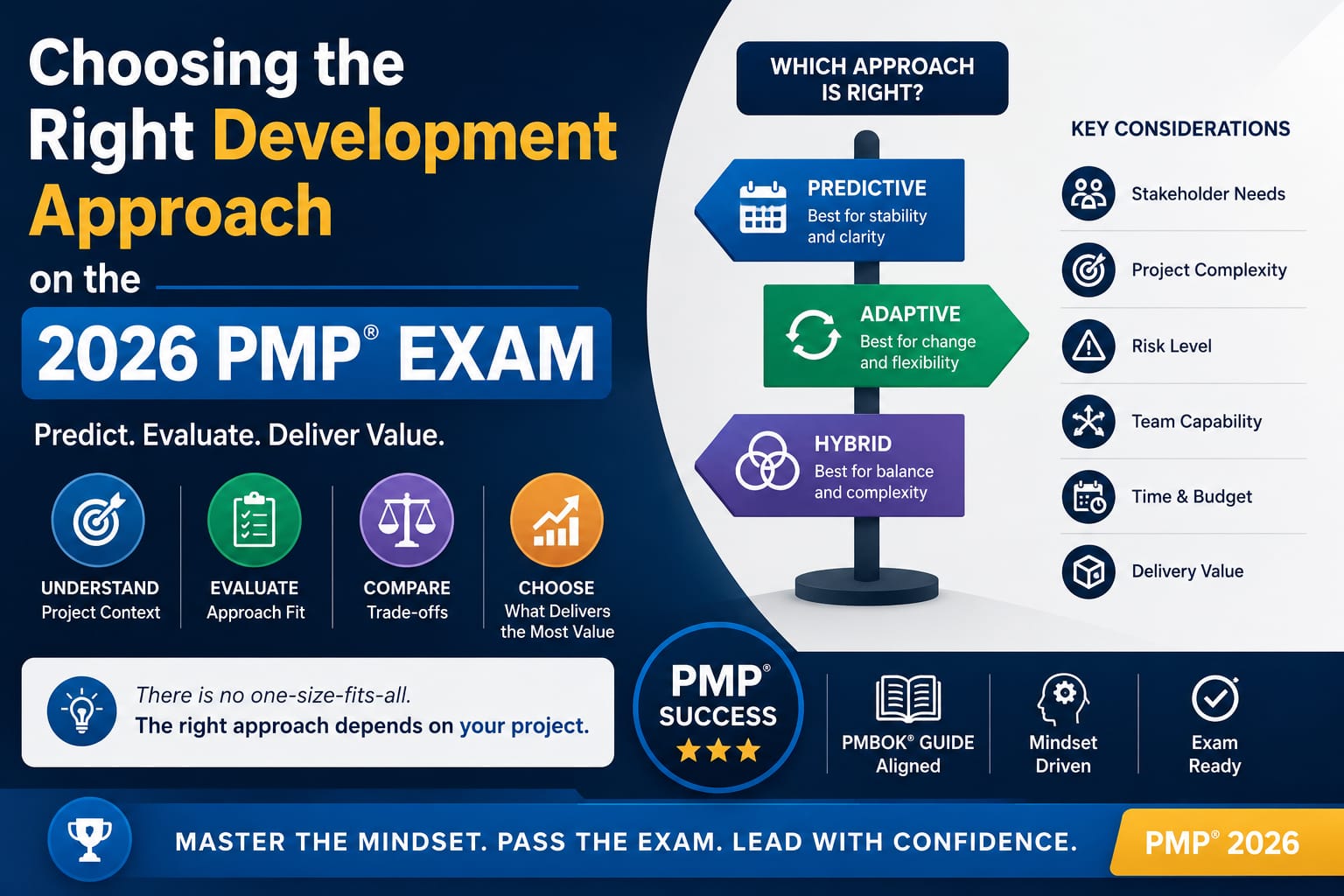
The project has changing requirements. The client wants regular feedback. The team is experienced. The timeline is tight. What development approach do you recommend?
If your answer was "agile" — you may have just lost a mark. Not because agile is wrong. But because the development approach PMP exam 2026 actually tests is not about picking your favourite methodology. It is about choosing the right approach for the specific context described in the scenario — and justifying that choice using the logic PMI has built into the new Exam Content Outline.
This is one of the highest-yield topics on the 2026 PMP exam. It appears across multiple domains, shows up in scenario-based questions, case sets, and situational judgment questions, and is tested in ways that consistently separate well-prepared candidates from those who studied the wrong framework.
This blog breaks down everything you need to know — clearly, practically, and aligned to how the 2026 ECO actually tests it.
Why Development Approach Is Central to the 2026 PMP Exam
The 2026 PMP Exam Content Outline reflects how project management has evolved globally. Projects today are not uniformly predictive or uniformly agile. They are diverse, complex, and context-dependent.
PMI recognises this. The new ECO explicitly requires candidates to demonstrate the ability to determine and advocate for a project development approach based on project requirements, organisational constraints, team capability, and stakeholder needs.
That means the exam is not asking you to memorise the definition of Scrum or Waterfall. It is asking you to think like a project leader who can look at a situation and recommend — with sound reasoning — whether the project should run predictively, adaptively, or through a hybrid model.
If you want to understand how this thinking sits within the broader 2026 PMP syllabus changes, that overview explains exactly what PMI updated and why it matters for your preparation strategy.
The Three Development Approaches You Must Know
Predictive Development Approach
The predictive approach — often called Waterfall — is built around the idea that the project scope, schedule, and cost can be defined early and remain largely stable throughout delivery.
Work is planned upfront, executed in phases, and delivered at the end. Changes are managed through a formal change control process. Documentation is detailed. Governance is structured.
When does PMI expect you to choose predictive?
Requirements are well-defined and unlikely to change
The technology or process is well-understood and low-risk
Regulatory or compliance frameworks require sequential phase approvals
Stakeholders need certainty of scope and cost before work begins
The project is in a safety-critical or construction-heavy environment
A bridge construction project. A pharmaceutical trial with fixed regulatory protocols. A government infrastructure programme with defined specifications. These are environments where predictive delivery is not just appropriate — it is the only responsible choice.
On the exam, predictive questions often test whether you understand integrated change control, phase gate reviews, the role of the project management plan, and how to manage scope creep in a structured environment.
Agile Development Approach
The agile approach is built around iterative, incremental delivery. Work is broken into short cycles — sprints or iterations — with frequent feedback, continuous reprioritisation, and adaptive planning.
Agile prioritises delivering value early and often over comprehensive upfront documentation. It thrives in environments of uncertainty, where requirements evolve as the project progresses and customer input shapes the direction of delivery.
When does PMI expect you to choose agile?
Requirements are unclear, evolving, or defined incrementally by the customer
Speed to market and early value delivery are business priorities
The team is experienced, self-organising, and empowered to make decisions
Frequent stakeholder collaboration is feasible and desired
The product or deliverable can be broken into working increments
A software product with evolving user stories. A marketing campaign where creative direction shifts based on audience feedback. A digital transformation initiative where the destination is clear but the path is not.
The 2026 PMP exam format tests agile heavily — at least 50% of exam content is agile or hybrid in nature. Understanding not just what agile is, but when and why to apply it, is non-negotiable for a 2026 first-attempt pass.
Hybrid Development Approach
This is where the 2026 exam separates truly prepared candidates from the rest.
Hybrid is not a compromise or a fallback. It is a deliberate, structured combination of predictive and agile practices, applied at the right points in the project lifecycle based on what each phase or workstream requires.
A hybrid project might use predictive planning for procurement, contracting, and regulatory approvals — while running agile sprints for the software development component. Or it might use a fixed scope and budget framework at the portfolio level while allowing iterative delivery within individual work packages.
When does PMI expect you to choose hybrid?
Different components of the project have different levels of uncertainty
Some deliverables are fixed while others evolve with stakeholder feedback
The organisation is transitioning from predictive to agile and needs a bridge
Regulatory requirements constrain some phases while other phases need flexibility
Team capability is mixed — some members are trained in agile, others in traditional PM
Most real-world projects today are hybrid. And most PMP 2026 delivery approach questions present hybrid scenarios — testing whether you can identify when full agile is inappropriate and when a blended model serves the project better.
How the 2026 ECO Tests Development Approach Selection
Understanding the three approaches is necessary — but not sufficient. The exam tests your ability to apply them in context. Here is how that plays out in actual question formats.
Scenario-Based Selection Questions
These present a project situation and ask you to recommend or identify the most appropriate development approach. The scenario will include clues — sometimes subtle ones — about requirements stability, stakeholder involvement, team maturity, delivery urgency, and organisational constraints.
The trap: candidates often pick agile by default because it sounds modern and flexible. The correct answer depends entirely on what the scenario is describing. A highly regulated nuclear energy project with government-mandated phase approvals is not an agile project — regardless of how experienced the team is.
Practice reading scenarios specifically for the contextual signals PMI embeds. This is exactly the kind of thinking Visakh RJ's PMP coaching program is built around — training your instincts to catch what the question is actually testing, not just what it appears to be asking.
Tailoring Questions
Tailoring is one of the most explicit themes in the 2026 ECO. PMI does not expect every project to follow a cookie-cutter methodology. It expects project managers to tailor their approach — including their development lifecycle — to fit the unique characteristics of the project.
PMP exam development lifecycle questions on tailoring will ask you to identify how you would adjust a predictive approach to introduce more flexibility, or how you would structure an agile approach within a governance-heavy environment. These questions test depth of understanding, not surface-level methodology recall.
Case Set Questions
The 2026 exam includes case sets — multi-question scenarios where several questions reference a single project narrative. Development approach selection is a common thread in these sets. You may be asked to recommend an approach in question one, then manage a consequence of that approach in questions two and three.
Understanding how your approach choice creates downstream implications — for change management, stakeholder engagement, risk planning, and team structure — is what these questions are designed to test.
Tailoring the Development Approach: What PMI Actually Expects
Tailoring is not just a concept — it is a competency. The 2026 ECO requires project managers to evaluate and tailor the development approach based on four key dimensions.
1. Project Characteristics
What is the nature of the deliverable? Is it a physical product, a software system, an organisational change, or a service implementation? How well-defined are the requirements? How much uncertainty exists in the technology, the market, or the regulatory environment?
Physical, tangible deliverables with well-understood specifications tend toward predictive. Knowledge work with evolving requirements tends toward agile. Projects combining both tend toward hybrid.
2. Organisational Factors
What does the organisation's governance structure look like? Are there audit requirements, board approvals, or contractual obligations that require sequential phase gates? Is the PMO prescriptive or supportive? What methodologies are already embedded in the culture?
An organisation with a mature PMO and heavy compliance obligations will almost never run a fully agile project — even if the team wants to. Tailoring the approach to fit organisational reality is as important as fitting project reality.
3. Team Capability and Maturity
An agile approach requires a team that is self-organising, skilled in iterative delivery, and capable of making daily decisions without constant management oversight. Imposing agile on a team that lacks this maturity creates chaos, not agility.
A predictive approach requires disciplined planning, strong documentation habits, and comfort with sequential execution. Not every team is built for this either.
The right development approach is partly a function of who is doing the work — not just what the work is.
4. Stakeholder Engagement Model
How available are stakeholders for feedback? How often do they need visibility into progress? How much ambiguity can they tolerate in the early phases of delivery?
Agile requires active, ongoing stakeholder participation — particularly from the product owner or customer representative. If stakeholders are unavailable or unwilling to engage frequently, agile delivery will stall.
Predictive suits stakeholders who want to approve a plan, step back, and receive a defined deliverable at the end. Hybrid suits stakeholders who need governance structure but value incremental visibility.
Common Mistakes Candidates Make on Development Approach Questions
Defaulting to Agile for Every Scenario
This is the single most common error. Many candidates enter the exam with a bias toward agile because it dominates current industry conversation and represents the majority of new ECO content. But PMI tests all three approaches equally. A scenario describing a construction project, a regulated pharmaceutical trial, or a government infrastructure contract is almost certainly pointing toward predictive or hybrid — not agile.
Confusing the Approach with the Methodology
The development approach is the overarching model — predictive, agile, or hybrid. The methodology is the specific framework used within that model — Scrum, SAFe, PRINCE2, PMBOK, Kanban. The exam tests approach selection, not methodology preference. Do not let familiarity with a specific framework bias your approach recommendation.
Ignoring Organisational Context
Many candidates analyse the project but forget to factor in the organisation. A project with perfect agile characteristics — evolving requirements, experienced team, engaged stakeholders — may still require a hybrid or predictive overlay because the organisation's governance, contracts, or culture demands it. Always read the full scenario before choosing.
Missing Tailoring Signals
When a scenario includes phrases like "the organisation requires formal phase approvals but wants flexibility in execution" or "the team will deliver incrementally within a fixed budget framework," PMI is signalling hybrid and tailoring. Missing these signals leads candidates to choose a pure approach when a blended one is correct.
These mistakes are avoidable — but only if your preparation builds the habit of reading scenarios analytically rather than reactively. This is exactly the kind of exam mindset shift that separates first-attempt passes from retakes.
How This Topic Connects to the Broader 2026 ECO
Development approach selection does not exist in isolation on the exam. It connects directly to several other high-weight topics in the 2026 ECO.
Planning approach and adaptive planning are directly tied to your development approach choice. A predictive project has a comprehensive project management plan developed upfront. An agile project has a rolling wave plan with iteration-level detail. Hybrid blends both.
Stakeholder engagement strategy changes based on approach. Agile demands a product owner. Predictive demands a well-defined stakeholder communication plan. Hybrid requires both.
Risk management tailoring depends on approach. Agile manages risk through short feedback cycles and backlog reprioritisation. Predictive manages risk through formal risk registers, contingency reserves, and trigger-based response plans.
Change management is fundamentally different across approaches. Understanding how each approach handles change — and what the exam expects you to do when change arrives — is a direct extension of your development approach knowledge.
If you are building a comprehensive study plan that connects all of these threads, the 90-day PMP exam preparation roadmap for Indian professionals shows you how to sequence your preparation so every topic reinforces the next.
Frequently Asked Questions
How much of the 2026 PMP exam covers development approach questions?
Development approach is not a standalone domain — it is woven throughout all three ECO domains: People, Process, and Business Environment. PMI estimates that approximately 50% of exam content involves agile or hybrid scenarios, which means development approach selection and tailoring appear regularly across the full exam. It is one of the highest-leverage topics to prepare deeply.
Does the 2026 PMP exam favour agile over predictive?
No. The exam tests your ability to select the right approach for the context — not your preference for any single methodology. Candidates who default to agile on every scenario question consistently underperform. PMI explicitly tests predictive, agile, and hybrid equally and expects you to distinguish between them based on project and organisational signals in the scenario.
What is the difference between development approach and project lifecycle on the PMP exam?
The development approach is the overarching delivery model — how the project will produce its outputs. The project lifecycle is the sequence of phases through which the project passes. A predictive project has a defined, sequential lifecycle. An agile project has an iterative lifecycle. A hybrid project may have a predictive lifecycle at the project level with agile iterations within specific phases.
How do I know when to choose hybrid on a PMP exam question?
Look for scenarios where different parts of the project have different characteristics — for example, fixed regulatory approvals required for some components while others involve evolving requirements. Also look for signals about organisational transition, mixed team capability, or fixed budget combined with flexible scope. These are hybrid indicators. When neither fully predictive nor fully agile fits every element of the scenario, hybrid is almost always the correct answer.
Is tailoring the development approach tested directly on the 2026 PMP exam?
Yes. Tailoring is explicitly called out in the 2026 ECO as a required competency. You can expect direct questions on how and why a project manager would tailor the development approach, lifecycle, or specific processes to fit project context. Tailoring questions test depth of understanding — they cannot be answered through surface-level methodology recall.
Conclusion
Development approach selection is not a topic you can memorise your way through. The 2026 PMP exam tests judgment — your ability to read a scenario, identify the contextual signals PMI has embedded, and choose the approach that reflects sound, value-driven project leadership.
Predictive, agile, and hybrid each have a place. The project manager's job — and the exam's test — is knowing which place that is, and why.
The candidates who get these questions right consistently are not the ones who know agile best. They are the ones who have trained their thinking to operate across all three approaches fluently — and who understand how development approach connects to every other decision a project manager makes.
If you want to build that level of exam-ready fluency with a coach who has a 99% first-attempt pass rate and over 10,000 certified professionals mentored across India, connect with Visakh RJ and find out when the next PMP batch opens.