
How to Study for PMP While Working Full Time: The 60-Day Plan That Actually Works
Most professionals who fail the PMP exam do not fail because they are not smart enough.
They fail because they tried to fit a massive certification into a life that was already full — back-to-back meetings, deliverables, family commitments, and a study schedule that collapsed by week two.
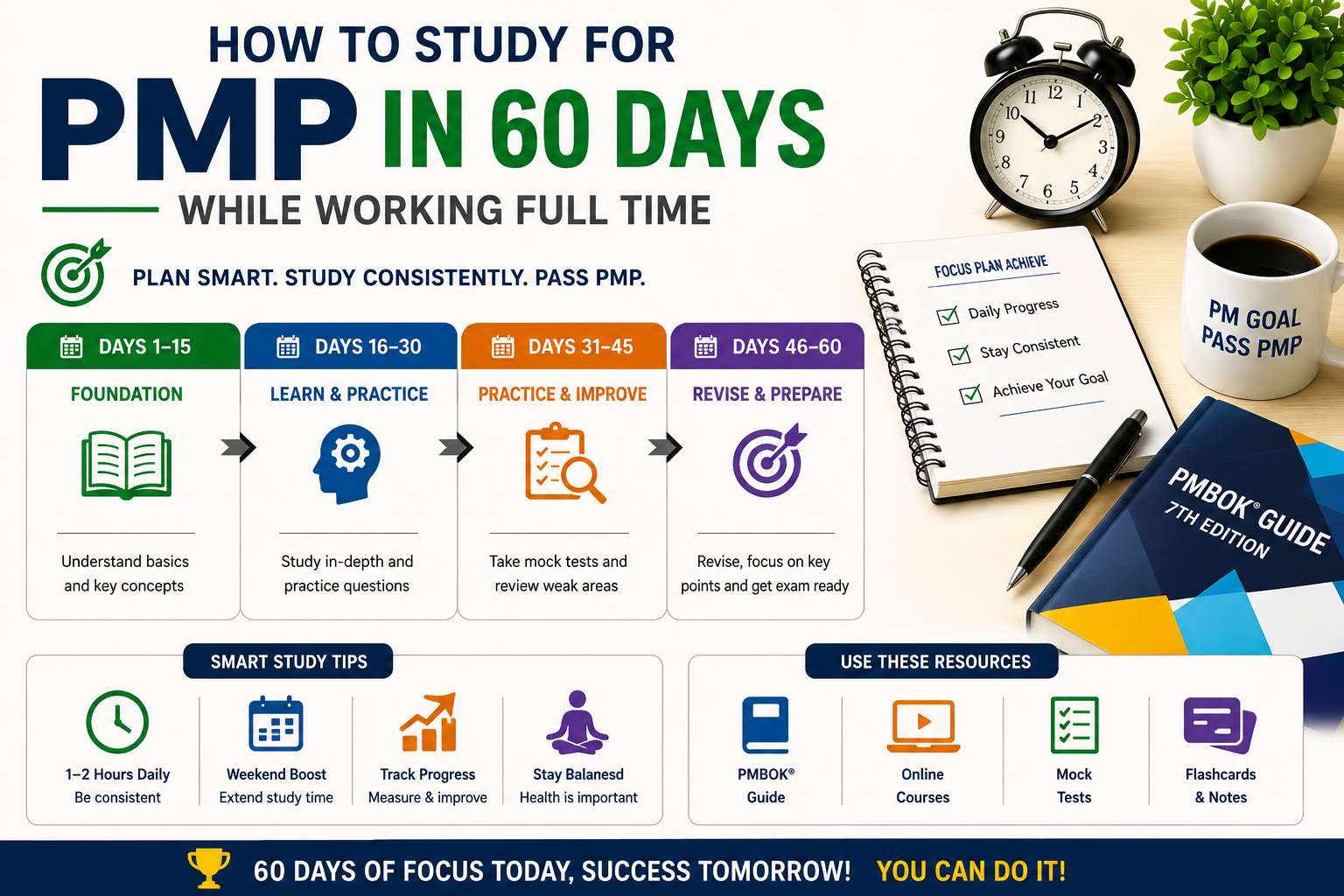
If you are searching for how to study for PMP while working full time, you already know the challenge is real. The good news is that thousands of working professionals in India and across the world pass the PMP exam every year without taking a sabbatical. They do it with a structured PMP exam study plan for 60 days, a clear daily routine, and the right guidance.
This guide gives you exactly that — a realistic, week-by-week roadmap designed around your life as a working professional.
Why 60 Days Is the Sweet Spot for PMP Preparation
Sixty days is not arbitrary. It is the window that most working professionals need to cover the PMP syllabus thoroughly without burning out.
Less than 45 days and you rush through critical concepts, especially in the People and Business Environment domains which now carry significant weight in the updated 2026 exam. More than 90 days and fatigue sets in — early chapters go stale, motivation dips, and the end feels perpetually distant.
The PMP 60-day study guide framework works because it is tight enough to maintain urgency and long enough to allow genuine understanding — not just surface-level memorisation.
It also maps well to the reality of a full-time job. Six to eight weeks is a timeline your employer, your family, and your calendar can absorb. Two to three months of focused effort, then you are done.
What You Need Before Day One: The Pre-Study Checklist
Before you open a single study material, complete these three things.
Submit your PMP application to PMI and get it approved. The application process can take one to two weeks. Do not start your 60-day clock until your application is approved and your exam is scheduled. Having a confirmed exam date is the single most powerful motivator in PMP preparation.
Complete your 35 contact hours of education. PMI requires this before you can sit the exam. If you have not done this yet, choose a structured programme that covers the full 2026 ECO. This does not count toward your 60 days — it is a prerequisite.
Gather your study resources. You will need the PMBOK Guide (available free as a digital download for PMI members), the Agile Practice Guide, the Process Groups Practice Guide, one quality mock test platform, and ideally a mentor or coach. More on resources below.
Understanding the 2026 PMP Exam Before You Study
The PMP exam prep strategy begins with understanding exactly what you are being tested on. The 2026 exam, updated from July 9, 2026, tests three domains:
People (33%) — Leadership, conflict resolution, team empowerment, emotional intelligence, and stakeholder collaboration.
Process (41%) — Planning, scheduling, risk management, procurement, scope control, quality management, and change control.
Business Environment (26%) — Governance, benefits realization, sustainability, AI-assisted decision-making, and organizational change management.
The exam consists of 185 questions (175 scored + 10 unscored), with 240 minutes to complete it. Roughly half the questions are predictive/waterfall in nature, and the other half are agile or hybrid focused.
For a full task-by-task breakdown of what PMI tests in 2026, read this detailed guide: PMP Exam Content Outline 2026: A Complete Task-by-Task Breakdown.
How Many Hours Per Day Do You Actually Need?
This is the most common question from every PMP certification preparation working professional, and the honest answer is: two to three hours on weekdays, four to five hours on weekends.
That adds up to roughly 200 to 230 hours over 60 days — which is within the range most PMP coaching experts recommend for working professionals.
Here is what that looks like in practice:
Early morning study (5:30 AM to 7:30 AM) works best for conceptual learning — your brain is fresh and undistracted. Evening sessions (9:00 PM to 10:30 PM) work well for reviewing notes and practising mock questions. Weekends are for full-length mock tests, revision, and tackling weak domains.
The key is consistency, not heroic cramming. Two focused hours every morning will outperform five hours of distracted weekend study every single time.
The 60-Day PMP Study Schedule: Week-by-Week Plan
Weeks 1 and 2 — Foundation and Mindset Shift (Days 1–14)
Goal: Understand the exam philosophy, complete the Process domain framework, and build your study rhythm.
In the first two weeks, the biggest mistake most candidates make is diving straight into PMBOK without understanding what the exam is actually testing. The PMP is not a knowledge test. It is a situational judgment test that expects you to think like an experienced, ethical, value-driven project manager.
Start with the Exam Content Outline 2026. Read it completely before touching any other resource. Understand every domain, every task, and what the enablers are asking you to demonstrate.
Then move into the Process domain — scheduling, risk management, scope, quality, and procurement. This is the heaviest domain at 41%, and a strong foundation here gives you early momentum.
Daily targets for weeks 1 and 2:
Study 1 to 2 ECO tasks per day. Read corresponding PMBOK 8 and Process Groups Practice Guide sections. Do 10 to 15 practice questions per day (not full mocks yet — concept-level questions only). Maintain a short notes document of key concepts, formulas, and situational frameworks.
Weeks 3 and 4 — People Domain and Agile Integration (Days 15–28)
Goal: Master leadership, team dynamics, and agile/hybrid concepts — and begin connecting them to real scenarios.
The People domain at 33% is where many traditional project managers lose marks. They understand Gantt charts and RACI matrices but underestimate PMI's emphasis on servant leadership, psychological safety, conflict resolution, and emotional intelligence.
This is also the phase where you must internalize agile and hybrid thinking. Nearly half of PMP exam questions involve agile or hybrid contexts. You need to be equally comfortable with a Scrum sprint review and a formal change control process.
Key focus areas for weeks 3 and 4:
All 14 tasks in the People domain — conflict management, coaching, empowerment, diversity and inclusion, virtual team management. Agile Practice Guide — Scrum, Kanban, iteration-based planning, and hybrid approaches. Scenario practice: 20 to 25 questions daily, focusing on people-centric situations.
For professionals preparing alongside significant syllabus changes, this detailed resource is essential reading: 2026 PMP Syllabus Changes for Working Professionals.
Week 5 — Business Environment and Strategic Thinking (Days 29–35)
Goal: Build strength in governance, benefits realization, sustainability, and AI-related decision-making.
The Business Environment domain has increased in weight and complexity with the 2026 update. Many candidates underestimate it — and it is where the difference between a pass and a fail often sits.
PMI now expects you to understand how projects connect to organizational strategy, how to evaluate and deliver benefits rather than just outputs, and how AI tools and sustainability considerations factor into project decisions.
This week's focus:
All 6 tasks in the Business Environment domain. Benefits realization and value delivery frameworks. Sustainability integration in project planning. Introduction to AI-assisted decision-making in a project context. Practice 25 to 30 scenario-based questions per day, mixing all three domains.
Week 6 — Full Integration and First Mock Test (Days 36–42)
Goal: Connect all three domains, take your first full-length mock exam, and identify your gaps.
By day 36, you have covered all three domains conceptually. Now the real learning begins — integration.
Take your first full-length 180-question mock exam under timed conditions. Aim to simulate the actual exam environment as closely as possible: same time of day, no interruptions, no checking notes mid-exam.
Do not panic at your first score. Most candidates score between 55% and 65% on their first mock. What matters is the analysis that follows.
After every mock exam:
Classify every wrong answer by domain (People, Process, Business Environment). Identify whether errors are conceptual (you did not understand the topic) or situational (you understood the topic but misread the scenario intent). Go back to the source material for your weakest domain and revise.
Weeks 7 and 8 — Mock Exams, Revision, and Exam Conditioning (Days 43–60)
Goal: Build exam stamina, achieve consistent mock scores above 70%, and master the PMI mindset.
The final two weeks are not for learning new content. They are for cementing what you know and training your brain to perform under exam conditions.
Take a full mock exam every two to three days. Between mocks, revise weak areas, review the PMI Agile mindset (servant leadership, iterative planning, team-first decision making), and drill scenario-based question patterns.
Key targets for weeks 7 and 8:
Minimum three to four full mocks with detailed analysis. Mock scores consistently above 68 to 70%. Flash card revision of key concepts — earned value formulas, critical path, risk response strategies, agile ceremonies, conflict resolution approaches. Mental conditioning: rest well, maintain your schedule, and trust the process.
Best PMP Study Resources for Working Professionals in 2025 and 2026
The right resources make or break your PMP certification fast track study plan. Here is what genuinely helps working professionals in India:
Primary References: PMBOK Guide 8th Edition (free with PMI membership), Agile Practice Guide, Process Groups Practice Guide.
Mock Question Platforms: PMI's own sample questions, PrepCast, PMTraining, or Agile PrepCast. Aim for a question bank of at least 800 to 1,000 unique questions.
Video Learning: Structured video content that maps to the 2026 ECO helps working professionals absorb concepts during commute time or short lunch breaks.
A PMP Coach: This is not optional for busy professionals. A good coach gives you a structured PMBOK study plan for working professionals, catches your misunderstandings early, and calibrates your thinking to PMI's expected mindset before you waste weeks studying in the wrong direction.
If you are looking for expert, personalised PMP coaching in India that is fully aligned with the 2026 exam, work with India's #1 PMP Mentor Visakh RJ directly.
How to Study for PMP While Working Full Time: 7 Rules That Make It Work
Beyond the schedule, these principles determine whether you cross the finish line or abandon the plan by week four.
1. Schedule your study like a meeting. Block your study hours in your calendar and treat them as non-negotiable. Your colleagues and family will learn to respect the boundary when you consistently enforce it.
2. Study the hardest material first. Always open your session with the topic you find most difficult. Your cognitive energy is finite, and it is sharpest at the beginning.
3. Do not read PMBOK cover to cover. The PMBOK is a reference, not a textbook. Use it to look up concepts, clarify doubts, and reinforce understanding — not as your primary reading material.
4. Practise scenarios, not definitions. The PMP exam never asks you to define a term. Every question is a scenario asking what you would do as a project manager. Train for that from day one.
5. Join a study group or accountability community. Working professionals who study alone are significantly more likely to drop out mid-preparation. A peer group — even a small one — creates accountability and often surfaces insights you would have missed in solo study.
6. Track your mock exam scores by domain. A flat overall score tells you very little. Knowing that you are strong in Process but weak in Business Environment tells you exactly where to focus your next 10 days.
7. Sleep is not optional. Memory consolidation happens during sleep. Professionals who sacrifice sleep to study more almost always perform worse on mocks and on exam day. Protect your sleep schedule especially in the final two weeks.
The PMBOK 7 to PMBOK 8 Transition: What It Means for Your Study Plan
If you started your preparation before July 2026 using PMBOK 7 materials, you need to understand what has changed — and what remains relevant.
PMBOK 8 restores some process-level structure that PMBOK 7 removed, while retaining the principles-based, value-driven approach introduced in the previous edition. For working professionals, the practical impact is that your study materials and mock questions need to reflect the updated domain weightings (People 33%, Process 41%, Business Environment 26%) and the new emphasis areas including AI and sustainability.
For a detailed breakdown of how PMBOK 7 and PMBOK 8 differ and what this means for your exam preparation, read: PMBOK 7 to PMBOK 8 Transition: PMP Coaching Programme 2026.
Common Mistakes Working Professionals Make While Preparing for PMP
Even with the best PMP exam study plan for 60 days, these errors are alarmingly common.
Memorising instead of understanding. PMI does not care if you can recite the definition of a risk register. It cares whether you can decide what to do when a risk materialises mid-sprint in a hybrid project environment. Study for application, not recall.
Skipping agile content because "I work in waterfall." Nearly half the exam is agile or hybrid. You cannot afford to skip it regardless of your current work environment.
Taking too few mock exams. One or two mock tests is not enough. The exam format itself — 185 scenario questions under time pressure — is a skill you need to develop through repetition.
Studying without a structured schedule. Picking up whatever material feels relevant on any given day is one of the most reliable ways to fail. The 60-day structure exists for a reason. Follow it.
Ignoring the PMI mindset. PMI has a very specific worldview about what good project management looks like. Proactive over reactive. Servant leadership over authority. Value delivery over task completion. If you answer questions through the lens of how things work at your current job rather than how PMI expects an ideal project manager to think, you will consistently choose the wrong option.
FAQs: PMP Exam Preparation for Working Professionals
How long does it realistically take to study for PMP while working full time?
Most working professionals need 60 to 90 days if studying two to three hours per weekday and four to five hours on weekends. Sixty days is achievable for professionals who can maintain consistency and have prior project management exposure. Those newer to formal PM frameworks may need closer to 90 days.
What is the PMP exam pass rate on the first attempt?
PMI does not officially publish a single global pass rate. However, structured coaching programmes consistently report first-attempt pass rates of 85 to 99% among candidates who follow a disciplined study plan and take sufficient mock exams. Rushing preparation or skipping mock tests significantly reduces first-attempt success.
Is it better to study for PMP alone or with a coach?
For working professionals with limited study hours, a coach provides structured guidance that dramatically reduces wasted time. A coach calibrates your understanding to PMI's expected mindset, identifies your weak domains early, and helps you avoid the common thinking errors that cause smart professionals to fail. Self-study is possible but carries a higher risk of spending weeks on the wrong things.
Do I need to study PMBOK 8 completely to pass the 2026 exam?
No. The PMP exam is based on the Exam Content Outline (ECO), not the PMBOK Guide itself. PMBOK 8 is a reference to deepen your understanding of concepts tested in the ECO. Use it to clarify doubts and reinforce concepts — not as your primary study text.
Can I pass PMP in 60 days if I have never formally studied project management?
It is significantly harder. Sixty days works best for professionals who have practical project management experience and are familiar with the general concepts of scheduling, risk, and stakeholder management — even if informally. If you are starting from zero, plan for 90 to 100 days.
Ready to Pass Your PMP on the First Attempt?
You now have the complete roadmap. The 60-day plan, the daily structure, the domain-by-domain approach, the resources, and the mindset shifts that separate candidates who pass from those who have to reschedule.
The only thing left is to start — and to start with the right support.
Visakh RJ is India's #1 PMP Mentor, named "The PMP Production Machine" by PMP co-founder Lee R. Lambert. With a 99% pass rate across 10,000+ professionals mentored over 15+ years, his coaching is built around exactly this challenge: helping working professionals crack PMP on the first attempt, without disrupting their careers or their lives.
Book your PMP coaching session with Visakh RJ today →
Or start exploring at rjvisakh.com to understand how the coaching programme is structured and what past students have experienced.
Your PMP is 60 days away. Make them count.