
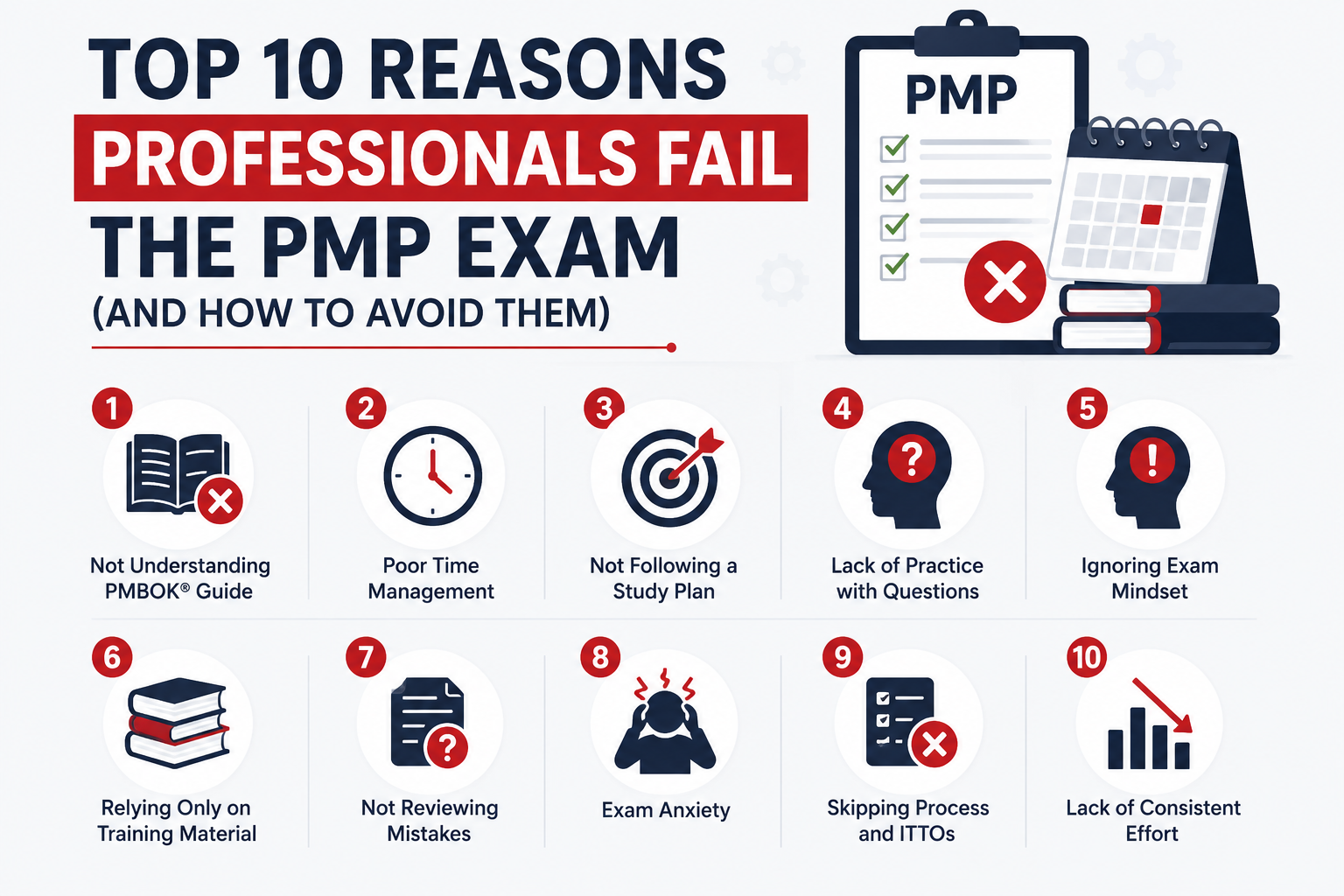
Top 10 Reasons Professionals Fail the PMP Exam (And How to Avoid Them)
You have the experience. You have the hours. You have submitted the application. So why do professionals fail the PMP exam even after months of preparation?
This question is asked by thousands of working professionals across India every year — engineers, IT leads, construction managers, and program managers who invest significant time, money, and energy into PMP preparation, only to fall short on exam day.
The truth is, PMP exam failure reasons are rarely about intelligence or even effort. They are almost always about preparation strategy, mindset, and a misunderstanding of what the exam actually tests.
Having personally coached over 7,000 students globally — with more than 1,000 PMP clears in 2023 alone — I have seen the same patterns repeat themselves. This article breaks down every one of them, so you can avoid the traps that catch even highly experienced project managers off guard.
Ready to prepare the right way from day one? Work directly with Visakh RJ — India's record-holding PMP coach and join thousands of professionals who cleared PMP on their first attempt.
The Real Reason the PMP Exam Is So Difficult
Before diving into specific mistakes, it is important to understand what the PMI PMP exam difficulty level is actually about — especially in 2026, where domain weightings shifted dramatically this year compared to what older study guides still teach.
The PMP is not a memory test. It does not reward the candidate who can recite all 49 processes verbatim. It rewards the candidate who can think like an experienced, ethical project manager in complex, ambiguous, real-world situations.
As of the current 2026 exam format, approximately:
50% of questions are based on predictive (waterfall) project management
50% are based on agile and hybrid project management approaches
This split confuses and catches off guard the majority of professionals who prepared primarily using traditional PMBOK frameworks. Understanding this balance is step one of any serious PMP certification study guide strategy.
Reason 1: Treating the PMBOK Guide as the Entire Syllabus
This is the single most common PMP exam preparation mistake — and it has become even more costly since the 2021 exam content update and the ongoing PMBOK 7 to PMBOK 8 transition that is reshaping how candidates must approach their preparation in 2026.
The "read the PMBOK cover to cover" advice that circulates across forums is dangerously outdated. PMI now bases the exam on the Examination Content Outline (ECO), which covers:
People (42% of questions — leadership, team management, stakeholder engagement)
Process (50% of questions — planning, execution, delivery)
Business Environment (8% of questions — strategy, benefits, compliance)
The PMBOK Guide, both 6th and 7th editions, and the Agile Practice Guide together serve as supporting references — not the exam blueprint itself.
How to avoid it: Base your study plan on the PMI Examination Content Outline first. Use PMBOK and the Agile Practice Guide as concept-deepening resources, not as your primary study material. Stay current on how the PMBOK transition is reshaping exam question design in 2026.
Reason 2: Ignoring Agile and Hybrid Methodologies Completely
Half the exam is agile. Let that sink in.
Many experienced project managers in India come from manufacturing, construction, or traditional IT environments where waterfall methodologies dominate. They have never run a Scrum sprint or worked with a Kanban board in a professional setting. As a result, agile PMP exam preparation gets minimal attention during their study plan — and the exam exposes that gap ruthlessly.
What makes this even more critical in 2026 is that hybrid project management now drives a large share of PMP 2026 questions — scenarios where you must decide how to blend predictive planning with agile delivery in the same project environment. These are not purely agile or purely waterfall questions. They require you to think in both frameworks simultaneously.
Questions on servant leadership, product backlogs, sprint retrospectives, velocity, and value delivery now appear throughout the entire exam — not in an isolated agile section.
How to avoid it: Dedicate at least 40% of your study time to agile and hybrid concepts. Read the full Agile Practice Guide. Practice with scenario-based questions where you must choose how a servant leader or Scrum Master responds to a given situation — and understand how those decisions change when the project uses a hybrid approach.
Reason 3: Relying Solely on Memorisation Instead of Situational Thinking
The PMP exam rarely asks: "What is the definition of a Risk Register?"
It asks: "You are the project manager. A team member flags a risk that is outside the project scope but could impact the business. What do you do first?"
These situational questions test your ability to apply project management principles under realistic constraints — with competing stakeholder priorities, ethical considerations, and resource limitations all in play simultaneously. Candidates who have spent their preparation memorising inputs, tools, outputs, and process flows are unprepared for this style of questioning.
How to avoid it: Use PMP exam practice questions that are scenario-based and aligned with the current exam format. Aim for a minimum of 2,000 to 3,000 practice questions before your exam. Review not just whether your answer was right or wrong, but why the correct option was preferred over the others. The reasoning behind PMI's preferred answers is a skill that compounds with deliberate practice.
Reason 4: Submitting a Poorly Prepared PMP Application
Surprisingly, many failures begin before the exam even starts — at the application stage.
PMP exam application process mistakes include:
Describing project management experience in generic terms rather than using PMI's language of leading, directing, and managing
Logging hours across projects that do not clearly demonstrate the required level of project management responsibility
Submitting experience descriptions that are vague, misaligned with PMI's definition of a project, or inconsistently formatted
Getting selected for an audit and being unprepared with the required documentation
PMI conducts random audits of applications. Candidates who are audited without proper supporting documentation face significant delays and psychological pressure that disrupts their preparation momentum entirely.
How to avoid it: Describe each project experience using action-oriented language that reflects PMI's Talent Triangle — Technical PM skills, Leadership, and Strategic Business Management. Keep all supporting documents — contact details, project descriptions, and experience verifications — organised and ready before you submit.
Reason 5: No Structured PMP Exam Study Plan
One of the clearest PMP exam failure reasons I observe among self-preparing candidates is the absence of a structured, week-by-week study plan.
The question "how long to study for PMP exam" has a clear answer based on experience: most professionals need 8 to 12 weeks of consistent, structured preparation — typically 10 to 15 hours per week. Without a plan, candidates either:
Rush through material in 3 to 4 weeks and feel underprepared on exam day
Drag preparation out over 6+ months, losing momentum and forgetting early content before they sit for the exam
Study topics in isolation without integrating predictive and agile content into a coherent, exam-ready mindset
How to avoid it: Build a 10-week study plan that covers ECO domains, agile concepts, PMBOK processes, professional ethics, and regular mock testing with structured review. Allocate the final two weeks exclusively to full-length mock exams and targeted revision of your weak areas.
Join Visakh RJ's PMP coaching programme in India — structured specifically for working professionals in India who are balancing full-time jobs with serious exam preparation.
Reason 6: Not Taking Enough Full-Length Mock Exams
This is an underestimated but critical failure point. The PMP exam is 180 questions over approximately 230 minutes — with two scheduled 10-minute breaks. That is a significant cognitive and stamina challenge on top of the technical difficulty.
Candidates who have never sat through a full 180-question mock exam before their actual exam day often find themselves:
Running out of time in the final 30 questions
Losing concentration after the first 100 questions
Making careless errors on questions they understood well — simply due to exam fatigue and decision-making depletion
How to avoid it: Attempt at least five to six full-length, timed 180-question mock exams before your actual exam. Simulate real exam conditions — no phone, no breaks beyond the scheduled two, strict 230-minute limit. After each mock, spend more time reviewing wrong answers than you spent taking the test itself.
The best PMP exam practice questions come from trainers with a documented track record of student passes — not from free question dumps that circulate online and frequently contain outdated, unverified content from old exam formats.
Reason 7: Misunderstanding PMI's "Right Answer" Mindset
Every PMP question has four plausible options. Often, two of them are both technically correct from a project management standpoint. The difference is that PMI consistently prefers one specific type of response over others.
PMI's preferred answer pattern tends to:
Communicate and consult before acting — always engage the stakeholder, team member, or sponsor first before making a unilateral decision
Follow the process — go through proper channels rather than improvising, even when improvising feels faster
Be proactive, not reactive — identify and address risks before they escalate into active issues
Prioritise the project's objectives and the customer's needs above personal convenience or team preference
Escalate appropriately — but only after genuine internal resolution attempts have been exhausted
Candidates who apply their real-world instincts — "I would just fix it and move on" — routinely select the wrong answer even when they fully understand the underlying concept. This is one of the most frustrating failure patterns, because the candidate walks out of the exam feeling confident and still does not pass.
How to avoid it: Practise PMI's decision-making mindset deliberately and consistently. Every time you review a wrong answer, ask: "What would the ideal, ethical, process-following PMI project manager do in this situation?" Over time, this mindset becomes second nature and starts showing up automatically in your answer selection.
Reason 8: Underestimating the PMP Exam Experience Requirements
PMP exam experience requirements are non-negotiable and often misunderstood. To sit for the PMP, you must have:
A four-year degree plus 36 months of project management experience within the last eight years, or
A high school diploma plus 60 months of project management experience within the last eight years
35 hours of formal project management education (contact hours) in all cases
Where professionals go wrong is misidentifying their experience. Not all professional experience qualifies as project management experience. PMI specifically requires experience where you were leading, directing, and managing projects — not simply participating in them as a team member or subject matter expert.
In India, many professionals work on projects in technical or team member roles for years before stepping into genuine leadership positions. Counting those years as full project management experience is a common miscalculation that can lead to application rejection or, worse, an audit.
How to avoid it: Review PMI's official eligibility criteria carefully and honestly. Count only the months where you were genuinely leading and directing projects with responsibility for outcomes. If you are on the boundary, discuss your experience profile with a certified trainer before submitting your application.
Reason 9: Choosing the Wrong PMP Exam Prep Course
Not all PMP preparation resources are equal. In India specifically, a large number of candidates enrol in the cheapest available online course primarily to complete their 35 contact hours — and then attempt self-study for the actual exam preparation.
This approach carries significant failure risk:
Contact hour courses that fulfil the 35-hour requirement are not designed for deep exam preparation
Free or low-cost question banks often contain outdated questions based on old exam formats that no longer reflect current question design
Self-study without expert guidance leaves gaps in agile content, situational reasoning, and exam strategy that are very difficult to detect until you see your result
No mentorship means there is no one to correct misconceptions that quietly accumulate during preparation
Choosing the best PMP exam prep course online means choosing a trainer with a verifiable, transparent track record of student results — not just a long video library or a heavily discounted price.
How to avoid it: Choose a trainer whose success rate is documented and whose students actively share their experience. Look for published pass rates, verifiable testimonials, and deep expertise in both predictive and agile methodologies that reflects the current 2026 exam reality.
Start your preparation with Visakh RJ — PMP coach in India with 7,000+ students trained and 1,000+ PMP clears in 2023 alone.
Reason 10: Giving Up After the First Attempt
The PMP exam retake policy PMI allows up to three attempts within your one-year eligibility period. Failing on the first attempt is not the end — but only if you treat the failure as data rather than as a verdict on your capability.
Candidates who fail and immediately rebook without changing their preparation approach fail again — often by a larger margin, because their confidence has dropped but their strategy has not changed.
The second attempt must be approached differently:
Identify the specific ECO domain areas — People, Process, Business Environment — where your performance was weakest using your PMI result report
Spend targeted extra time on agile and hybrid content if your predictive foundation is stronger
Increase the volume and quality of PMP exam practice questions focused specifically on your identified weak areas
Work with a mentor or trainer for targeted guidance between attempts rather than returning to the same self-study materials
Every professional who has cleared PMP after an initial failure will tell you the same thing: the second preparation was more focused, more intentional, and ultimately more effective — because they knew exactly where they had gone wrong the first time.
Summary: The 10 PMP Exam Failure Reasons at a Glance
Treating the PMBOK Guide as the complete exam syllabus
Ignoring agile and hybrid methodology content
Memorising instead of developing situational thinking
Submitting a weak or vague PMP application
Having no structured study plan
Skipping full-length mock exam practice
Misunderstanding PMI's preferred answer mindset
Miscounting eligible project management experience
Choosing the wrong prep course for the wrong reasons
Repeating the same approach after an initial failure
Frequently Asked Questions: PMP Exam Failure and Preparation
What is the PMP exam pass rate in India?
PMI does not publish an official global or India-specific pass rate. However, industry estimates and trainer observations consistently place the first-attempt pass rate between 60% and 70% for well-prepared candidates. For candidates who self-study without structured guidance, the pass rate is considerably lower. The single biggest differentiator between those who pass and those who fail is structured preparation with scenario-based practice — not the total number of hours studied.
How many practice questions should I do before the PMP exam?
Most PMP trainers with strong pass rates recommend completing between 2,000 and 3,500 practice questions before your exam — but only from high-quality, current sources. Quantity without quality review is counterproductive. For every 50 questions you attempt, spend equal time reviewing the explanations of every question you got wrong, and every question where you guessed correctly without genuine understanding.
Can I pass the PMP exam without reading the full PMBOK Guide?
Yes — and many successful candidates do. The current PMP exam is based on the PMI Examination Content Outline, not the PMBOK Guide directly. A thorough understanding of the ECO domains, the Agile Practice Guide, and solid scenario-based practice will take you further than a PMBOK cover-to-cover reading without contextual application. That said, the PMBOK 6th Edition process groups remain relevant for predictive project management questions and should not be ignored. Staying informed about the ongoing PMBOK 7 to PMBOK 8 transition is equally important as you plan your preparation timeline.
What happens if I fail the PMP exam twice?
Under PMI's current retake policy, you have three attempts within a single one-year eligibility period, which begins on the date of your first exam. If you fail all three attempts, you must wait one year before reapplying. After a second failure, a structured re-preparation programme with expert mentorship is strongly recommended before attempting the third time. Your PMI result report will indicate performance levels across the three ECO domains — use this as your precise roadmap for targeted improvement, not as a source of discouragement.
How have PMP exam domain weightings changed in 2026?
The 2026 exam has seen meaningful shifts in how questions are distributed across the People, Process, and Business Environment domains — and the integration of hybrid thinking across all three has increased significantly. Before you finalise your study plan, read the detailed breakdown of how domain weightings shifted dramatically this year to ensure your preparation reflects what the exam is actually testing right now, not what it tested two years ago.
Final Word: Passing the PMP Is a Strategy Problem, Not an Intelligence Problem
Every professional who has failed the PMP exam was capable of passing it. The gap was never about intelligence. It was about strategy — what to study, how deeply, in what order, with what resources, and with what guidance.
Why professionals fail the PMP exam can almost always be traced back to one or more of the ten patterns outlined in this article. Now that you can see them clearly, you are already ahead of the majority of candidates preparing today.
The PMP certification is one of the most valuable professional credentials available to project managers in India and globally. PMI data consistently shows that PMP-certified professionals earn a median salary 16% higher than their non-certified peers. For professionals in Bengaluru, Hyderabad, Mumbai, and Pune, that salary premium is even more pronounced in the technology and consulting sectors.
You have already invested in understanding where candidates go wrong. The next step is investing in a preparation strategy that ensures you are not one of them.
Visakh RJ has helped over 7,000 professionals across India, the Middle East, the US, Canada, and Singapore pass the PMP exam — many on their very first attempt. His training is built around the exact failure patterns described in this article, updated for the 2026 exam reality.
Begin your PMP preparation with Visakh RJ today →