
The PMBOK 8 Framework: 6 Principles, 5 Focus Areas, 7 Performance Domains
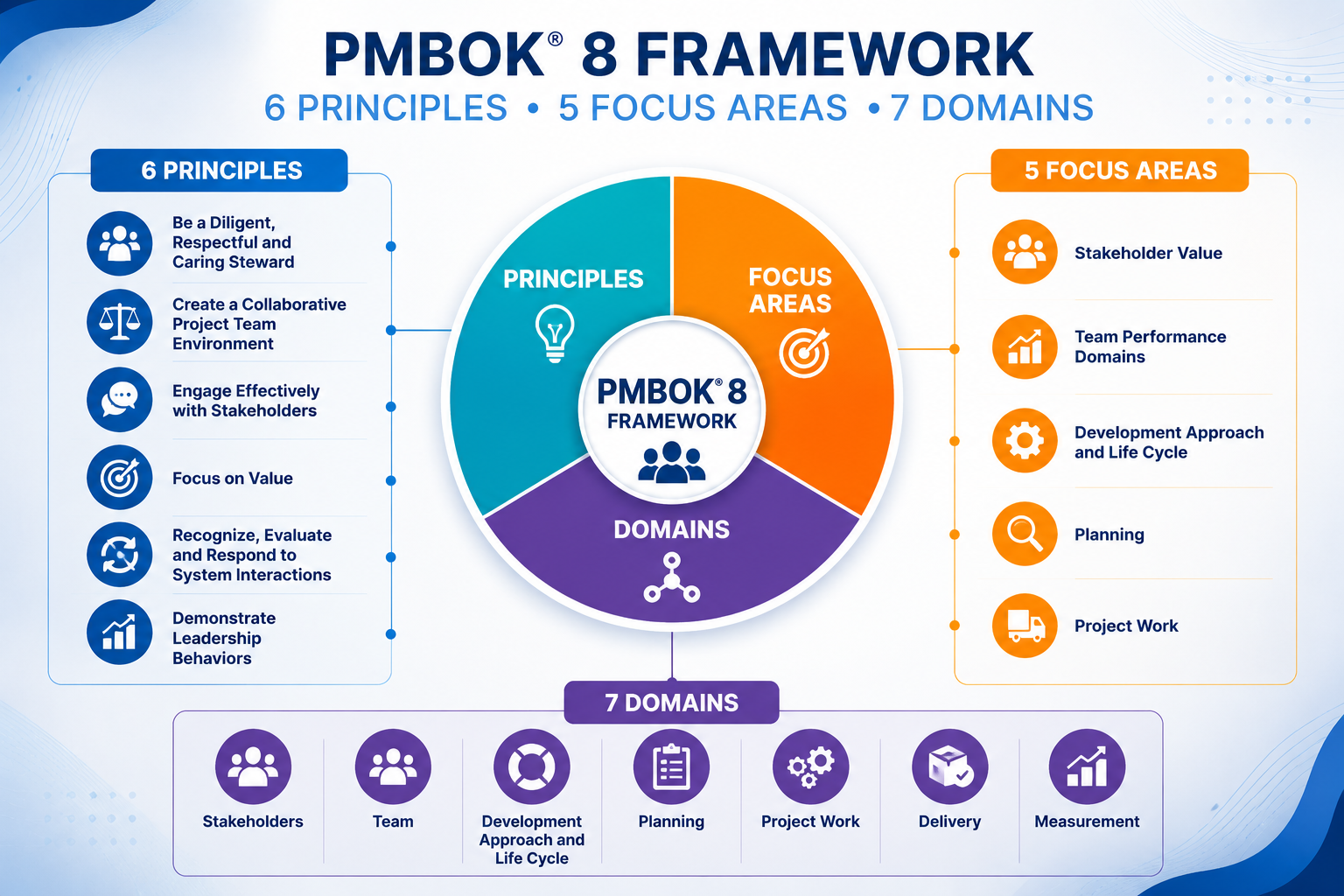
If you're preparing for the PMP exam or simply trying to keep up with how project management standards are evolving, understanding the PMBOK 8 Framework is no longer optional. Released in November 2025, PMBOK 8 reshapes how PMI structures its guidance, blending the flexibility of PMBOK 7 with the practical structure many practitioners felt was missing.
In this guide, I'll break down the three building blocks of the new framework, the 6 principles, the 5 Focus Areas, and the 7 performance domains, so you understand not just what changed, but why it matters for your exam prep and daily project work.
Why PMI Rebuilt the PMBOK Framework Again
PMBOK 7 removed the familiar process-based structure in favor of pure principles and outcome-based domains. While this gave flexibility, many practitioners found it too abstract for day-to-day application. The PMBOK Guide 8th Edition changes directly respond to that feedback.
PMBOK 8 reintroduces structure without abandoning the principle-based mindset. It combines:
Six core principles guiding behavior and decision-making
Five Focus Areas representing the project lifecycle
Seven performance domains organizing functional responsibilities
Forty nonprescriptive processes providing practical mechanics
This is the foundation candidates preparing for the exam launching July 9, 2026 need to internalize.
The 6 Principles of PMBOK 8 Explained
The 6 principles of PMBOK 8 were streamlined from PMBOK 7's twelve principles to eliminate overlap and create clearer decision-making guidance. Each principle shapes behavior across predictive, agile, and hybrid environments:
Adopt a Holistic View — See the project as an interconnected system, not isolated tasks
Focus on Value — Every decision and deliverable must generate verifiable value, not just output
Embed Quality Into Processes and Deliverables — Quality is built in continuously, not inspected at the end
Be an Accountable Leader — Combines stewardship and leadership into one practical standard
Integrate Sustainability Within All Project Areas — A new principle covering environmental, social, and economic responsibility
Build an Empowered Culture — Encourages collaboration, trust, and psychological safety across the team
These PMBOK 8 principles explained form the "how to think" layer that sits above every domain and process.
PMBOK 8 Focus Areas: The Return of Lifecycle Structure
One of the most welcomed updates is the reintroduction of lifecycle thinking through PMBOK 8 Focus Areas. These five areas closely resemble what many candidates studied as Process Groups under earlier editions:
Initiating
Planning
Executing
Monitoring and Controlling
Closing
Despite the resemblance, this represents PMBOK 8 Process Groups renamed, not simply relabeled. Focus Areas are framed to apply across delivery approaches, meaning they're approach-agnostic rather than tied strictly to predictive project management.
The 7 Performance Domains in PMBOK 8
The 7 performance domains PMBOK 8 replace PMBOK 7's eight outcome-focused domains with a more actionable, function-oriented structure:
Governance — Oversight, decision rights, and compliance
Scope — Defining and controlling what the project delivers
Schedule — Planning and managing timelines
Finance — Budgeting, cost control, and financial value
Stakeholders — Engagement, communication, and expectation management
Resources — Team, tools, and material management
Risk — Identifying and responding to uncertainty
Interestingly, Quality isn't listed as a standalone domain anymore, it's now embedded within the principles layer instead. Team and Stakeholder concepts from PMBOK 7 have been consolidated into Resources and Stakeholders respectively.
PMBOK 8 Performance Domains vs PMBOK 7: What Changed
Comparing PMBOK 8 vs PMBOK 7 highlights just how significant this restructuring is:
PMBOK 7 (8 Domains)PMBOK 8 (7 Domains)TeamMerged into ResourcesStakeholdersStakeholdersPlanningDistributed across Scope/ScheduleProject WorkDistributed across GovernanceDeliveryDistributed across Scope/ScheduleMeasurementEmbedded across all domainsUncertaintyAddressed within RiskDevelopment Approach & Life CycleReflected in Focus Areas
This consolidation makes the framework feel far more concrete and easier to apply directly to real project scenarios, which is exactly the feedback PMI incorporated into this edition.
PMBOK 8 Nonprescriptive Processes: Structure Without Rigidity
Within the seven domains, PMBOK 8 introduces 40 PMBOK 8 nonprescriptive processes, down from 49 in earlier editions. Each process includes illustrative ITTOs (Inputs, Tools and Techniques, Outputs), but these are examples rather than strict requirements.
This matters because it allows project managers to tailor their approach to the specific project environment, whether predictive, agile, or hybrid, rather than following a rigid checklist. I explain how this tailoring mindset directly affects the updated PMP exam in my article on PMP Exam Content Outline 2026: Task-by-Task Breakdown.
PMBOK 8 Sustainability Principle: A Notable Addition
The PMBOK 8 sustainability principle deserves special attention since it's entirely new to this edition. It requires project managers to consider environmental, social, and economic impact, often called the triple bottom line, as part of core project decision-making, not as an optional add-on.
This reflects PMI's broader emphasis on responsible project delivery and connects closely with the expanded Business Environment domain in the updated PMP exam, which I cover in detail in Why the People Domain Dropped to 33% in the 2026 Syllabus.
PMBOK 8 Value Delivery: The Central Thread
Running through every principle, Focus Area, and domain is a consistent emphasis on PMBOK 8 value delivery. Rather than measuring success purely by schedule, budget, and scope, the framework encourages project managers to ask whether outcomes are genuinely worth the investment of time, cost, and effort.
This shift from output-based to outcome-based thinking is one of the most important mindset changes candidates need to internalize before sitting the updated exam.
How the Framework Fits Together
Think of it this way: principles are the mindset, Focus Areas provide the lifecycle lens, and performance domains define where you apply functional expertise. Together, they form a complete, integrated view of how modern project management actually works.
For a full PMBOK 8 summary for PMP candidates, I recommend studying each domain alongside its related tasks in the updated Examination Content Outline rather than memorizing the structure in isolation.
Frequently Asked Questions
When was PMBOK 8 officially released?
PMBOK 8 was released in November 2025, making it the most current PMI standard ahead of the updated PMP exam launching July 9, 2026.
Do I need to study PMBOK 8 for the current PMP exam?
If you're testing before July 8, 2026, the current exam is still based on the previous ECO. If you're testing on or after July 9, 2026, PMBOK 8 becomes directly relevant to your preparation.
What happened to Quality as a performance domain?
Quality is no longer a standalone performance domain in PMBOK 8. It's now embedded within the principles, specifically under "Embed Quality Into Processes and Deliverables."
How many processes does PMBOK 8 include?
PMBOK 8 includes 40 nonprescriptive processes, down from 49 in earlier editions, organized across the seven performance domains.
Is PMBOK 8 the same as the new PMP Examination Content Outline?
No. PMBOK 8 is PMI's standard reference guide, while the ECO defines what's actually tested on the exam. The ECO draws on PMBOK 8 but is a separate document specifically for exam content.
Master the PMBOK 8 Framework Before Your Exam
Understanding the PMBOK 8 Framework in depth gives you a real advantage heading into the updated PMP exam. The principles, Focus Areas, and performance domains aren't just theory, they reflect how project managers are expected to think and operate in 2026 and beyond.
With over 10,000 professionals mentored and a 99% pass rate, I've rebuilt my entire coaching curriculum around this new framework so students walk in fully prepared, not guessing at what changed.
Ready to master PMBOK 8 and the updated PMP exam? explore my PMP certification training program, or check out more insights on the blog to stay ahead of every 2026 update.
Author: Visakh RJ