
PMP Exam Update 2026: A Plain-English Summary
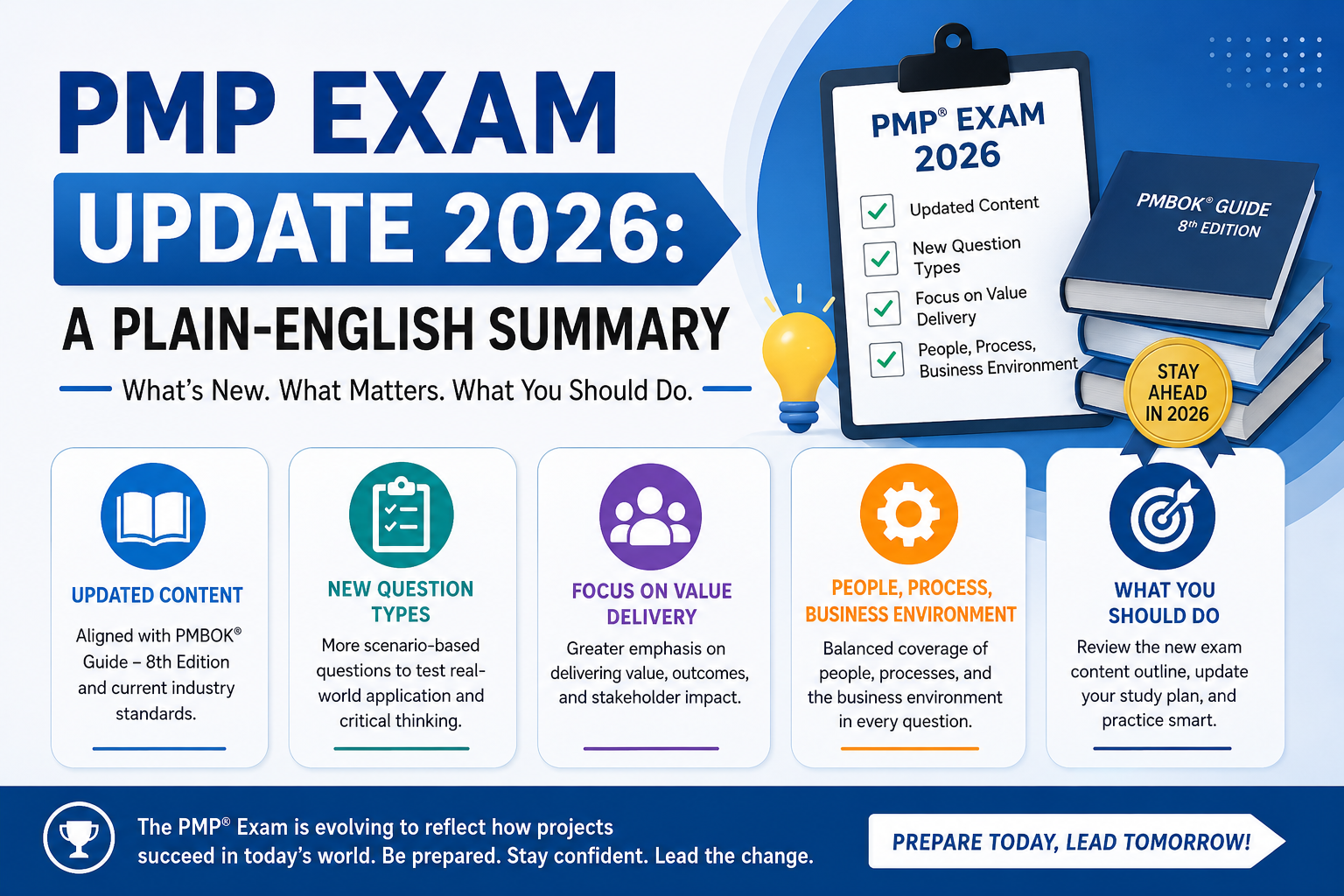
You don't have hours to decode PMI's official documentation between meetings, deadlines, and everything else on your plate. This PMP Exam Update 2026 summary skips the jargon and gives you exactly what changed, why it matters, and what to actually do about it.
If you're a working professional squeezing in study time before or after work, you need clarity, not a 40-page technical breakdown.
Here's everything you need to know about the 2026 PMP changes, explained the way a colleague would explain it over coffee — not the way PMI's official documentation explains it.
What Changed in PMP Exam 2026: The Short Version
Let's start with what changed in PMP exam 2026 in one sentence: PMI rebalanced how much each of the three exam domains counts, and added two entirely new topic areas that didn't exist before.
That's it. That's the core of it. Everything else in this guide simply unpacks what that actually means for your study plan.
For the full technical breakdown, our detailed guide on PMP exam content outline 2026 task-by-task covers every domain in depth — but if you just need the plain-English version, keep reading.
PMP Exam Changes Explained Simply: The Three Domains
Here's PMP exam changes explained simply, domain by domain, without the technical language.
People Domain: Down from 42% to 33%
Still important, still about leading teams and managing conflict — just slightly less of the total exam than before.
Process Domain: Down from 50% to 41%
Still the biggest chunk of the exam. Still about planning, risk, and execution. Just a bit less weight than it used to carry.
Business Environment Domain: Up from 8% to 26%
This is the one that actually matters for your study plan. It more than tripled. This domain now covers governance, compliance, sustainability, and organizational alignment — topics most candidates barely studied before.
PMP Exam Domains Explained Simply: What Each One Actually Tests
If domain names alone don't mean much to you, here's PMP exam domains explained simply in terms of real job tasks.
People = How you lead, motivate, and resolve conflict with your team
Process = How you actually plan, execute, and control a project
Business Environment = How your project connects to company strategy, compliance, and outside factors
Think of it this way: People is about your team, Process is about your work, and Business Environment is about your company and the world around your project.
PMP 2026 Syllabus Summary: The Two New Topics
Beyond the percentage shifts, this PMP 2026 syllabus summary wouldn't be complete without mentioning what's genuinely new content.
1. Artificial Intelligence
The exam now expects you to understand how AI tools affect planning, estimating, and reporting — not to be an AI expert, just to know how it fits into modern project work.
2. Sustainability
ESG (Environmental, Social, Governance) considerations are now part of the exam. This reflects how much sustainability has become a standard business expectation, not a niche concern.
Neither topic requires deep technical expertise — just working familiarity with how they show up in real project decisions.
PMP Exam Format Update 2026: What's Different on Test Day
Beyond content, this PMP exam format update 2026 covers changes to how the test itself feels when you sit down to take it.
Quick Format Changes
Slightly more questions than before
More scenario-based questions, fewer simple definition questions
Expanded question types (case sets, drag-and-drop, interactive formats)
Slightly longer overall exam duration
In plain terms: expect more "here's a situation, what would you do" questions and fewer "what does this term mean" questions.
For a deeper look at exactly what these new question types look like, our guide on PMP 2026 exam format and question types decoded breaks it down with real examples.
PMP Exam Content Outline Summary: Why It's the Real Blueprint
Here's something many candidates get wrong: the PMBOK Guide is not what the exam is directly based on. This PMP exam content outline summary clarifies the distinction.
The Examination Content Outline (ECO) is PMI's actual exam blueprint. PMBOK is reference material to help you understand concepts — but every exam question traces back to the ECO, not PMBOK page numbers.
If you're studying primarily from PMBOK without cross-checking the ECO, you might be spending time on the wrong things.
PMBOK vs ECO 2026 Update: Which One Should You Actually Study?
This confusion comes up constantly, so let's settle this PMBOK vs ECO 2026 update question directly.
Study the ECO For:
Understanding exactly what topics and tasks will be tested
Prioritizing your study time by domain weight
Knowing the actual scope of each domain
Study PMBOK For:
Deeper conceptual understanding of terms and frameworks
Context and background behind ECO tasks
Reference material when a concept feels unclear
Short version: the ECO tells you what to study, PMBOK helps you understand why it matters.
PMP Exam Update for Working Professionals: A Realistic Study Approach
Here's the PMP exam update for working professionals section you actually came here for — how to prepare when you don't have unlimited study hours.
A Realistic Weekly Approach
Week 1-2: Get familiar with the ECO structure and domain weights
Week 3-5: Focus extra time on Business Environment — it's the newest, least familiar content
Week 6-8: Practice scenario-based questions specifically, not just flashcards
Week 9-10: Review weak areas identified through practice tests
Final week: Light review only — avoid cramming new content
This structure assumes 5-8 hours per week, realistic for most working professionals juggling a full-time job.
PMP 2026 Update for Busy Professionals: Time-Saving Study Tips
If you're truly short on time, this PMP 2026 update for busy professionals section gives you the highest-impact shortcuts.
Smart Shortcuts That Actually Work
Prioritize Business Environment study time above its raw 26% weighting — it's newest and least intuitive
Use practice questions early, not just at the end — they reveal gaps faster than passive reading
Study in short, focused 30-minute sessions rather than rare long marathons
Join a structured coaching program rather than piecing together scattered free resources
For structured, time-efficient coaching designed specifically around these 2026 changes, our PMP coaching program compresses the learning curve for professionals with limited study hours.
Quick Guide to PMP Exam Changes: The One-Page Summary
If you only remember one section from this entire guide, make it this quick guide to PMP exam changes.
The Five Things That Actually Matter
Business Environment domain more than tripled in weight (8% → 26%)
AI and sustainability are now tested topics
Expect more scenario-based, fewer definition-based questions
The ECO — not PMBOK — is your real study blueprint
Study time should skew toward Business Environment, not match its raw percentage
Screenshot this list if nothing else.
PMP Exam Transition July 2026: Timing Considerations
If you're weighing whether to test before or after the transition, understanding PMP exam transition July 2026 timing matters for your planning.
Candidates who sit the exam before the cutoff date test under the previous structure; everyone after must prepare for the updated 2026 outline. This timing decision genuinely affects your study approach, so it's worth clarifying early rather than assuming.
Our detailed analysis on whether you should rush your PMP before the July 2026 transition walks through the practical trade-offs of testing under either version.
PMP Exam Prep Changes 2026: Adjusting Your Study Materials
Given everything covered, meaningful PMP exam prep changes 2026 are necessary if you're using older study materials.
What to Check in Your Study Resources
Does your material reflect the updated domain percentages (33/41/26)?
Does it cover AI and sustainability topics explicitly?
Does it include practice questions in the new scenario-based format?
Is it aligned with the ECO structure, not just PMBOK chapters?
If your current study guide doesn't check these boxes, it's likely built for the previous exam version — worth confirming before you invest more study hours into it.
PMP Certification Changes 2026: What Corporate Teams Should Know
For L&D managers and corporate training teams, understanding PMP certification changes 2026 timing helps you communicate clearly with employees pursuing certification.
Make sure your team knows which exam version they'll actually sit for based on their testing date, and ensure any company-sponsored training materials are updated accordingly — outdated internal training resources create unnecessary confusion during an already busy work schedule.
Our broader complete guide to PMP certification covers eligibility and full certification requirements alongside these exam changes.
Frequently Asked Questions
1. Do I need to relearn everything if I already started studying under the old syllabus?
No — most content overlaps significantly. Focus your remaining time specifically on Business Environment topics and scenario-based practice, since those represent the biggest genuine gaps.
2. Is the new PMP exam harder than before?
Not harder, just different — it emphasizes applied judgment over memorization, which often suits experienced working professionals better than pure recall-based testing.
3. How much extra study time does the 2026 update require?
Most candidates need roughly the same total study time, just reallocated — spend proportionally more time on Business Environment and scenario-based practice than you might have previously.
4. Should I study PMBOK 8 for the updated exam?
Treat PMBOK as supporting reference material; the ECO remains the actual exam blueprint, so prioritize studying against ECO tasks first.
5. Can I still pass with limited weekly study time as a busy professional?
Yes — a focused 5-8 hours per week over 8-10 weeks, prioritized correctly by domain weight, is realistic for most working professionals.
Final Thoughts
The PMP Exam Update 2026 isn't as overwhelming as it first appears once you break it down: rebalanced domains, two new topics, and a shift toward scenario-based questions. With focused, prioritized study time — even just a few hours a week — busy professionals can absolutely prepare effectively for this updated exam.
Ready to prepare efficiently for the 2026 PMP exam? Visit the RJ Visakh to explore coaching programs designed specifically for working professionals with limited study time.