
PMP 2026 Exam Format: Question Types Decoded | RJ Visakh
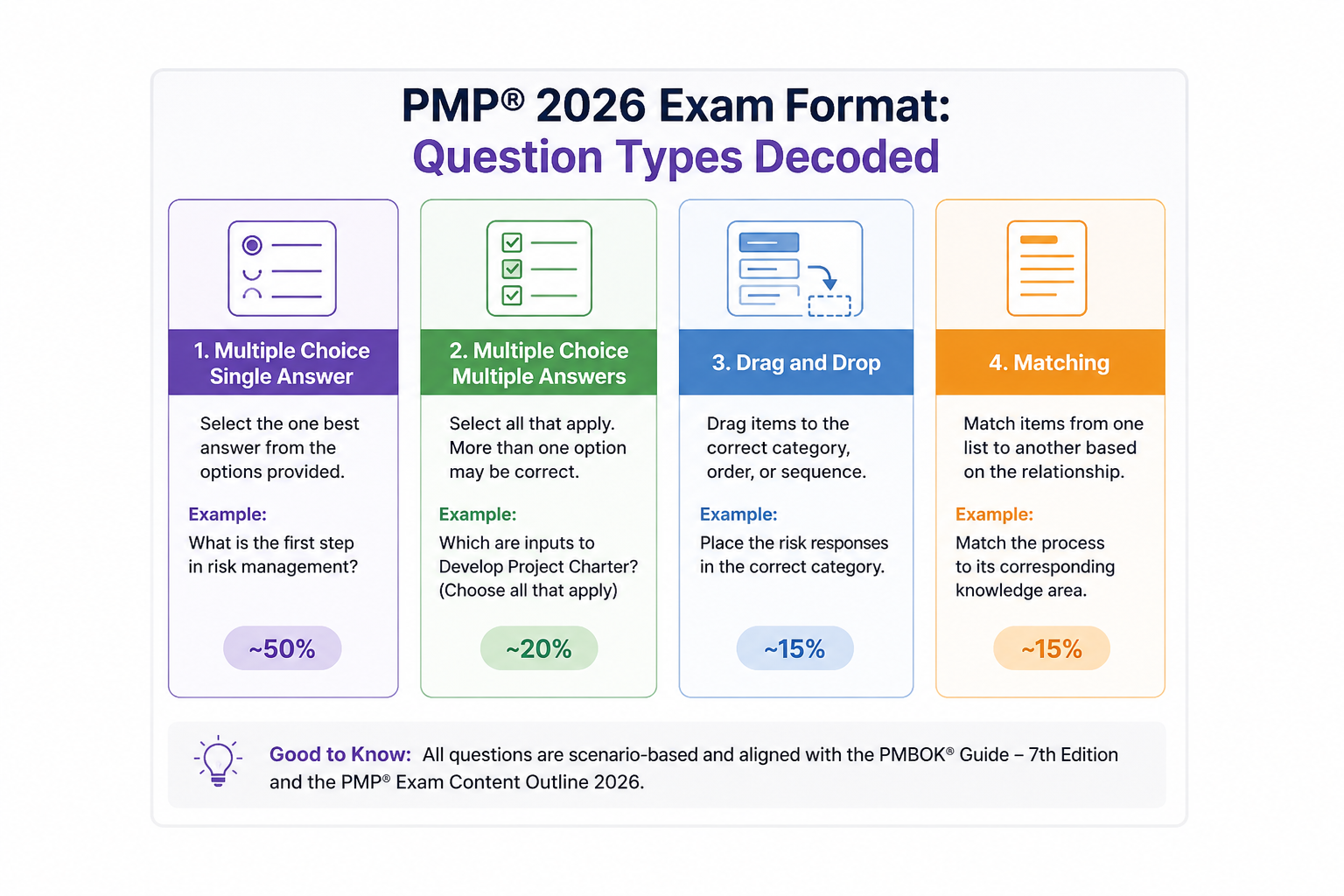
PMP 2026 exam format is changing in a way that every serious certification candidate — whether you are based in India, the UAE, the United States, or anywhere else in the world — needs to fully understand before sitting the exam. Starting July 9, 2026, PMI has introduced significant structural updates that go well beyond a simple content refresh. This is a fundamental shift in how project management competence is tested.
If you are preparing right now, this guide decodes exactly what is new, what it means for your preparation, and how expert coaching can help you pass with confidence.
What Is Changing in the PMP 2026 Exam Format
The PMP 2026 exam format moves away from knowledge memorisation toward real-world judgment and applied decision-making. The new exam extends testing time to 240 minutes and introduces significantly reweighted domains — People drops from 42% to 33%, Process drops from 50% to 41%, and the Business Environment domain more than triples, rising from 8% to 26%.
This is not a minor tweak. The Business Environment domain was historically the least-studied section. In 2026, it carries more than a quarter of your total score. Candidates who prepared using older frameworks and question banks are now significantly underprepared.
New topics like AI in project management and sustainability are now testable, and the exam introduces more interactive question types including scenario sets, hotspot, and matching questions.
New PMP Exam Question Types 2026 — A Complete Breakdown
Understanding the PMP exam question types 2026 is critical to both your study strategy and your exam-day performance. Here is exactly what you will face.
Multiple Choice and Multiple Response
These remain part of the exam but are no longer the dominant format. Multiple response questions require selecting more than one correct answer, demanding deeper understanding of project scenarios rather than surface-level recall.
Drag and Drop and Matching
The exam features drag-and-drop questions requiring candidates to match processes, frameworks, or project phases correctly. These test your ability to organise information logically — a skill that rote memorisation alone cannot build.
Hotspot and Graphic Interpretation
Graphic-based questions ask you to interpret visual information like charts, graphs, or diagrams before answering. This format reflects real project environments where decisions are made from dashboards and data rather than written text.
Case Sets and Scenario-Based Questions — The Biggest Change
This is the most significant addition to the PMP 2026 exam format. PMI describes these as detailed situations that may include charts, graphs, or other visuals, followed by a series of questions based on that shared scenario — meaning you are not just answering one standalone item and moving on.
Candidates will be presented with a detailed scenario or situation, possibly including graphs or charts, and must answer a series of linked questions — one long introduction followed by four or five connected questions.
This format demands sustained concentration, analytical thinking, and the ability to apply multiple project management principles within a single context. Candidates who only practise isolated one-question drills will find the real exam far more mentally demanding than expected.
Domain Weightings in the PMP 2026 Exam Format
The three-domain structure remains, but the balance has shifted substantially.
People Domain — 33% Focus on leadership, team management, stakeholder engagement, and conflict resolution across predictive, agile, and hybrid environments.
Process Domain — 41% Focus on project delivery, planning, execution, quality, risk, and procurement. Both waterfall and agile methods are tested equally.
Business Environment Domain — 26% This is the major shift. Expect questions on business value, strategic alignment, AI tools in project management, sustainability, and organisational change — topics that were barely tested before.
How to Master PMP Scenario-Based Questions Preparation
PMP scenario-based questions preparation is now the single most important investment of your study time. Here is a structured approach that works for candidates globally — from India and the Middle East to Europe and North America.
Think in context, not in definitions. Every scenario question asks what you should do as a project manager in a specific situation. The right answer always serves the project, the stakeholders, and business value — not the one that merely quotes a framework.
Read the full scenario before answering. Case sets contain layered information. Rushing to the question without absorbing the full scenario is one of the most costly exam-day mistakes.
Practise with updated full-length mock exams. Traditional question banks built for the pre-2026 exam do not reflect the new item types. Your preparation must include case-set simulations and graphic interpretation exercises.
Study AI and sustainability in project management. Scenario-based questions may include AI tools much like dashboards or other project artefacts — the exam validates judgment around how a project professional evaluates tools, trade-offs, and implications in a real situation.
Strengthen your agile and hybrid knowledge. More questions will focus on Scrum, Kanban, SAFe, and hybrid delivery, along with scenario questions about adapting your approach based on project characteristics.
Is the PMP 2026 Exam Harder?
This is the question every candidate asks. The honest answer — it is not harder, it is different. The 2026 version focuses more on real-world judgment, scenario analysis, and critical thinking, and many candidates find applied questions easier to understand than memorisation-style questions.
What makes it challenging is the shift in preparation mindset. Candidates who approach it like a knowledge test will struggle. Those who prepare like a practising project manager — thinking through decisions, understanding context, and applying frameworks — will find it entirely manageable.
How Professional Coaching Makes the Difference
The PMP 2026 exam format rewards candidates who prepare strategically, not just extensively. Expert coaching helps you understand the reasoning behind correct answers, build scenario-thinking skills, and navigate the new case-set format with confidence.
At RJ Visakh, our PMP coaching programme is fully updated for the July 2026 exam. We cover every new PMP exam question type 2026, walk you through real case-set practice, and guide your PMP scenario-based questions preparation with a structured, exam-aligned approach — whether you are preparing from India, the Middle East, Europe, or North America.
Frequently Asked Questions
What is the PMP 2026 exam format? The PMP 2026 exam format includes 180 questions to be completed in 240 minutes across three domains — People, Process, and Business Environment. It introduces new question types including case sets, drag and drop, hotspot, graphic interpretation, and scenario-based questions, effective from July 9, 2026.
What are the new PMP exam question types in 2026? The new PMP exam question types 2026 include case or scenario sets, graphic-based interpretation questions, drag-and-drop matching, hotspot questions, and enhanced multiple response items — all designed to test applied judgment rather than memorisation.
How should I approach PMP scenario-based questions preparation? Effective PMP scenario-based questions preparation involves thinking like a practising project manager, reading full case scenarios carefully before answering, practising with updated mock exams, and strengthening your knowledge of agile, hybrid, AI, and sustainability topics.
Does the PMP 2026 exam still cover agile and predictive methods? Yes. Both agile and predictive methods remain core to the exam. The 2026 format tests your ability to apply the right delivery approach — whether waterfall, agile, or hybrid — based on the specific project scenario presented.
Can I prepare for the PMP 2026 exam on my own? Self-study is possible, but the new scenario-based and case-set format significantly benefits from guided coaching. A structured programme aligned with the 2026 Exam Content Outline helps you build the right thinking skills and avoid the preparation gaps that cause most candidates to underperform.
Ready to Pass the PMP 2026 Exam With Confidence?
The PMP 2026 exam format is already here. Candidates who start preparing with the right strategy today will walk into the exam centre ready — not guessing.
Visit rjvisakh.com to explore our PMP coaching programmes, book a free consultation, and start your preparation with a coach who understands exactly what the 2026 exam demands.