
From Memorization to Judgment: How the 2026 PMP Exam Tests Differently
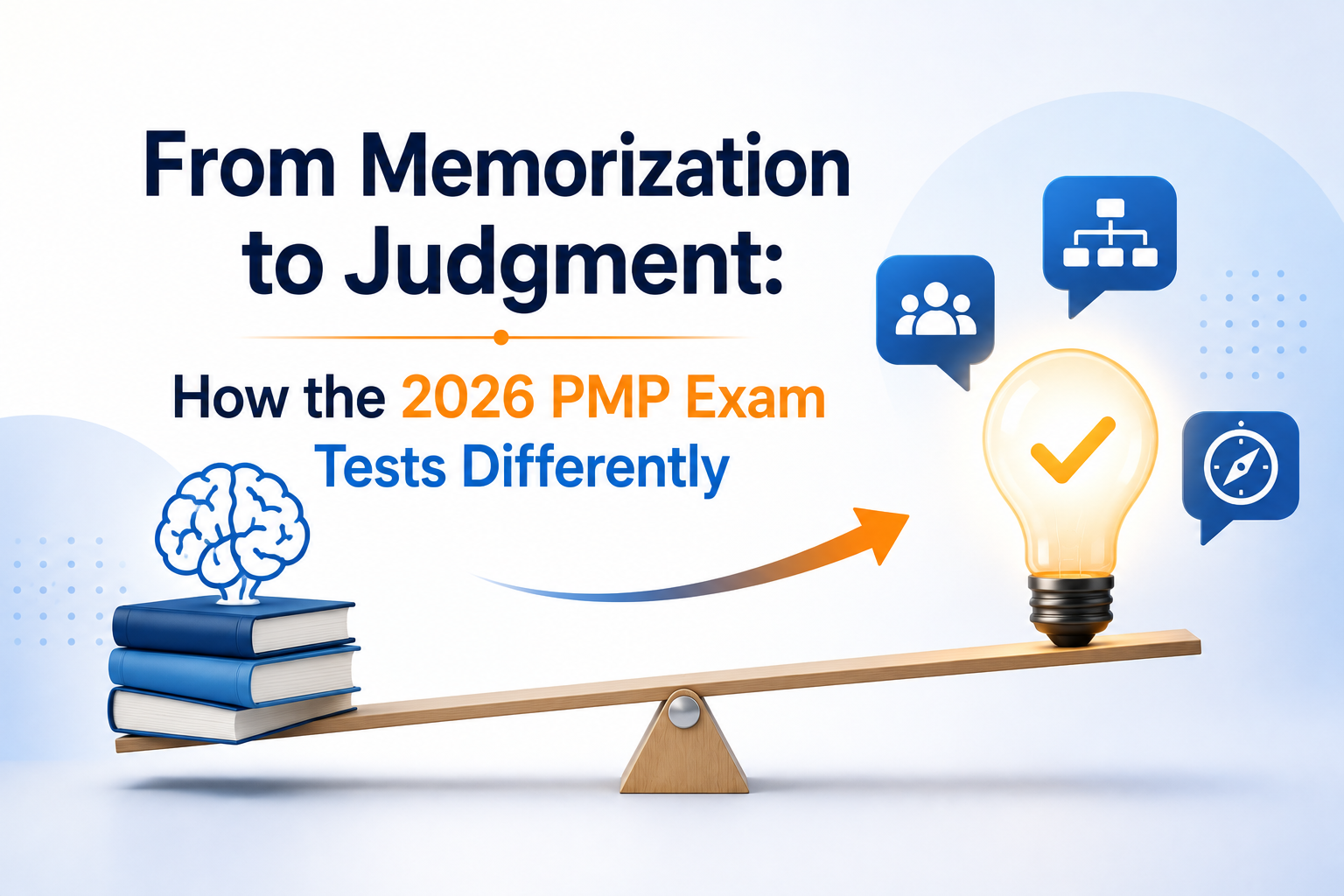
How the 2026 PMP exam tests differently is the single biggest adjustment aspirants need to make before exam day. If your study plan still revolves around flashcards, formula sheets, and definition lists, you're preparing for an exam that no longer exists in its old form.
This guide explains exactly how the 2026 PMP exam tests differently from previous versions, why PMI made this shift, and how to rebuild your study strategy around judgment instead of pure recall.
Why Understanding How the 2026 PMP Exam Tests Differently Matters
For years, PMP preparation meant memorizing process names, inputs, outputs, and formulas. That approach worked because the exam rewarded recognition — you saw a term, you matched it to a definition, you moved on.
That is no longer how the exam works. Understanding how the 2026 PMP exam tests differently is now the foundation of any effective study plan, because the underlying skill being measured has changed, not just the question format.
For the full scope of what changed, see our detailed breakdown of why the 2026 PMP exam is the biggest change in a decade.
The Shift From Recall to Applied Judgment
The clearest way to understand how the 2026 PMP exam tests differently is to compare what each question actually measures.
Old Format: Testing What You Know
Previous exams leaned heavily on questions like "What is the definition of a risk register?" or "Which input comes before which output?" These questions test memory. You either recalled the fact correctly, or you didn't.
New Format: Testing What You Would Do
The 2026 exam replaces much of this with situational prompts: a stakeholder conflict, a schedule slip, an ambiguous risk event. You're asked what a competent project manager should do next — not what a term means. This is the core of how the 2026 PMP exam tests differently, and it rewards experience-based reasoning over textbook recitation.
Why PMI Rebuilt the Exam Around Judgment
PMI didn't make this change arbitrarily. Real project management rarely involves reciting definitions — it involves navigating ambiguity, managing people, and making decisions with incomplete information.
The updated Exam Content Outline was designed to reflect this reality, testing whether candidates can actually apply PMBOK 8 principles rather than just recognize them. Our article on why PMI rewrote the PMP syllabus for 2026 covers the research and industry pressure behind this decision in detail.
The Role of the Expanded Business Environment Domain
One of the clearest signals of how the 2026 PMP exam tests differently is the expanded weight given to the Business Environment domain. Questions here rarely have a single "correct" textbook answer — they require weighing organizational context, compliance, and strategic alignment, which is a judgment skill, not a memorization skill.
New Question Formats That Reflect This Shift
The format changes on the 2026 exam aren't cosmetic — they exist specifically to test judgment rather than recall. This is central to how the 2026 PMP exam tests differently in practice:
Scenario-based questions — testing your decision-making in realistic project situations
Case sets — multiple linked questions built around one extended, evolving scenario
Drag-and-drop and sequencing items — testing structural understanding, not just recognition
Graphic interpretation questions — testing your ability to read and analyze visual project data
These interconnected formats often appear together within a single case, which is why understanding PMP case set questions and how to answer them has become essential exam-readiness knowledge.
How to Adjust Your Study Strategy
Once you understand how the 2026 PMP exam tests differently, your preparation needs to shift accordingly. Here's what that looks like in practice:
Step 1: Stop Studying Definitions in Isolation
Instead of memorizing what a term means, study how it's applied in context. Ask yourself: in what situation would this concept determine the correct decision?
Step 2: Practice With Realistic Scenarios Daily
Judgment is a skill built through repetition, not insight gained once. Daily exposure to situational questions trains your instinct the same way experience does on a real project.
Step 3: Learn PMI's Underlying Mindset
PMI consistently favors proactive, transparent, and collaborative responses over reactive or authoritative ones. Once you internalize this mindset, many "hard" scenario questions become far more predictable.
Step 4: Simulate Full Exam Conditions
Because the new format blends scenario-based, visual, and interactive question types within case sets, practicing them separately isn't enough. Mixed, timed mock sets are essential to build genuine exam readiness.
Step 5: Review Every Wrong Answer for the "Why"
When you miss a judgment-based question, don't just note the correct answer — understand why the other options were wrong. This is how you internalize PMI's decision-making logic rather than just memorizing one more fact.
What This Shift Means for Working Professionals in India
For busy professionals balancing full-time jobs with exam prep, this shift actually works in your favor. Real project experience — the kind you've already lived through — is now directly tested, rather than buried under rote memorization.
This is precisely why structured coaching matters more in 2026 than it did in previous exam versions. Guided practice helps translate your on-the-job experience into the specific decision-making patterns PMI is testing for, closing the gap between "I know this" and "I can apply this under pressure."
Common Mistakes Aspirants Make With the New Format
Continuing to rely on flashcard-based memorization as the primary study method
Skipping timed, scenario-based mock practice until the final weeks
Assuming strong theoretical knowledge alone guarantees strong judgment scores
Ignoring the expanded Business Environment domain's weight in the new ECO
Not reviewing wrong answers deeply enough to understand PMI's underlying reasoning
Working with thousands of aspirants across India, these are the exact adjustments that separate a confident first-attempt pass from a frustrating retake.
FAQs on How the 2026 PMP Exam Tests Differently
1. What is the biggest change in how the 2026 PMP exam tests differently? The shift from recall-based definition questions to applied judgment through scenario-based and situational formats is the most significant change.
2. Do I still need to memorize formulas for the 2026 exam? Yes, foundational formulas still matter, but they're now applied within realistic scenarios rather than tested as standalone calculations.
3. Is the 2026 PMP exam harder than previous versions? It tests a different skill set — judgment over memorization — so aspirants who adapt their study approach often find it more intuitive, not harder.
4. How can I practice judgment-based thinking for the PMP exam? Regular exposure to scenario-based mock questions, combined with deep review of wrong answers, is the most effective way to build this skill.
5. Does real project experience help more under the new format? Yes. Because the exam now tests applied decision-making, candidates with genuine project experience often adapt faster than those relying purely on textbook study.
Understanding how the 2026 PMP exam tests differently isn't just useful — it's the foundation your entire study plan should be built on. Once you shift from memorizing facts to practicing judgment, the exam becomes far more predictable and far less intimidating.
Ready to master how the 2026 PMP exam tests differently with a 99% pass-rate coach? 👉 Book Your Free PMP Strategy Call
Learn more about Visakh RJ, India's leading PMP trainer, at rjvisakh.com.
Address: Visakh RJ, Mumbai, India Phone: +91 62825 40905