
Why PMI Rewrote the PMP Syllabus for 2026
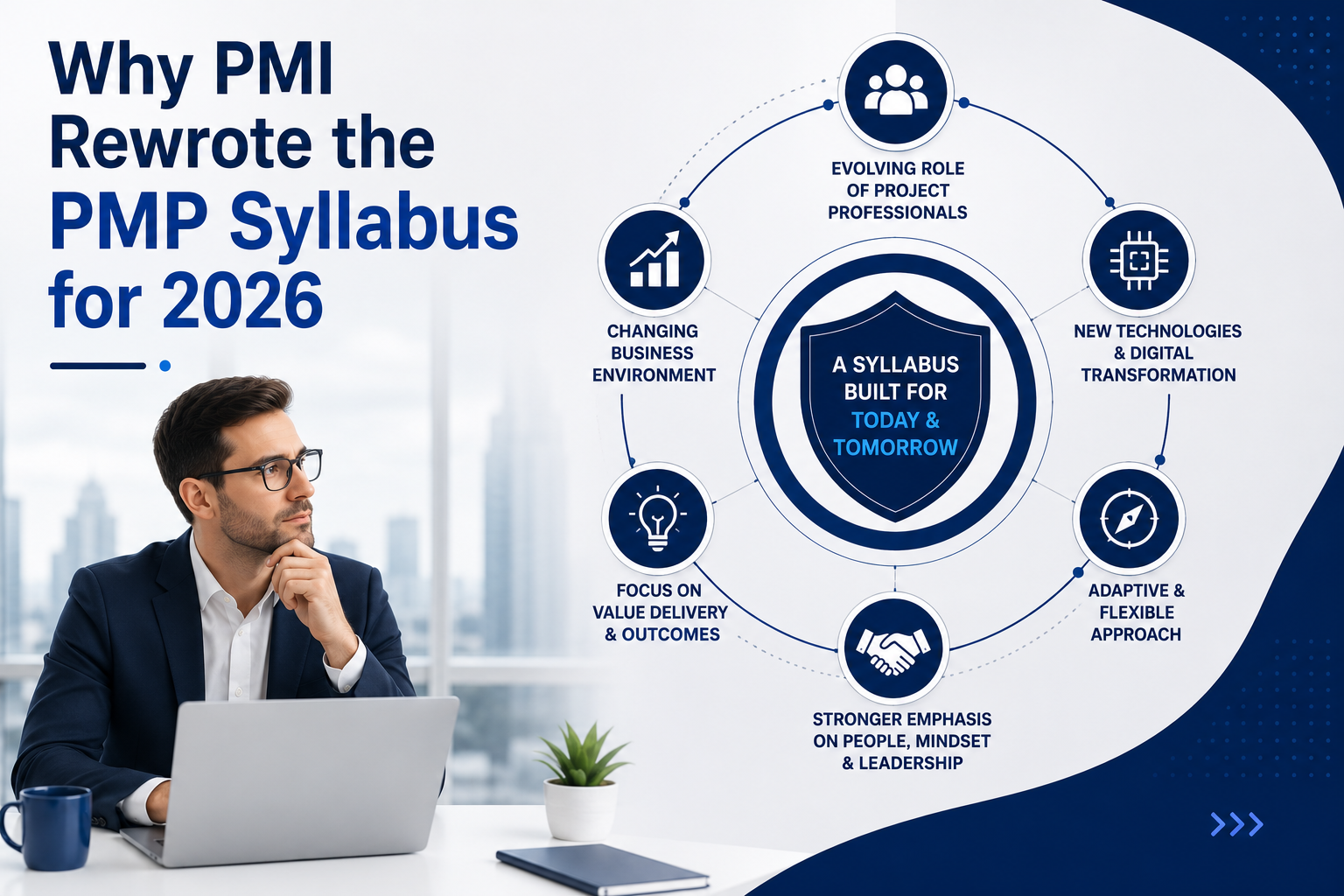
Certification updates don't happen randomly. When you understand why PMI rewrote the PMP syllabus for 2026, the scale of change suddenly makes sense — this isn't a minor content refresh, it's a response to how project management itself has fundamentally shifted.
For candidates in India preparing for certification, and for trainers updating their curriculum, knowing the reasoning behind these changes helps you study smarter, not just harder.
This article breaks down the research, industry pressures, and strategic thinking that pushed PMI to redesign its Examination Content Outline (ECO) so significantly.
The Research Behind the Rewrite: PMI Job Task Analysis
Every major PMP update begins with the same foundational process: PMI job task analysis PMP research. This isn't opinion-based revision — it's data-driven, built from surveying thousands of practicing project managers worldwide about what they actually do on the job.
PMI gathered extensive input from professionals across industries and regions to identify gaps between the existing exam content and real-world project management responsibilities. The findings revealed a credential that no longer fully reflected modern practice.
This research foundation is why the update carries so much weight — it's grounded in verified role data, not internal assumption.
Understanding the PMI Role Delineation Study
The PMI role delineation study is the formal methodology behind every ECO revision cycle. It systematically maps the tasks, knowledge, and skills project managers need across different industries, seniority levels, and delivery methodologies.
This study process typically identifies:
Which competencies have grown in importance
Which topics have become outdated or less relevant
Emerging skill areas not yet reflected in current certification content
How project delivery approaches (predictive, agile, hybrid) are actually being used in practice
The 2026 role delineation findings pointed clearly toward one conclusion: project managers today function as strategic business leaders, not just technical coordinators.
Why the PMP Exam Is Changing: The Core Drivers
Understanding why PMP exam is changing requires looking at three converging industry shifts that PMI's research consistently identified.
1. Projects Are More Strategically Complex
Modern projects increasingly connect directly to business strategy, requiring project managers to understand organizational goals, not just execute tasks in isolation.
2. Delivery Methods Have Diversified
Pure predictive (waterfall) project management is no longer the default. Most organizations now blend agile, hybrid, and predictive approaches depending on project needs.
3. Technology and Sustainability Are Now Core Responsibilities
AI-assisted decision-making and sustainability considerations have moved from "nice to know" to expected competencies for practicing project managers.
For a closer look at how these shifts affect the actual test-taking experience, see our breakdown of the PMP 2026 exam format with new question types and case sets.
PMP Business Environment Domain Increase: The Clearest Signal
If you want the single clearest evidence of PMI's intent, look at the PMP business environment domain increase — jumping from a minor 8% weighting in 2021 to a substantial 26% in 2026.
This isn't a cosmetic adjustment. It represents PMI formally declaring that understanding organizational strategy, compliance, governance, and business value delivery is now core to project management competency — not a peripheral consideration.
Meanwhile, the People and Process domains were proportionally reduced, not because they matter less, but because Business Environment topics had been significantly underrepresented relative to how project managers actually spend their strategic thinking time.
PMP Exam AI Sustainability Update: Reflecting Modern Practice
A major driver behind the rewrite is the explicit PMP exam AI sustainability update — two topic areas that simply didn't exist in the 2021 outline in any meaningful way.
Why AI Made the Cut
AI now influences planning, estimation, risk analysis, and reporting across nearly every industry. PMI's research confirmed that project managers increasingly need to understand how AI tools affect decision-making, even if they're not building the tools themselves.
Why Sustainability Made the Cut
ESG (Environmental, Social, Governance) accountability has become a standard business expectation globally. Sustainability now appears within quality management and compliance-related tasks, reflecting real organizational requirements project managers must navigate.
Neither topic exists in isolation — both are woven across multiple domains rather than treated as standalone sections.
PMI Industry Research PMP Update: Listening to the Market
Beyond internal analysis, PMI industry research PMP update initiatives draw heavily on external market signals — hiring trends, job postings, employer feedback, and industry certification demand.
PMI regularly monitors how project management roles are actually being advertised and structured across sectors. When employers consistently seek skills the existing PMP credential didn't test, that gap becomes a strong signal for revision.
This market-responsiveness is part of why the PMP has remained one of the most globally respected certifications — it evolves alongside actual hiring expectations rather than staying static.
Future of Project Management PMP: What PMI Is Betting On
The future of project management PMP certification represents isn't just about passing an exam — it's PMI's vision for where the profession is heading over the next several years.
PMI is clearly betting on:
Project managers as strategic business partners, not just execution managers
Fluency across predictive, agile, and hybrid delivery — not specialization in just one
Comfort with AI-assisted workflows as standard practice
Sustainability and governance awareness as baseline professional competencies
This forward-looking approach means the certification aims to stay relevant for years, not just reflect current-day practice.
PMP Syllabus Modernization: A Broader Pattern
This update fits into a broader pattern of PMP syllabus modernization that PMI has pursued through multiple certification cycles. Each revision moves the credential further from rigid, process-group-based thinking toward flexible, principles-based competency.
Comparing this rewrite to earlier updates, the shift from five process groups to three domains years ago set the foundation — the 2026 update builds on that structure by rebalancing emphasis toward business strategy and modern delivery methods.
If you're transitioning your study materials, our guide on moving from PMBOK 7 to PMBOK 8 through an updated PMP coaching program explains how reference material aligns with these ongoing changes.
PMP Certification Relevance 2026: Why This Matters for Your Career
Ultimately, all of this research and restructuring serves one goal: protecting PMP certification relevance 2026 and beyond. A credential that doesn't reflect real job requirements loses value to both candidates and employers.
By rewriting the syllabus now, PMI ensures that:
Employers can trust PMP holders possess current, applicable skills
Candidates study material that genuinely prepares them for real project work
The certification maintains its position as the global standard for project management credibility
For Indian professionals, this relevance matters especially in IT, consulting, and infrastructure sectors where hybrid delivery and business alignment are already daily realities.
PMP Exam Evolution 2026: Practical Implications for Candidates
Understanding the reasoning behind PMP exam evolution 2026 should directly shape your preparation strategy, not just satisfy curiosity.
What This Means for Your Study Plan
Don't treat Business Environment as a minor topic — it now carries significant exam weight
Build genuine understanding of agile and hybrid delivery, not just predictive processes
Familiarize yourself with how AI tools are used in real project contexts
Practice scenario-based questions extensively, since the exam now tests applied judgment
To build confidence with the new question formats, our collection of PMP 2026 mock exam questions with ECO-aligned scenario-based practice gives hands-on exposure to how these concepts actually get tested.
Common Preparation Pitfalls Given These Changes
Many candidates approach the 2026 exam using outdated study habits from previous certification cycles. Avoiding these mistakes early saves significant preparation time.
Our detailed breakdown of the top 10 mistakes Indian PMP aspirants make in 2026 covers exactly where candidates commonly go wrong when adjusting to this rewritten syllabus.
Frequently Asked Questions
1. Why did PMI increase the Business Environment domain so significantly?
PMI's research found that project managers increasingly need strategic business alignment, governance, and organizational awareness skills that were previously underrepresented in the exam.
2. Is the PMP syllabus rewrite based on PMI's own opinion or actual data?
The rewrite is grounded in a formal Job Task Analysis and role delineation study, gathering input from thousands of practicing project managers globally rather than internal assumptions.
3. Why did PMI add AI and sustainability to the PMP exam now?
Both topics reflect genuine shifts in how organizations operate today — AI increasingly influences project decision-making, while sustainability has become a standard business and compliance expectation.
4. Does this rewrite mean the PMP exam is now harder?
Not necessarily harder, but different — the exam now emphasizes applied judgment and scenario-based thinking over memorization, which benefits candidates with genuine project experience.
5. How often does PMI rewrite the PMP syllabus this significantly?
Major structural rewrites like this happen periodically based on role delineation research cycles, typically spaced several years apart, though smaller content refreshes occur more frequently.
Final Thoughts
PMI didn't rewrite the PMP syllabus on a whim — this update reflects genuine, research-backed shifts in how project management is practiced globally. Understanding these underlying reasons doesn't just satisfy curiosity; it directly informs a smarter, more targeted preparation strategy.
Ready to align your PMP preparation with the 2026 syllabus changes? Visit the RJ Visakh to explore training programs and coaching designed specifically around the updated exam content outline.