
Why the Process Domain Fell to 41% in the New PMP ECO
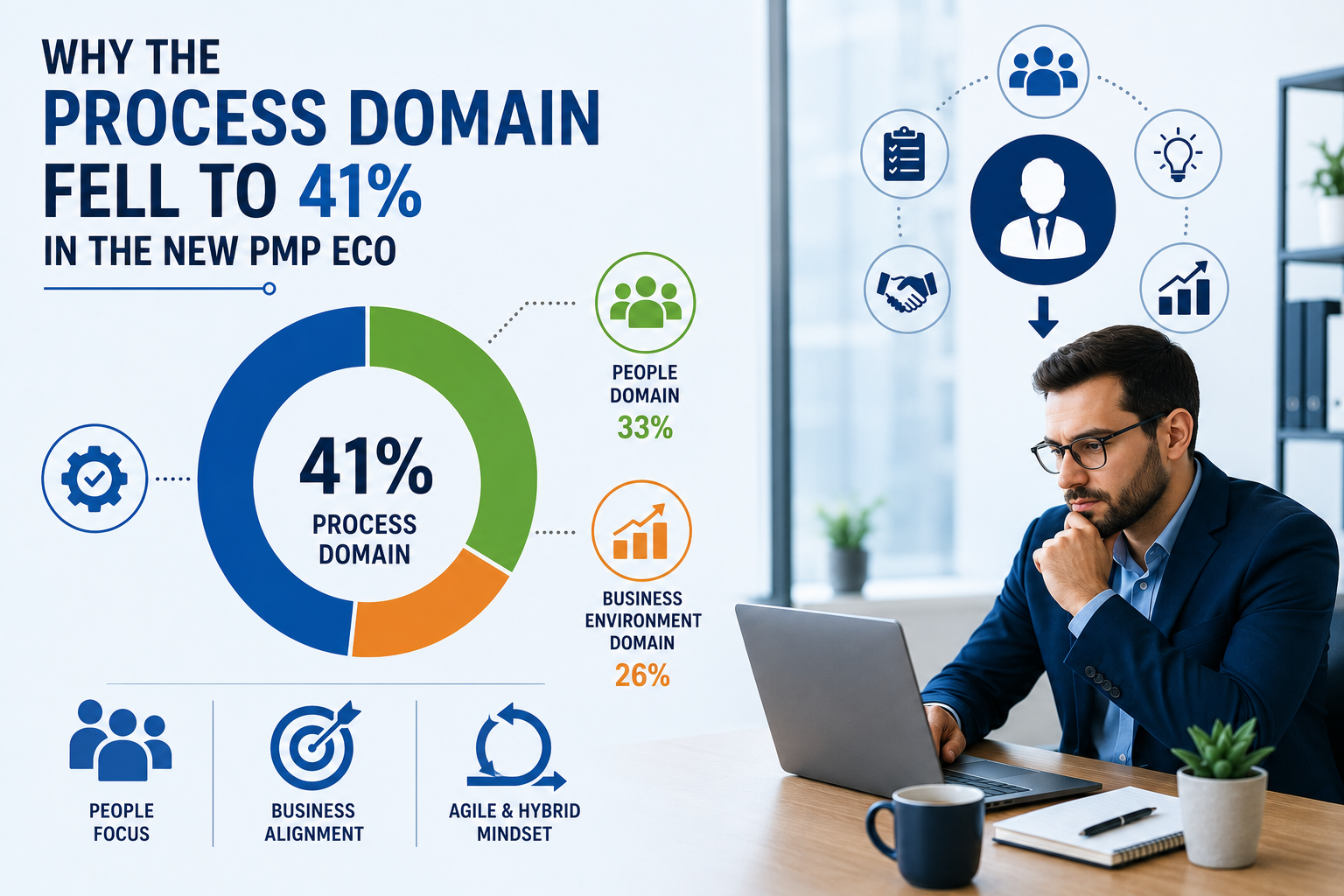
If you studied for the PMP exam even a few years ago, one number probably stuck in your head: Process was 50% of the exam, full stop. That assumption no longer holds, and understanding why the Process domain fell to 41% in the new PMP ECO is essential before you build a 2026 study plan around outdated percentages.
This isn't a random adjustment. PMI's reweighting reflects genuine research into how project managers actually spend their time and judgment today — and Process, while still the largest domain, had to make room for a category that had been badly underrepresented.
This article breaks down exactly what changed, why PMI made this specific decision, and what it means for how you should actually study.
PMP Process Domain 2026 vs 2021: The Numbers That Started the Conversation
Let's start with the PMP Process domain 2026 vs 2021 comparison that's driving so much discussion among candidates and trainers alike.
The Direct Comparison
Domain2021 Weighting2026 WeightingChangeProcess50%41%−9 pointsPeople42%33%−9 pointsBusiness Environment8%26%+18 points
Process dropped by 9 percentage points — a meaningful shift, but notice it's still the single largest domain by a comfortable margin. This wasn't a demotion of Process; it was a redistribution to correct a much bigger imbalance elsewhere.
For the complete task-level breakdown of all three domains, our guide on the 2026 PMP ECO domain reweighting covers exactly how percentages shifted across People, Process, and Business Environment together.
Why PMP Process Domain Decreased: It's Not About Process Mattering Less
Here's the most important thing to understand upfront: why PMP Process domain decreased has nothing to do with planning, risk management, or execution becoming less important to real project work.
What Actually Drove the Decrease
Business Environment was severely underweighted at just 8% in 2021, despite covering genuinely critical modern competencies
PMI's Job Task Analysis found project managers increasingly navigate governance, compliance, and strategic alignment as core responsibilities
Something had to give proportionally to accommodate this expansion, and Process — while still substantial — absorbed part of that redistribution alongside People
Process didn't shrink because it matters less. It shrank because Business Environment had been dramatically under-represented relative to real project management practice.
PMP Domain Reweighting Reasons: The Research Behind the Shift
Understanding the PMP domain reweighting reasons requires looking at PMI's actual methodology, not just the resulting percentages.
How PMI Determines Domain Weights
Job Task Analysis (JTA) — surveying thousands of practicing project managers globally about their actual day-to-day responsibilities
Role delineation study — mapping how time and judgment are genuinely distributed across competency areas
Industry trend analysis — tracking how project delivery methods and business expectations have evolved
This research consistently pointed toward one conclusion: modern project managers spend meaningfully more time on governance, compliance, and strategic alignment than the 2021 exam structure reflected.
PMI Process Domain Rationale: Why 41% Still Makes It the Largest Domain
Despite the reduction, understanding the PMI Process domain rationale for keeping it at 41% — still comfortably the largest single domain — matters just as much as understanding why it dropped.
Why Process Retains the Largest Share
Planning, scheduling, risk management, and execution remain the operational core of project management
These tasks span both predictive and agile/hybrid delivery approaches, covering a huge range of exam content
Even as Business Environment expanded, PMI's research confirmed Process still represents the single largest block of daily project management activity
Think of it this way: Process lost relative ground, but it didn't lose its position as the foundation of the exam.
PMP Process Domain Tasks 2026: What's Still Covered
Understanding PMP Process domain tasks 2026 covers helps clarify that the content itself remains extensive, even at the reduced percentage.
Core Process Domain Tasks
Executing projects to deliver business value
Managing communications and stakeholder engagement within project execution
Assessing and managing risks throughout the project lifecycle
Managing project changes and integration across planning and execution
Applying appropriate methodology, methods, and practices (predictive, agile, hybrid)
Establishing and maintaining project governance structures
Managing project artifacts, budget, resources, and quality
This is still a substantial list — candidates who assume a lower percentage means less content to study are making a costly mistake.
PMP Process Domain vs People Domain: Why Both Dropped Together
It's worth addressing PMP Process domain vs People domain directly, since both dropped by the exact same 9 percentage points — a detail that's easy to miss.
Why Both Domains Absorbed the Same Reduction
PMI's redistribution wasn't targeted at Process specifically — it proportionally reduced both domains to accommodate Business Environment's expansion
This suggests PMI viewed People and Process as similarly "mature" content areas that didn't need percentage growth
Business Environment, by contrast, needed the most room precisely because it contained the most genuinely new material
Neither domain was singled out as less important — both simply made proportional room for a domain that had been badly underrepresented.
PMP Business Environment Domain Increase: The Other Half of This Story
You can't fully understand why Process fell without understanding the PMP Business Environment domain increase it was making room for — jumping from just 8% to 26%.
What Business Environment Absorbed
Governance and organizational decision-making authority
Compliance requirements, including sustainability and ESG considerations
Organizational change management support
External environment evaluation (regulatory shifts, technology change, market conditions)
This domain more than tripled specifically because PMI's research found it had been the most disconnected from real-world project management responsibilities under the old structure.
PMP Exam Domain Shift Explained: The Bigger Picture Pattern
Zooming out, this PMP exam domain shift explained section helps place the Process reduction within PMI's broader certification evolution strategy.
This isn't PMI's first major restructuring — the shift from five process groups to three domains years ago set a precedent for moving away from rigid, execution-only thinking toward broader competency evaluation. The 2026 reweighting continues that same trajectory: less emphasis on pure mechanical execution, more emphasis on strategic and organizational judgment.
For a deeper look at PMI's underlying motivations across this entire update, our article on why PMI rewrote the PMP syllabus for 2026 covers the full research and industry context behind these changes.
PMP ECO Process Domain Breakdown: Task-Level Detail
For a more granular PMP ECO Process domain breakdown, it helps to understand that while overall domain weight decreased, individual tasks within Process were also consolidated and broadened in scope.
Rather than many narrow, granular tasks, the 2026 outline groups Process responsibilities into fewer, broader tasks — meaning each remaining task now covers more integrated responsibility than before. This consolidation is part of why the percentage dropped without the actual content feeling thin.
PMP Domain Percentage Changes 2026: Translating This Into Study Time
Understanding raw PMP domain percentage changes 2026 numbers only helps if you translate them into an actual study allocation strategy.
Recommended Study Time Approach
Process (41%): Still deserves significant study time — don't under-prepare just because the percentage dropped
People (33%): Moderate investment, particularly scenario-based practice
Business Environment (26%): Disproportionately higher study time recommended, since this content is newest and least familiar to most candidates
A common mistake is treating the Process percentage drop as license to under-study it — 41% of the exam is still nearly two out of every five questions.
PMP Process Domain Study Priority: A Practical Framework
Bringing this to a practical level, here's a PMP Process domain study priority approach that balances Process's continued importance against Business Environment's novelty.
Suggested Study Sequence
Business Environment first — newest content, highest unfamiliarity risk relative to weighting
Process second — still the largest domain, though often more intuitive for experienced practitioners
People third — generally most familiar territory for candidates with team leadership experience
This isn't about neglecting Process — it's about recognizing where your existing knowledge gaps are likely largest relative to each domain's weight.
PMP Syllabus Domain Rebalancing: What This Means Going Forward
Looking ahead, this PMP syllabus domain rebalancing likely signals how future PMI updates will continue evolving. As project management increasingly intersects with AI, sustainability, and organizational strategy, expect continued emphasis on Business Environment-adjacent competencies in future exam revisions.
For candidates preparing right now, the practical takeaway is straightforward: Process remains foundational, but it's no longer the dominant majority it once was — your study plan needs to reflect that shift honestly.
If you're specifically preparing for the practical differences in exam questions this reweighting produces, our PMP 2026 exam format and question types decoded guide shows exactly what these scenario-based questions look like across all three domains.
And if you want structured practice specifically calibrated to these new domain weightings, our PMP 2026 mock exam questions with ECO-aligned scenario-based practice gives hands-on exposure to how Process, People, and Business Environment questions are actually distributed on test day.
Frequently Asked Questions
1. Does the Process domain dropping to 41% mean it's less important for real project management?
No — the reduction reflects redistribution to properly weight Business Environment, not a judgment that Process skills matter less; Process remains the single largest domain on the exam.
2. Should I study Process less because its percentage decreased?
No — 41% is still nearly two-fifths of the exam; the safer approach is maintaining strong Process preparation while adding extra focus to Business Environment specifically.
3. Why did People and Process both decrease by the same amount?
Both domains proportionally absorbed reductions to accommodate Business Environment's expansion from 8% to 26%, rather than either domain being specifically targeted for reduction.
4. Are the actual Process domain tasks different, or just the percentage?
Both — while some tasks were consolidated into fewer, broader categories, the underlying content covers essentially the same core planning, execution, and risk management responsibilities as before.
5. What's the biggest study mistake candidates make regarding this change?
Assuming the percentage drop means less content to study — Process remains extensive and foundational, even at 41% rather than 50%.
Final Thoughts
The Process domain's drop to 41% isn't a story about Process becoming less relevant — it's a story about Business Environment finally getting the exam representation modern project management practice actually demands. Understanding this context helps you build a 2026 study plan that respects both domains appropriately, rather than either over-correcting or under-preparing.
Ready to build a study plan calibrated to the new 2026 domain weightings? Visit our PMP coaching program page for structured training designed specifically around this reweighted exam structure, or visit the RJ Visakh to explore all our PMP resources.