
The 2026 PMP ECO: How the Three Domains Were Reweighted
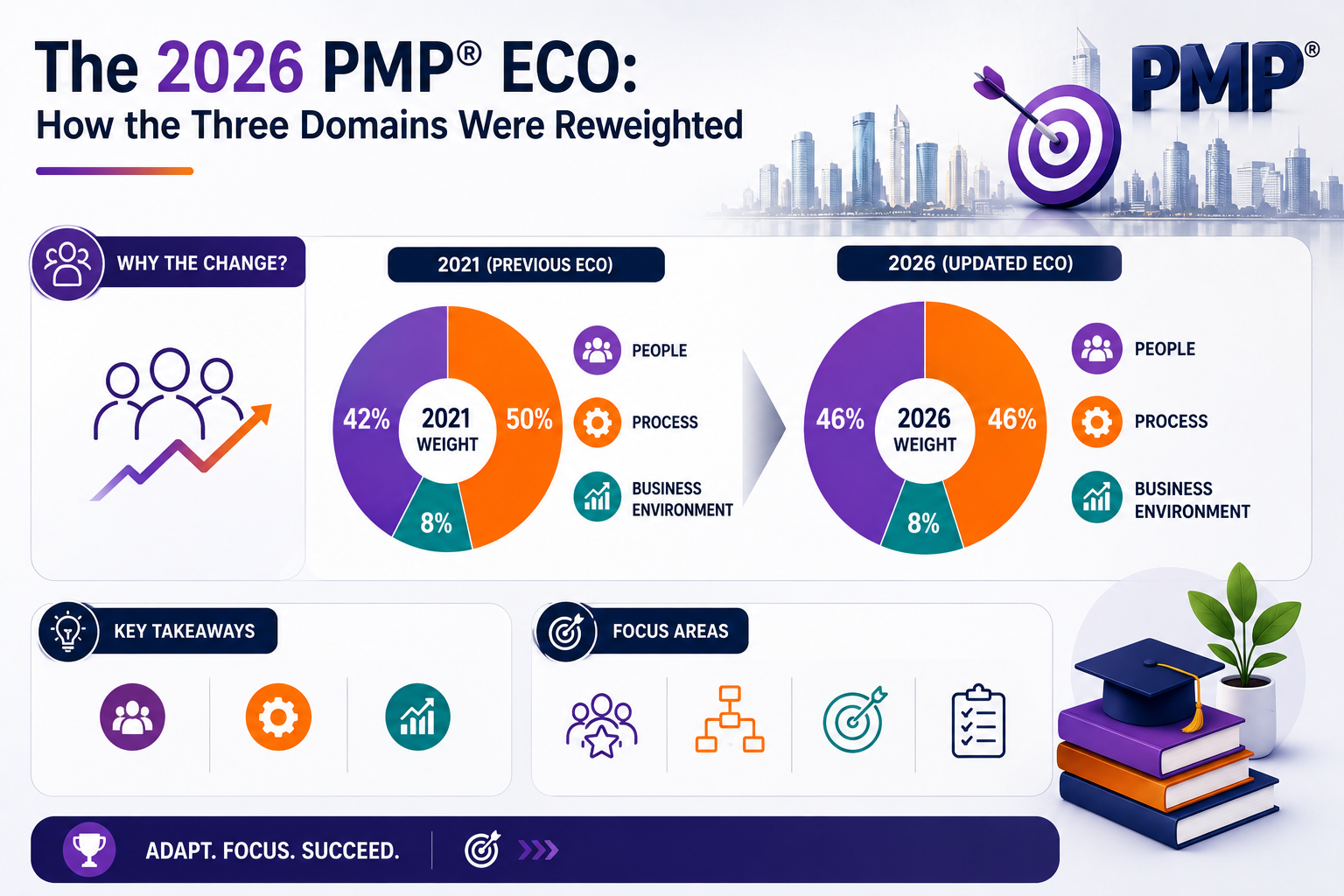
Numbers tell a story, and few numbers in project management circles have generated as much discussion as the 2026 PMP ECO domain reweighting. When PMI shifted percentage points across the three core domains, it wasn't a cosmetic tweak — it fundamentally changed what candidates need to prioritize.
If you're preparing for certification in India or anywhere else, understanding exactly how these weights shifted — and why — determines whether your study plan actually matches the exam you'll sit for.
This article breaks down the precise percentage changes across all three domains, explains what's driving each shift, and shows you how to translate these numbers into a smarter study strategy.
Understanding PMI Three Domain Structure Before the Changes
Since 2021, the PMP exam has been organized around three core domains rather than the traditional five process groups. Understanding this PMI three domain structure provides essential context before diving into the 2026 reweighting.
The three domains — People, Process, and Business Environment — represent distinct competency areas every certified project manager needs. What changed in 2026 wasn't the domains themselves, but how much exam weight each one carries.
For a complete overview of how this fits into the broader certification landscape, our complete guide to PMP certification in India for 2026 covers eligibility, structure, and preparation strategy in full.
PMP Domain Comparison 2021 vs 2026: The Numbers That Matter
Here's the PMP domain comparison 2021 vs 2026 breakdown that every candidate needs to understand before building a study plan.
Domain Weighting Shift
Domain2021 Weighting2026 WeightingChangePeople42%33%−9 pointsProcess50%41%−9 pointsBusiness Environment8%26%+18 points
Business Environment's weighting more than tripled, while both People and Process were proportionally reduced to accommodate this shift. This isn't a minor rebalancing — it's a fundamental restatement of what PMI considers core project management competency in 2026.
PMP People Domain Weighting 2026: What Changed and Why
Understanding PMP people domain weighting 2026 starts with the numbers: down from 42% to 33% — still substantial, but no longer the near-majority it once represented.
What the People Domain Still Covers
Team leadership and conflict resolution
Stakeholder engagement and communication
Emotional intelligence and servant leadership
Team development and motivation theories
The reduction doesn't mean people skills matter less — it reflects PMI redistributing exam weight to account for the expanded Business Environment content, while People remains a substantial third of the total exam.
PMP Process Domain Weighting 2026: Still the Largest Domain
Despite the reduction, PMP process domain weighting 2026 remains the single largest domain at 41%, down from its previous 50% share.
What the Process Domain Still Covers
Planning fundamentals — WBS, scheduling, cost estimating
Risk management — identification, analysis, and response strategies
Earned value management and performance measurement
Change management and quality control
Even with the reduced percentage, Process still represents roughly two out of every five exam questions — candidates who neglect this domain in favor of newer content areas do so at significant risk.
PMP Business Environment Domain Weighting: The Headline Change
If there's one number defining the entire 2026 update, it's the PMP Business Environment domain weighting jump from 8% to 26% — a 225% relative increase in exam representation.
Why This Domain Grew So Dramatically
Governance and organizational decision-making authority now receive dedicated focus
Compliance requirements, including sustainability and ESG considerations, expanded significantly
Organizational change management moved from a minor topic to a core competency
External environment factors (regulatory shifts, technology change) now carry more weight
What Business Environment Now Covers
Establishing project governance structures
Managing compliance, including sustainability requirements
Controlling changes and removing impediments
Supporting organizational change and evaluating external environment shifts
This domain went from being the one candidates could safely under-study to potentially the highest-risk area for underpreparation, given how much new content it now encompasses.
PMP ECO 2026 Breakdown: Task-Level Changes
Beyond percentage shifts, the PMP ECO 2026 breakdown at the task level reveals how PMI restructured content within each domain, not just between them.
While the total number of individual tasks was consolidated compared to 2021, each remaining task now covers a broader scope. Business Environment tasks, in particular, absorbed entirely new content areas — governance authority boundaries, AI ethics considerations, and sustainability compliance simply didn't exist in the 2021 outline.
For a detailed breakdown of how these format changes affect actual exam questions, our guide on PMP 2026 exam format and question types decoded walks through exactly what these restructured tasks look like in practice.
PMI Exam Content Outline Domains: Understanding the Official Blueprint
The PMI exam content outline domains structure remains the authoritative source for exam content — every single question on the PMP exam maps back to a specific task within this document.
Unlike PMBOK, which serves as reference material, the ECO functions as the direct blueprint for exam construction. Candidates studying primarily from PMBOK without cross-referencing the ECO risk misallocating study time toward content that carries less exam weight than they assume.
PMP Domain Percentage Changes: Translating Numbers Into Study Time
Understanding raw PMP domain percentage changes is only useful if you translate them into an actual study allocation strategy.
Recommended Study Time Allocation
Process (41%): Largest time investment, but candidates with practical experience often need less review time here
People (33%): Moderate investment, particularly scenario-based practice around interpersonal judgment
Business Environment (26%): Disproportionately higher study time recommended — many trainers suggest allocating 30%+ of study time here despite its 26% exam weighting, given how much genuinely new content it contains
This last point matters enormously: don't simply match study time to exam percentage. Business Environment content is newest and least familiar to most candidates, justifying extra preparation time beyond its raw percentage.
PMP Exam Weightage 2026: How Questions Are Distributed
Understanding PMP exam weightage 2026 at the practical question-count level helps candidates visualize exactly what they're preparing for.
Of the total exam questions, a portion are unscored pretest items used by PMI for future exam development, with the remainder counting toward your final score. Applying the domain percentages to this scored question count gives you an approximate breakdown of how many questions to expect from each domain — useful for pacing your exam-day time allocation.
PMP Domain Study Priority: A Practical Framework
Bringing everything together, here's a practical PMP domain study priority framework based on the 2026 reweighting.
Suggested Priority Order
Business Environment first — newest content, highest unfamiliarity risk relative to its weighting
Process second — largest domain, but often more intuitive for experienced practitioners
People third — generally most familiar territory, especially for candidates with team leadership experience
This isn't about ignoring any domain — it's about recognizing where your existing knowledge gaps are likely largest relative to exam weight, and front-loading study time accordingly.
PMP Task Breakdown by Domain: What Each Domain Actually Tests
A clear PMP task breakdown by domain helps candidates understand not just percentages, but the actual scope of what they're being tested on.
People Domain Tasks
Team management, conflict resolution, stakeholder engagement, servant leadership, and communication strategies.
Process Domain Tasks
Project planning, execution, risk management, quality control, procurement, and integration across predictive, agile, and hybrid approaches.
Business Environment Domain Tasks
Governance, compliance management, organizational change support, and external environment evaluation.
Understanding task-level detail, not just domain percentages, ensures your preparation covers genuine breadth rather than surface-level familiarity.
PMP ECO Reweighting Reasons: Why PMI Made This Shift
Understanding the underlying PMP ECO reweighting reasons helps candidates appreciate that this update reflects genuine research, not arbitrary change.
PMI's Job Task Analysis — gathering input from thousands of practicing project managers globally — consistently identified a gap between what the exam tested and what project managers actually do. Modern project managers increasingly navigate organizational governance, sustainability requirements, and strategic alignment as core responsibilities, not peripheral concerns.
This research-driven approach explains why Business Environment specifically absorbed the largest weighting increase — it was the domain most disconnected from real-world project management demands under the old structure.
PMP Exam Syllabus Domains Explained: Putting It All Together
To summarize the PMP exam syllabus domains explained throughout this guide: the 2026 exam maintains the same three-domain structure introduced in 2021, but fundamentally rebalances their relative importance.
Business Environment's dramatic increase doesn't diminish People or Process — both remain substantial, high-weight domains. Instead, it corrects what PMI's research identified as a significant gap between exam content and real project management practice.
For candidates specifically weighing timing around this transition, our analysis on whether you should rush your PMP before July 8, 2026 covers the practical implications of testing under the old versus new domain structure.
If your preparation strategy also needs to account for agile and hybrid delivery questions distributed across these domains, our guide on hybrid project management PMP 2026 and agile hybrid questions breaks down exactly how these approaches integrate into domain-specific content.
Frequently Asked Questions
1. Which PMP domain saw the biggest percentage increase in 2026?
The Business Environment domain saw the largest increase, growing from 8% in 2021 to 26% in 2026 — more than tripling its exam representation.
2. Is Process still the largest domain after the 2026 reweighting?
Yes, Process remains the largest domain at 41%, though this represents a reduction from its previous 50% weighting in the 2021 exam structure.
3. Should I study Business Environment more than its 26% weighting suggests?
Many trainers recommend allocating 30% or more of total study time to Business Environment, since it contains the most genuinely new content relative to what most candidates already know.
4. Did the number of tasks within each domain change in 2026?
Yes, while the overall number of individual tasks was consolidated compared to 2021, several tasks — particularly within Business Environment — now cover significantly broader scope than before.
5. Why did PMI reduce the People domain weighting if soft skills still matter?
The reduction reflects redistribution to accommodate Business Environment's expansion, not a judgment that people skills matter less — People remains a substantial third of total exam content.
Final Thoughts
The 2026 PMP ECO domain reweighting isn't just a statistical curiosity — it's a direct signal of how PMI expects certified project managers to operate today. Understanding exactly how these percentages shifted, and why, transforms abstract exam anxiety into a concrete, prioritized study strategy.
Ready to build a study plan aligned with the reweighted 2026 domains? Visit our PMP coaching program page to explore structured training designed specifically around the updated domain weightings, or visit the RJ Visakh to explore all our PMP resources.