
Why Projects Fail: How Well-Planned Projects Still Fall Apart in the Real World
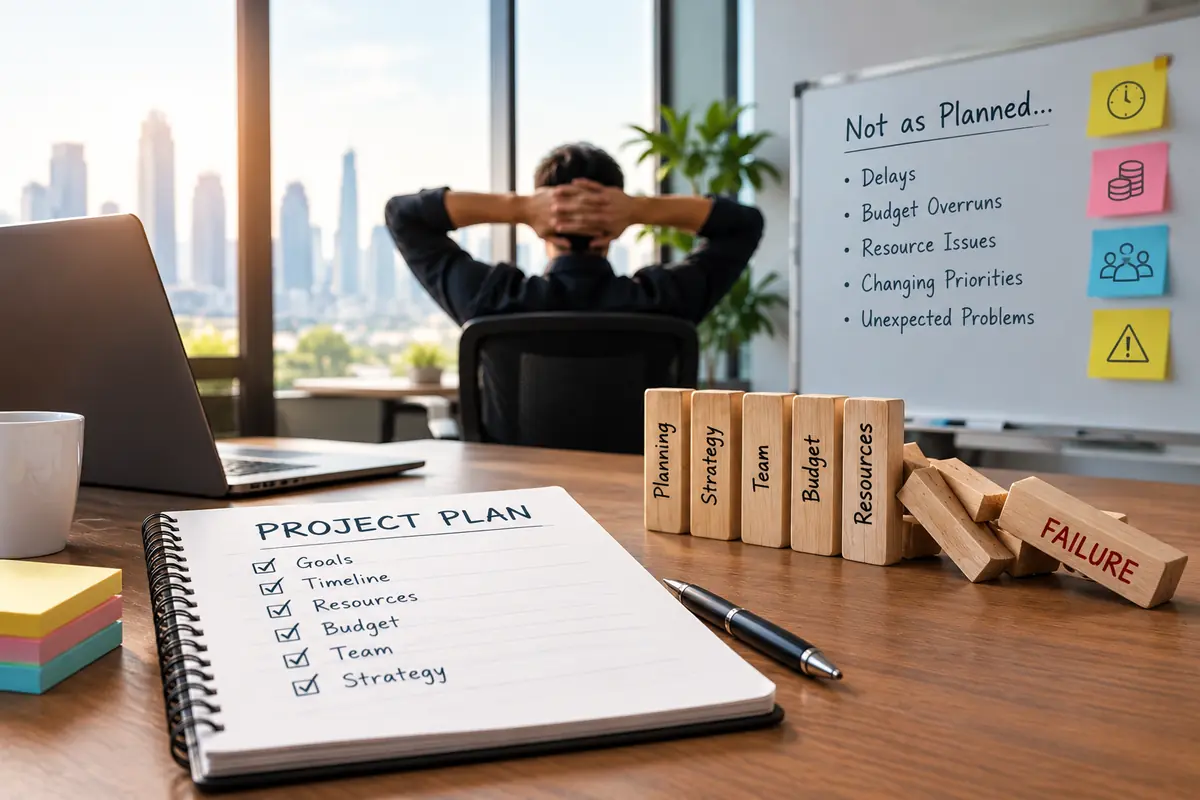
Why projects fail even when the plan is thorough, approved, and neatly formatted is one of the most uncomfortable questions in project management, because the answer is rarely a missing document. Most well-planned projects fail somewhere between the plan and the people who have to carry it out. This guide explains the gaps that open during execution, the early warning signs to watch for, and the delivery habits that help projects land as intended.
Why Projects Fail in Project Management: The Plan Is Not the Project
A plan is a snapshot of assumptions: that scope will hold, that people will be available, that stakeholders will stay aligned, and that nothing major will change. The moment work begins, those assumptions meet reality. Why projects fail in project management is therefore less about poor planning and more about treating the plan as a promise instead of a hypothesis to test every week.
Project Planning vs Execution: Where the Gap Opens
The distance between project planning vs execution shows up in a few predictable places:
Stable scope assumed: requests keep arriving, and nobody formally decides what to drop.
Resources assumed free: the same specialists are quietly promised to three projects.
Cooperation assumed: stakeholders who approved the plan in a meeting resist it in practice.
Dependencies assumed on time: vendors, approvals, and other teams slip, and delays compound.
Planning is a quiet-room activity. Execution is a negotiation with people, priorities, and pressure.
Common Project Management Failures Behind "Perfect" Plans
The common project management failures below turn up across industries:
Success never defined in business terms. The team delivers outputs nobody needed.
Optimistic estimates. Best-case timelines become commitments.
Scope drift. Small, unapproved additions accumulate until the schedule breaks.
An absent sponsor. Decisions stall because nobody with authority is engaged.
Communication gaps. Bad news travels slowly, so problems reach leaders late.
Overloaded teams. Everyone is busy, so nobody has capacity to fix problems.
None of these needs a bad plan. Each one grows inside a good plan that nobody revisits.
Why Projects Fail Even When Time and Budget Targets Are Met
Hitting the schedule and the budget is not the same as succeeding. Consider a composite illustration, not a real case: a team delivers every milestone on time and on budget, but the finished system is rarely used because the people who needed it were never consulted. By the project's own measures it succeeded. By business value it failed. This is why defining success in terms the business cares about, such as adoption, savings, or revenue, matters as much as tracking time and cost.
Project Failure Causes You Can Spot Early
Many project failure causes announce themselves weeks before the miss. Watch for:
Status reports that stay green while the team sounds worried in conversation
Decisions repeatedly deferred to the next meeting
The same issue reappearing in every review
A key stakeholder who stops attending
Rising unplanned work that nobody is tracking
Treat two or more of these appearing together as a reason to pause and reset, not to wait for the next formal report.
Project Execution Challenges and Project Implementation Challenges
The two terms overlap but are not identical. Project execution challenges concern delivering the work: resource contention, dependency delays, vendor performance, and quality slips. Project implementation challenges concern making the result stick: user adoption, resistance to change, training, and handover to operations. A team can execute well and still fail at implementation if the people who must use the outcome were never brought along. Plan for both from the start.
Project Stakeholder Management: The Quiet Failure Point
Strong project stakeholder management is often the difference between a plan that survives and one that doesn't. Stakeholders who say yes in a meeting may say no through inaction later. A few habits help: map stakeholders by influence and interest, speak with key people one-on-one before group decisions, and confirm what support actually means in practice (time, budget, decisions), not just verbal agreement.
If you are studying for the PMP, see how the exam's People domain changed in the 2026 syllabus.
Project Risk Management That Actually Gets Used
Project risk management fails when the risk register is written once and never reopened. Make it a working tool. Give every risk an owner, define a trigger that signals it is becoming real, review it weekly in the team meeting, and add new risks as information arrives. Include risks that sit between teams, because those are the ones nobody owns by default.
Project Management Best Practices, Applied With Judgment
Project management best practices such as charters, baselines, change control, and risk registers are valuable, but they work when applied with judgment, not ritual. A change process that takes three weeks to approve a small fix will simply be bypassed. Tailor the process to the project's size, risk, and pace, and keep what adds value. For the framework itself, see our overview of the PMBOK 8 framework.
Successful Project Delivery Strategies That Hold Up Under Pressure
Practical successful project delivery strategies to apply from week one:
Define success in business terms and confirm it with the sponsor.
Plan in rolling waves: detailed for the next few weeks, lighter beyond.
Name one accountable owner for every decision and deliverable.
Keep the sponsor close with short, honest updates and clear asks.
Report truthfully. Reward early warnings instead of punishing them.
Review risks and assumptions weekly, not only at phase gates.
Hold honest retrospectives and carry the lessons into the next project.
The Bottom Line
Why projects fail is rarely a mystery of missing templates. It is usually the gap between a plan built on assumptions and an execution shaped by people, change, and pressure. Teams that define success clearly, manage stakeholders actively, keep risks alive, and report truthfully close that gap far more often than teams that simply plan harder.
Frequently Asked Questions
Q1: Why do well-planned projects still fail?
Plans rest on assumptions such as stable scope, available people, and aligned stakeholders. Those assumptions change once work starts, and failure usually comes from how the changes are handled.
Q2: What is the most common reason projects fail?
No single cause fits every project, but unclear success criteria, scope drift, weak stakeholder engagement, and late-surfacing risks recur across industries.
Q3: What is the difference between execution and implementation challenges?
Execution challenges are about delivering the work. Implementation challenges are about making the delivered result adopted and sustained in the organization.
Q4: How can a project manager spot trouble early?
Watch for green status reports alongside an uneasy team, repeatedly deferred decisions, recurring issues, and growing unplanned work.
Q5: Does PMP certification prevent project failure?
It gives you a shared framework and vocabulary. Outcomes still depend on judgment, stakeholder skills, and honest reporting on real projects.
Want practical project leadership beyond the textbook? Explore PMP coaching with Visakh RJ, read real student testimonials, or browse the PMP blog for more real-world guidance.
Start Your PMP Journey — Enquire on WhatsApp →
Visakh RJ — PMP Coach · Speaker · Mindset Alchemist
📞 +91 62825 40905
📍 Mumbai, India