
What Is PMI-SP Certification? Is It Worth Pursuing After Your PMP?
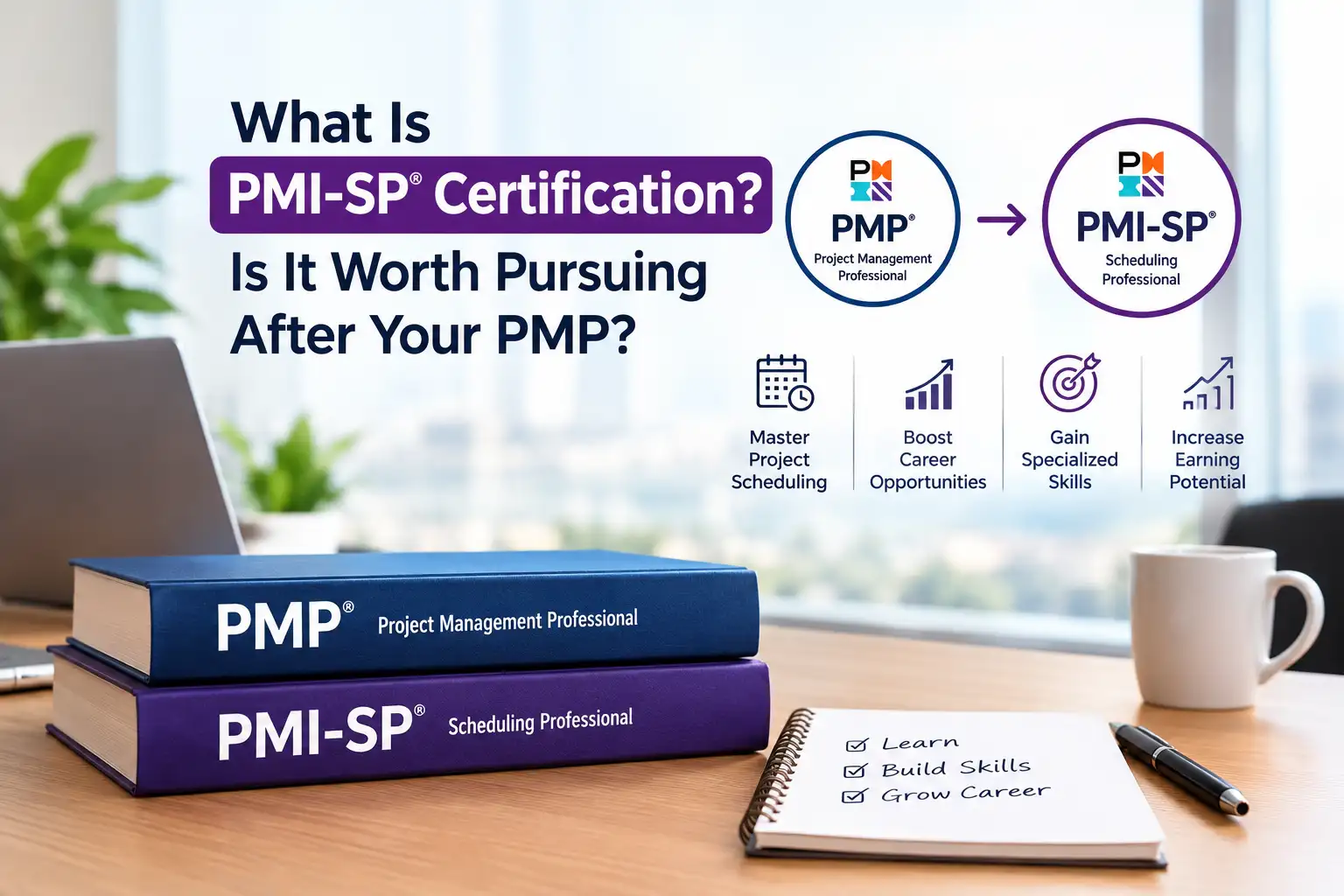
What Is PMI-SP Certification, and does it make sense once you already hold the PMP? It is a specialist credential for professionals who build, analyse and control project schedules.
Many PMP holders reach a point where general management skills are not enough. Planning engineers and project controls teams in Doha's construction and infrastructure sectors need deeper scheduling expertise. This guide explains the credential, its benefits and who should pursue it. If you are still building your PMP foundation, start at the Visakh RJ home page.
What Is PMI-SP Certification? A Clear Definition
The PMI Scheduling Professional credential is issued by the Project Management Institute (PMI). It validates your ability to develop, manage and maintain project schedules. In short, it is a Project Scheduling Professional Certification built for specialists rather than generalists.
The exam covers five domains, including schedule strategy, planning, monitoring and controlling. It is not an entry-level credential, because PMI expects real scheduling experience before you apply.
Holders keep the credential by earning 30 professional development units (PDUs) in each three-year cycle.
Who Should Consider PMI-SP Certification?
This Project Scheduling Certification suits professionals who work with schedules every day. Typical candidates include:
Planning engineers and project schedulers
Project controls specialists
Construction and infrastructure professionals
Engineers moving into planning roles
PMP holders who want a scheduling specialty
If scheduling is only a small part of your job, the credential may be too narrow. However, if you build baselines, run critical path analysis and report variance, it fits well.
PMP vs PMI-SP: Key Differences
PMP vs PMI-SP is the most common question we see. The two credentials solve different problems.
PMP (Project Management Professional)
Focus: whole-project management
Audience: project managers
Scope: people, process and business environment
Best for: leadership roles
PMI-SP (PMI Scheduling Professional)
Focus: scheduling specialty
Audience: schedulers and planners
Scope: schedule modelling and control
Best for: technical planning roles
In simple terms, the PMP shows you can run a project. The PMI-SP shows you can build and defend the schedule that drives it. Because of this, the two work well together rather than competing.
Risk specialists face a similar choice. Our breakdown of PMI-RMP vs PMP shows how a second PMI credential can complement the PMP.
PMI-SP After PMP: Does It Make Sense?
PMI-SP After PMP is a popular path, and it often pays off for the right profile. The PMP gives you the management foundation. The PMI-SP then adds deep Project Planning and Scheduling skill.
It makes sense when:
You lead or support large projects with complex schedules.
You want to move into planning, controls or PMO roles.
Your employer bids on contracts that value scheduling expertise.
You want a clear specialty beyond the PMP.
It makes less sense when you mostly manage people and stakeholders. In that case, a leadership or agile credential may add more value.
To refresh the scheduling basics first, read the PMP schedule management guide. It covers critical path method and schedule compression, which are also core PMI-SP skills.
PMI-SP Certification Benefits
Understanding PMI-SP Certification Benefits helps you judge the return on your time and exam fee. The main advantages are:
Specialist credibility: it proves advanced scheduling knowledge, not just general management.
Stronger technical skill: preparation sharpens critical path, resource and schedule risk techniques.
Differentiation: fewer professionals hold it than the PMP, so it stands out.
Better collaboration: you speak the same language as planners, cost engineers and controls teams.
Global recognition: PMI credentials travel across markets and employers.
If you are still asking what is PMI-SP certification worth in daily practice, the answer is simple: it turns scheduling from a task into a recognised specialty.
PMI-SP Career Opportunities
PMI-SP Career Opportunities are strongest in industries where schedules drive cost and risk. That includes construction, oil and gas, utilities, rail and large real-estate developments across the Gulf.
Common roles include:
Senior planning engineer
Project scheduler or lead scheduler
Project controls manager
Schedule risk analyst
PMO planning lead
Claims and delay analysis specialist
Salary and promotion outcomes depend on your employer, region and experience. Therefore, treat the credential as a strong differentiator rather than a guarantee.
PMI-SP Certification in Doha, Qatar: Why It Matters
Qatar's construction, energy and infrastructure sectors run on tightly controlled schedules. Contractors and consultants in Doha often look for planners who can defend a baseline and prove delay claims.
Professionals asking What Is PMI-SP Certification in this market are usually planning engineers, schedulers and project controls leads. For them, the credential signals a level of depth that general certifications do not.
Project Controls Certification for Professionals: Where PMI-SP Fits
Many professionals compare options before committing. A Project Controls Certification for Professionals can cover cost, schedule, risk and reporting together. The PMI-SP is narrower and goes deeper on scheduling.
Choose PMI-SP if schedule development and analysis are your core work. Choose a broader controls credential if you handle cost control, earned value and reporting equally. Some professionals eventually hold both.
How to Prepare for the Exam
Preparation is easier when you follow a plan:
Check eligibility on PMI's website. Requirements are based on scheduling experience and education, and PMI can update them.
Download the exam content outline. It shows the domains and tasks you will be tested on.
Revisit What Is PMI-SP Certification on PMI's official page. Confirm the current eligibility sets and audit documents.
Revise scheduling fundamentals. Cover network logic, critical path, float, resource levelling and schedule compression.
Practise with software you know. Many planners use Primavera P6 or Microsoft Project.
Take timed practice exams. This builds speed and exposes weak domains.
Is PMI-SP Worth Pursuing? A Quick Decision Guide
Ask yourself these questions:
Do I spend most of my week on schedules?
Does my employer or target employer value scheduling expertise?
Do I want a specialist path rather than a leadership path?
Can I commit to the study time and exam fee?
Once you understand What Is PMI-SP Certification and what it demands, these answers make the decision easier. If you said yes to most, it is likely worth it. If not, wait until your role leans further into planning.
Frequently Asked Questions
What Is PMI-SP Certification used for?
It validates advanced skill in building, analysing and controlling project schedules. Employers use it to identify trusted scheduling specialists.
Is PMI-SP harder than the PMP?
They test different skills. The PMP is broader, while the PMI-SP is more technical and scheduling-focused.
Can I take PMI-SP without the PMP?
Yes. The PMP is not required. PMI sets separate eligibility rules based on scheduling experience and education.
How long does the credential last?
You must earn 30 PDUs in every three-year cycle to keep it active.
Is PMI-SP worth it in Qatar?
It can be, especially in construction, energy and infrastructure, where scheduling skill is in high demand.
Final Thoughts
The PMI-SP is a strong next step for PMP holders who want technical depth. Weigh your role, your industry and your goals before committing. If you want a trusted explanation of What Is PMI-SP Certification before you invest, start with the PMP foundation and build from there. For that, see our guide on what PMP certification is and how to get it.
About the Author
Visakh RJ is a PMP coach with 15+ years of industry experience and 10,000+ professionals mentored. He was named "The PMP Production Machine" by PMP co-founder Lee R. Lambert.
Ready to Advance Your Project Career?
Get personal guidance on What Is PMI-SP Certification, PMP and your next credential.
🔥 Chat With Visakh RJ on WhatsApp
Address: Visakh RJ, Mumbai, India