
PMI-RMP vs PMP: Do You Need Both as a Risk-Focused Project Manager?
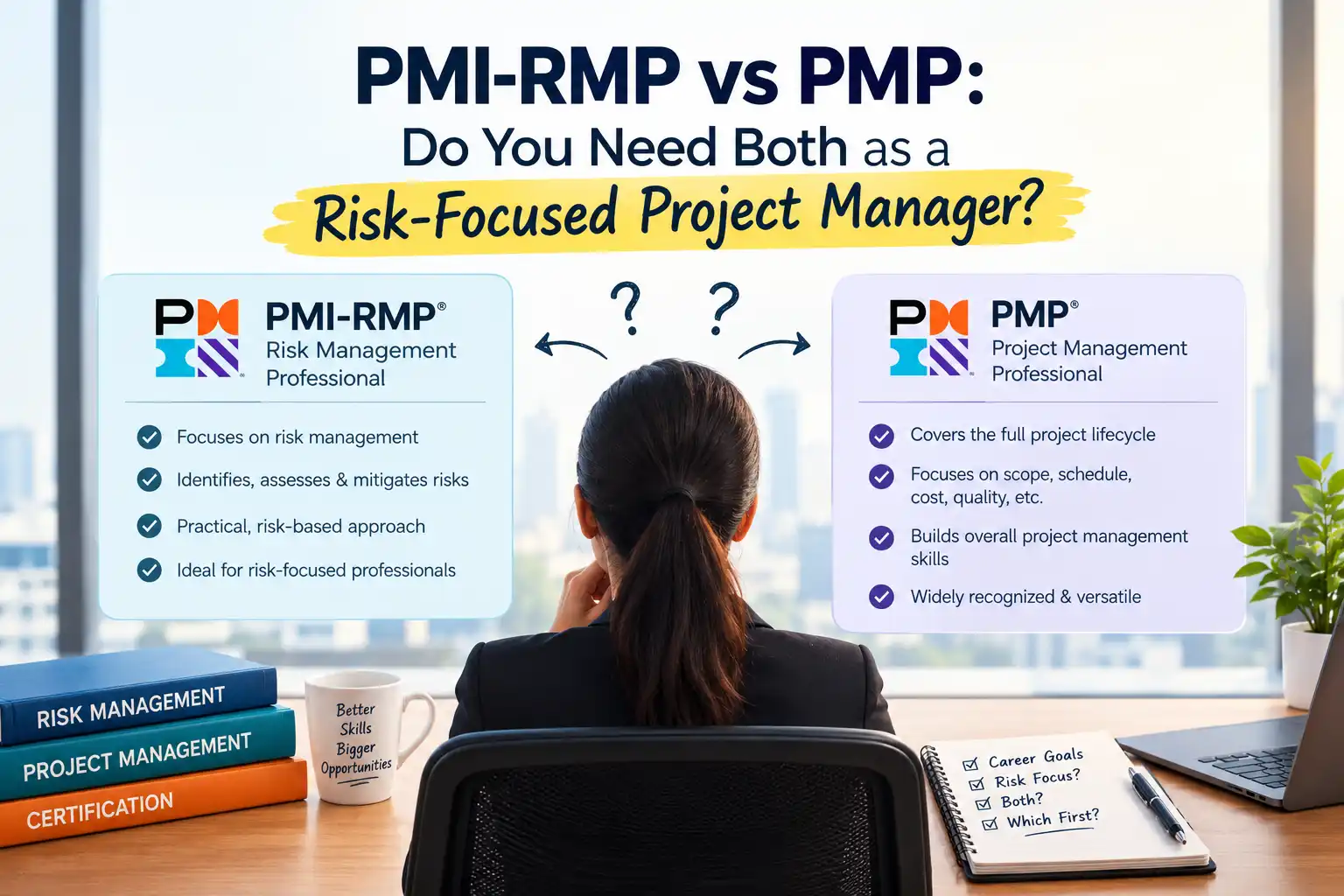
PMI-RMP vs PMP is the question many risk-focused project managers ask once they realize both credentials cover risk, but at very different depth. The short answer: PMP shows you can lead whole projects, PMI-RMP shows you can specialize in risk, and whether you need both depends on where your career is heading.
I coach PMP candidates, so I'll be upfront about my perspective. This guide compares the two fairly. For fees and eligibility details, always confirm the latest information on pmi.org before applying.
PMI-RMP vs PMP at a Glance
Here is the quick comparison before we go deeper:
PMP: a broad project leadership credential covering people, process, and business environment
PMI-RMP: a specialist credential for professionals whose main focus is project risk
Exam length: the PMP exam runs 180 questions over 230 minutes in the 2026 format, while the PMI-RMP exam has 115 questions and runs 150 minutes
Prerequisite: you do not need a PMP before earning the PMI-RMP
What the PMP Certification Covers
The PMP certification validates your ability to lead a project from start to finish across predictive, agile, and hybrid approaches. The 2026 exam is organized around three domains: People, Process, and Business Environment. Risk appears as one topic among many, not as the main subject.
You can read more in our guide to what PMP certification involves for Indian professionals.
PMP Certification Benefits
The main PMP certification benefits are breadth and recognition. It opens doors to project, program, and PMO roles across industries, it is widely understood by employers in India and abroad, and it gives you a common language for leading teams and stakeholders.
What the PMI-RMP Certification Covers
The PMI-RMP certification is PMI's specialist credential for risk practitioners. PMI positions it as a specialist credential that treats risk in far more detail than the PMP does, covering the risk lifecycle from strategy and planning through identification, analysis, response, and monitoring. It is a strong project risk management certification for people who spend most of their working time on risk.
PMI-RMP Certification Benefits
The main PMI-RMP certification benefits are depth and credibility in risk-heavy roles. It tends to carry the most weight in sectors where project volatility is high, including construction, IT, finance, and energy. As a risk management professional certification, it signals that you can do more than maintain a risk register. Skills like presenting risk clearly matter just as much, as covered in our post on translating risk registers into real client meetings.
PMI-RMP vs PMP Certification: Key Differences
Scope and Depth
PMP is wide. PMI-RMP is deep. A PMP holder can manage the whole project, while a PMI-RMP holder is trained to run the risk process in detail, including analysis and response planning.
Exam Format
The PMP exam is longer and covers more topics. The PMI-RMP exam is shorter but focused entirely on risk, so questions go further into risk analysis and response decisions.
Eligibility
Both credentials require education and experience, and PMI offers more than one eligibility route for each. Requirements can change, so check the current handbook on pmi.org.
Cost and Renewal
Fees are set in US dollars and change from time to time. One 2026 guide lists the PMI-RMP exam at $520 for PMI members and $670 for nonmembers. For renewal, the PMI-RMP requires 30 PDUs in each three-year cycle. PMI lists 60 PDUs per three-year cycle for the PMP. Confirm all figures on pmi.org.
PMP vs Risk Management Certification: Which Fits Your Role?
The PMI-RMP vs PMP choice starts with your daily work, not with which credential sounds more advanced. Ask what you spend most of your time doing:
Leading projects end to end: PMP fits best
Running risk analysis for several projects or a portfolio: PMI-RMP fits best
Doing both in a risk-heavy industry: the two may complement each other over time
A PMP vs risk management certification comparison is really a question about job design. Credentials follow the work you do.
Do You Need Both? PMI-RMP vs PMP Is Not Always Either-Or
Not at the same time, and often not at all. Most professionals sequence them. In the PMI-RMP vs PMP debate, timing matters more than choosing one winner:
PMP first if you lead projects and want broad career options
PMI-RMP first if you are already in a dedicated risk role, since no PMP is required
Both if risk is central to your career and you also want to lead projects
If you are still early in your career, PMP is usually the more flexible starting point. You can add PMI-RMP later when risk becomes your focus. Our guide on PMP vs PRINCE2 vs PSM shows how to compare certifications against your goals.
PMI-RMP and PMP Career Opportunities
How the PMI-RMP vs PMP choice shapes your career depends on the roles you want.
PMP-aligned roles: project manager, program manager, PMO lead, delivery manager
PMI-RMP-aligned roles: project risk manager, risk analyst, PMO risk lead, risk lead on construction, infrastructure, or financial projects
Both combined: senior program roles where you own delivery and risk together
PMI-RMP and PMP career opportunities overlap in senior roles, where employers want leaders who can deliver and also anticipate what could go wrong. I'd avoid choosing based on salary claims you see online, since figures vary widely by industry and city.
Best Certification for Risk Management Professionals
There is no single best certification for risk management professionals. For project risk specifically, PMI-RMP is PMI's dedicated credential. Other frameworks also exist, such as the PRINCE2 Risk Management Practitioner and M_o_R Practitioner, which suit different organizational contexts. The PMI-RMP vs PMP decision is about depth versus breadth, so pick the one that matches the work you do and the employers you target.
A Practical PMI-RMP vs PMP Decision Path
Use these questions to decide:
What is my current role, and what will it be in two years?
Do I lead whole projects, or mainly manage risk?
Which employers or industries am I targeting?
Do I meet the eligibility requirements for each credential today?
Which one will I use immediately, not just list on a CV?
If you answer "leading projects" to the first two, start with PMP. If you answer "risk specialist," look seriously at PMI-RMP.
Common Mistakes in the Decision
Assuming PMI-RMP replaces PMP. They serve different purposes.
Assuming PMP is required first. For PMI-RMP, it is not.
Trying both at once. Studying for two exams together often dilutes results.
Ignoring documentation. Experience hours must be recorded clearly for either application.
Choosing by hype. The PMI-RMP vs PMP question is best answered by your role, not by social media debates.
Final Word on PMI-RMP vs PMP
PMP gives you breadth, PMI-RMP gives you depth, and the right choice depends on your role, your industry, and your timeline. If you are unsure, start with the credential that matches your current work.
If you are leaning toward PMP, I can help you build a realistic plan around it. Explore my coaching at rjvisakh.com.
FAQs
What is the main difference between the two certifications?
PMP covers leading whole projects, while PMI-RMP focuses specifically on project risk management in greater depth.
Do I need a PMP to take the PMI-RMP?
No. A PMP is not required before applying for the PMI-RMP, though you must meet the PMI-RMP's own eligibility requirements.
Which is better for a risk-focused project manager?
It depends on your role. If you lead projects, PMP is usually more flexible. If you specialize in risk, PMI-RMP is the more targeted choice.
Should I get both certifications?
Many professionals sequence them, usually PMP first and PMI-RMP later, but you don't need both if one fits your career goals.
Where do I confirm current fees and eligibility?
On pmi.org, since fees and requirements can change.
Not sure which certification fits your career? Talk to Visakh RJ →
Visakh RJ | PMP Coach · Speaker · Mindset Alchemist
📍 Mumbai, India | 📞 +91 62825 40905