
Decision Ownership in Project Management: The Silent Project Killer
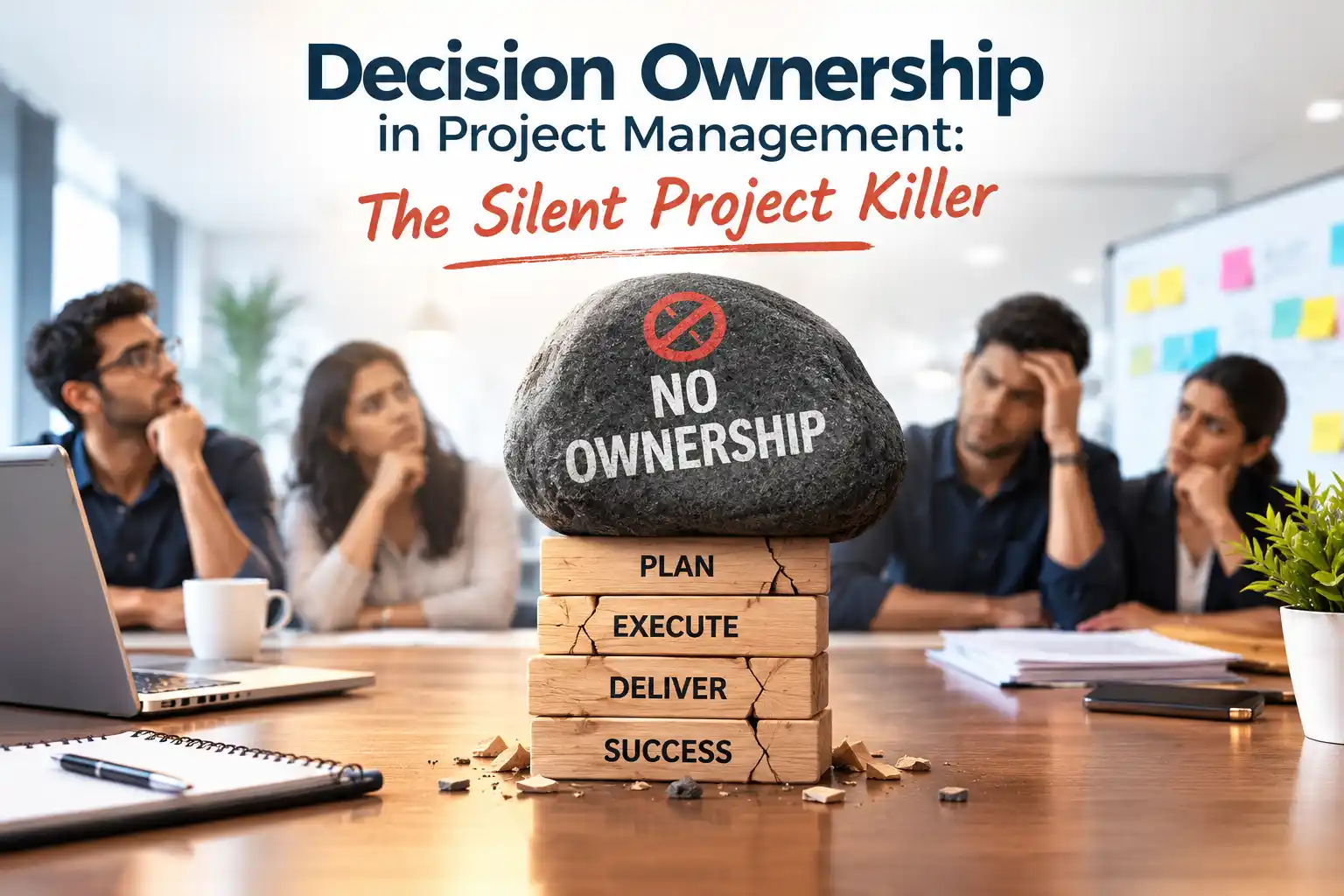
Decision ownership in project management rarely appears on a risk register, yet unclear ownership of decisions quietly stalls projects that look perfectly healthy on paper. Work slows, the same questions return meeting after meeting, and everyone assumes someone else is deciding. This guide explains how unclear ownership shows up, why it causes delays and rework, and the practical steps that help teams assign, record, and protect decisions.
Why Decision Ownership in Project Management Is a Silent Killer
Most project problems announce themselves: a missed milestone, a budget overrun, a failed test. Unclear ownership does not. Nothing visibly breaks. Decisions simply wait.
Picture a design question that sits unresolved for two weeks because the technical lead assumes the sponsor will decide, and the sponsor assumes the technical lead already did. Clear ownership removes that gap by making one person responsible for each decision and answerable for its outcome. Without it, the cost arrives later as rework, missed dates, and blame.
What Unclear Ownership Looks Like in Practice
Watch for these signs:
The same decision is revisited in several meetings.
Meetings end with "let's align offline," and nobody follows up.
Small calls are escalated to the sponsor because nobody feels authorized.
Two leaders give the team conflicting direction.
After a problem, the question is "who approved this?" and nobody knows.
Team members wait for permission instead of acting.
If three or more sound familiar, the project probably has an ownership problem, not a people problem.
Decision-Making Accountability vs Decision Rights
Decision-making accountability is about who answers for the outcome of a decision. Decision rights in project management are about who has the authority to make it. The two are related but not identical, and projects often define one without the other. A project manager may be accountable for the schedule yet lack the authority to approve a scope trade-off.
Make sure the person accountable for an outcome also holds the right to decide, or has a clear path to the person who does. It also helps to separate four roles in every decision: who gives input, who recommends, who decides, and who is informed.
Clear Roles and Responsibilities in Projects
Clear roles and responsibilities in projects start by naming the decisions that recur: scope changes, budget and funding, schedule trade-offs, technical design, quality and acceptance, vendor choices, and release go/no-go. For each category, record who decides, who must be consulted, and who is informed. A short decision map might look like this (illustrative only):
Scope change: the sponsor decides, the project manager recommends, the business lead is consulted.
Technical design: the technical lead decides, the project manager is informed.
Release go/no-go: the product owner decides, the project manager and QA lead are consulted.
A one-page map like this is often more useful than a long governance document nobody reads.
RACI Matrix in Project Management: A Practical Use
The RACI matrix in project management assigns each activity or decision to people who are Responsible, Accountable, Consulted, or Informed. Many practitioners recommend a single Accountable person per task or deliverable, so there is always one clear owner. The accountable person can delegate the doing, but not the ownership of the outcome.
A few habits keep RACI useful:
Apply it to decisions as well as tasks.
Use it for the 10–30 decisions or deliverables that matter most. Applied to every micro-decision, it turns into bureaucracy.
Keep the Consulted list short. Every extra name adds waiting time.
Avoid multiple Accountable roles. Shared accountability usually means no accountability.
Variants such as RACI+F or RACI-VSL add facilitation or verification roles when a project needs them.
Project Decision-Making Delays: The Cost of Waiting
Project decision-making delays are expensive because they rarely look like delays. Teams stay busy on other work while a critical question waits, then discover weeks later that the answer was needed on the critical path.
Common triggers include approvals routed to too many people, endless consultation without a deadline, and escalation loops where each level sends the question back down. Set a decision deadline for every open question, and give overdue decisions the same visibility as overdue tasks. Naming one owner per decision removes most of these delays before they start.
Project Management Communication Gaps That Hide Ownership Problems
Many project management communication gaps are really ownership gaps. A decision is made in a meeting, but nobody confirms who communicates it, so half the team never hears it. People assume agreement because nobody objected, and in distributed teams the gap widens.
A simple rule helps: record every significant decision in a shared log within 24 hours. A useful entry has five fields: the decision, the owner, the date, the reason, and who was informed. That one habit turns a vague intention into a visible record anyone can check.
Project Governance Best Practices for Decision Ownership
Project governance best practices put decision-making on a clear footing. A widely cited principle is a single point of accountability for the project's success, with clear delegation limits below it. Define what the project manager can approve alone, what needs the sponsor, and what needs a steering group. Agree escalation timelines so a stuck decision moves up in days, not weeks.
Treat decision ownership in project management as a governance matter as much as a team habit. PMBOK 8 lists governance, including decision rights, among its performance domains; see our overview of the PMBOK 8 framework.
Building Project Accountability: A Seven-Step Fix
Improving project accountability does not need heavy process. Try this project decision-making process from your next planning session:
List the recurring decisions the project will face.
Name one accountable owner for each.
Identify who must be consulted, and keep that list short.
Set a decision deadline and an escalation path.
Record each decision in a shared log with owner, date, and rationale.
Communicate it to everyone affected.
Review the log weekly and revisit unresolved items.
Teams that follow a routine like this make ownership part of how the project runs, not a special effort.
The Bottom Line
Unclear ownership is a silent killer because it hides inside healthy-looking status reports. Decision ownership in project management becomes strong when each decision has one named owner, a deadline, and a written record. Clarify decision rights, keep consultation short, and make decisions visible, and delays, rework, and blame all shrink.
Frequently Asked Questions
Q1: What does decision ownership mean on a project?
It means naming one person who is accountable for making each decision and answering for its outcome, with others consulted or informed.
Q2: How is decision ownership different from a RACI matrix?
Decision ownership is the principle, and RACI is a tool for recording it. RACI helps most when you use it for decisions as well as tasks.
Q3: Who should own project decisions?
It depends on the decision type. Day-to-day schedule calls often sit with the project manager, budget or scope trade-offs with the sponsor, and technical design with the technical lead. Agree this per project, in advance.
Q4: How do I fix unclear ownership on a project already underway?
List the decisions currently stuck, assign an owner and a deadline to each, record them in a shared log, and tell the whole team who owns what.
Q5: Can a decision have more than one accountable owner?
Many practitioners recommend a single accountable owner per decision, because shared accountability tends to slow decisions and blur responsibility.
Want real-world project leadership beyond the textbook? Explore PMP coaching with Visakh RJ, read real student testimonials, or browse the PMP blog for more practical guidance.
Start Your PMP Journey — Enquire on WhatsApp →
Visakh RJ — PMP Coach · Speaker · Mindset Alchemist
📞 +91 62825 40905
📍 Mumbai, India