
What the Expanded 26% Business Environment Domain Now Covers
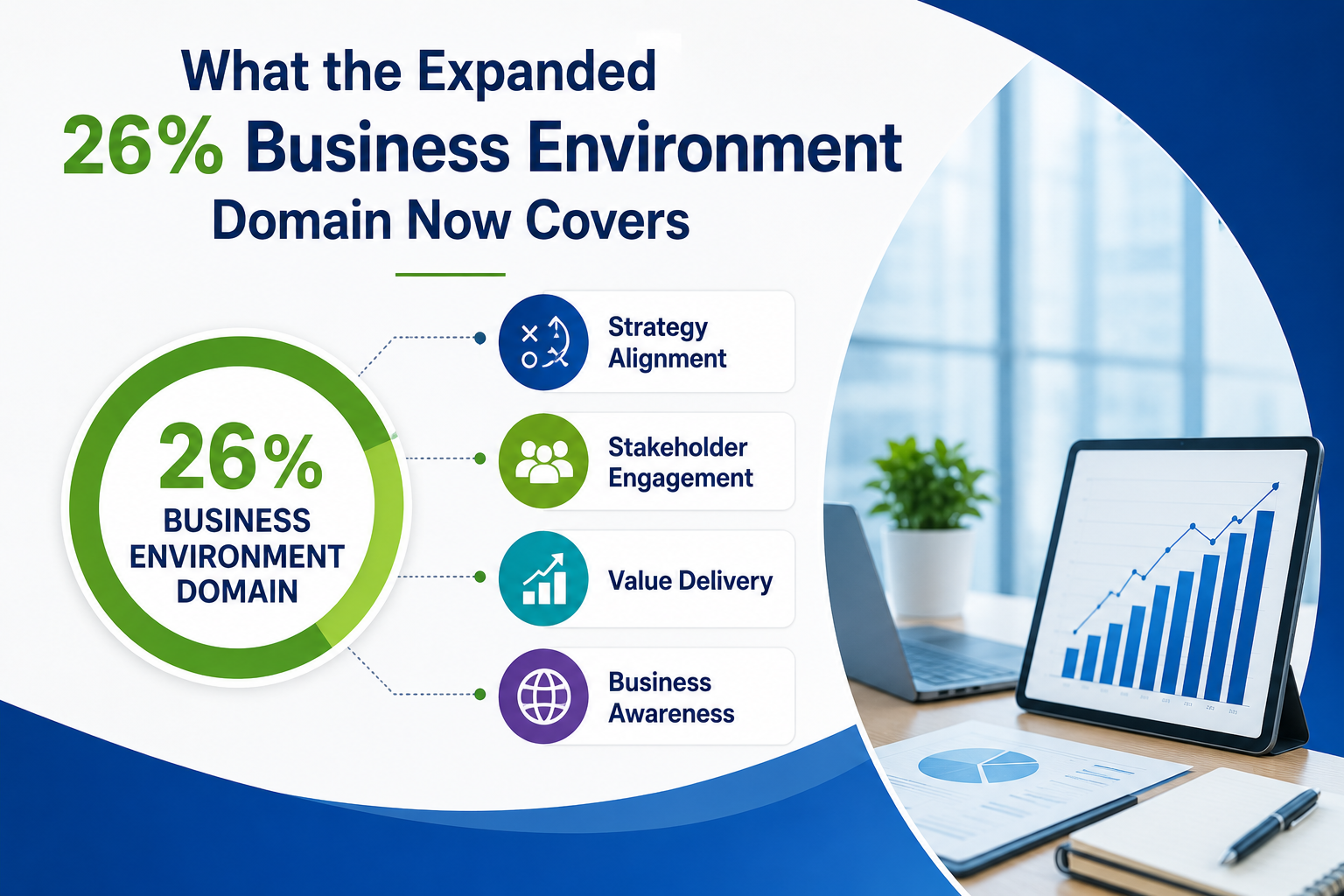
Of everything that changed in the 2026 PMP exam, nothing moved as dramatically as this: the Expanded 26% Business Environment Domain, up from just 8% in 2021. That's not a tweak — it's PMI declaring that an entire category of skills candidates could previously skim over is now nearly a quarter of the exam.
If you're studying with older materials, or even a 2021-era mental checklist of "Business Environment is the small one," you're preparing for the wrong exam.
This guide breaks down exactly what content now lives inside this domain, why each piece was added, and how to actually study for it without wasting time.
PMP Business Environment 8 to 26 Percent: Understanding the Scale of Change
Before diving into content, it's worth sitting with the sheer scale of this shift. The jump in PMP Business Environment 8 to 26 percent weighting represents more than a tripling of exam representation — a change unlike anything else across the three domains.
Why This Number Matters So Much
At 8%, Business Environment was almost an afterthought — a handful of questions candidates could deprioritize
At 26%, it now approaches People's 33% weighting, making it a genuinely major study focus
This single domain absorbed nearly all the redistribution from both People and Process combined
For the complete comparison across all three domains, our guide on the 2026 PMP ECO domain reweighting shows exactly how this fits alongside the People and Process percentage shifts.
PMP Business Environment Domain 2026: The Core Definition
Understanding the PMP Business Environment domain 2026 structure starts with a simple reframing: this domain is about how your project connects to the organization and world around it, not the mechanics of running the project itself.
The Domain's Central Focus
How projects align with organizational strategy and business value
How compliance, governance, and external factors shape project decisions
How project managers support organizational change beyond the project's immediate scope
If People is about your team and Process is about your work, Business Environment is about your company and the broader context your project operates within.
What Is Covered in Business Environment Domain: The Complete Topic List
Here's the direct answer to what is covered in Business Environment domain content for 2026, organized by theme.
Full Topic Coverage
Project compliance and regulatory requirements
Sustainability and ESG considerations
Organizational governance structures and decision-making authority
Organizational change management and impact assessment
External environment factors (market, regulatory, technological shifts)
Benefits realization and business value delivery
AI and emerging technology considerations in project decision-making
Each of these represents genuinely testable exam content, not background context — candidates need working familiarity with all seven areas.
PMP Business Environment Domain Tasks: Breaking Down the Official Structure
Moving from topics to PMI's official structure, understanding PMP Business Environment domain tasks helps map exactly what the ECO expects you to demonstrate.
Core Tasks Within This Domain
Manage compliance requirements — evaluating internal and external compliance needs and their impact on the project
Evaluate and deliver project benefits and value — ensuring the project's outcomes align with intended business value
Evaluate and address external business environment changes — assessing how market or regulatory shifts affect the project
Support organizational change — assisting the organization in adopting new processes, tools, or ways of working
Each task carries specific enablers (sub-skills) that translate into actual exam scenarios — understanding the task names alone isn't sufficient preparation.
PMI Governance and Compliance Domain: The Foundational Pillar
Among all the new content, PMI governance and compliance domain material forms perhaps the most heavily tested foundation within Business Environment.
What Governance and Compliance Coverage Includes
Understanding organizational governance frameworks and decision-making hierarchies
Identifying applicable regulatory and legal compliance requirements for a project
Assessing the impact of compliance failures or changes on project scope and timeline
Establishing appropriate governance structures for project oversight
Candidates should expect scenario-based questions asking them to identify governance gaps or determine appropriate escalation paths within an organizational structure.
PMP Sustainability Topics Explained: Why ESG Made the Exam
One of the most genuinely new inclusions, PMP sustainability topics explained simply: environmental, social, and governance (ESG) considerations are now directly testable content, not a peripheral mention.
What Sustainability Coverage Involves
Understanding how environmental impact considerations factor into project decisions
Recognizing social responsibility factors relevant to project stakeholders and communities
Evaluating how sustainability requirements intersect with quality and compliance management
Balancing sustainability goals against traditional project constraints (time, cost, scope)
This inclusion reflects how thoroughly ESG accountability has become a standard business expectation across industries, not a niche specialization.
PMP AI Ethics Exam Topics: Understanding the New Technology Focus
Alongside sustainability, PMP AI ethics exam topics represent the exam's acknowledgment that AI now genuinely influences how projects are planned and executed.
What AI-Related Content Covers
How AI tools affect estimation, planning, and reporting processes
Ethical considerations in AI-assisted project decision-making
Recognizing appropriate and inappropriate uses of AI within project governance
Understanding AI's role as a support tool rather than a replacement for project judgment
Importantly, this content doesn't require deep technical AI expertise — it tests your understanding of how AI fits into modern project management practice and where ethical considerations arise.
PMP Organizational Change Domain: Supporting Transformation
A significant portion of Business Environment content addresses the PMP organizational change domain, reflecting how frequently projects now intersect with broader organizational transformation efforts.
What This Coverage Includes
Assessing organizational readiness for change resulting from project outcomes
Identifying resistance points and stakeholder concerns during change implementation
Supporting change management processes alongside project delivery
Evaluating the broader organizational impact of project-driven change
Project managers are increasingly expected to think beyond their project's immediate deliverables toward how those deliverables reshape the organization itself.
PMP External Environment Factors: Looking Beyond the Project
Rounding out the domain, PMP external environment factors coverage tests your ability to recognize and respond to conditions outside the project's direct control.
Key External Factors Covered
Regulatory and legal environment shifts affecting project scope or compliance
Market conditions influencing project priorities or resource availability
Technological changes that may affect project approach or tools
Competitive or industry trends relevant to project strategic alignment
This content tests whether candidates can identify when external shifts require project adjustments, rather than assuming a project operates in isolation from its broader environment.
PMI ESG Project Management Exam: Connecting the Dots
Bringing sustainability and governance together, understanding the PMI ESG project management exam content as an integrated theme — rather than isolated topics — helps clarify how these questions actually appear on test day.
Expect scenario-based questions combining multiple Business Environment elements simultaneously: a project facing a new regulatory requirement (compliance) that also has sustainability implications (ESG) requiring you to assess organizational impact (change management) — all within a single question set.
PMP Business Environment Domain Examples: What Exam Questions Actually Look Like
To make this concrete, here are representative PMP Business Environment domain examples reflecting the type of scenarios you'll encounter.
Sample Scenario Themes
A project manager discovers a new compliance requirement mid-project and must determine the appropriate response
A project's outcome will require significant organizational process changes, and the PM must assess change readiness
A shift in market conditions requires reassessing project priorities against original business case assumptions
A sustainability requirement conflicts with the original project timeline, requiring a value-based trade-off decision
These scenarios test applied judgment, not memorized definitions — exactly the shift PMI intended with this reweighting.
PMP Exam Governance Compliance Topics: A Study Checklist
Bringing governance and compliance content into a practical study format, here's a focused PMP exam governance compliance topics checklist.
Governance and Compliance Study Priorities
Understand common organizational governance structures (functional, matrix, projectized)
Practice identifying appropriate escalation paths for governance issues
Review how compliance requirements typically intersect with quality management
Study how to assess and communicate the impact of compliance changes on project scope
Treating this as its own focused study block, rather than folding it loosely into general Business Environment review, produces better exam readiness.
PMP Business Environment Domain Weightage: Translating Percentage Into Study Hours
Understanding the PMP Business Environment domain weightage at 26% is only useful once translated into actual study time allocation.
Recommended Study Time Approach
Don't cap Business Environment study time at exactly 26% of your total hours
Because this content is newest and least familiar to most candidates, many trainers recommend allocating 30%+ of total study time here
Prioritize scenario-based practice specifically for this domain, since applied judgment questions dominate here more than simple recall
Under-allocating study time to match the raw percentage is one of the most common mistakes candidates make with this particular domain.
PMP Business Environment Study Guide: A Practical Weekly Plan
Bringing everything together into an actionable PMP Business Environment study guide, here's a realistic approach for covering this expanded domain.
Suggested Study Sequence
Week 1: Governance structures and compliance fundamentals
Week 2: Sustainability and ESG considerations in project contexts
Week 3: AI's role in project decision-making and associated ethical considerations
Week 4: Organizational change management and external environment factors
Week 5: Integrated scenario-based practice combining multiple Business Environment elements
This sequencing builds foundational understanding first, then layers in the more integrated, multi-topic scenarios the actual exam favors.
For hands-on practice specifically calibrated to this domain's new weighting, our PMP 2026 mock exam questions with ECO-aligned scenario-based practice gives realistic exposure to how these questions actually appear.
Why This Expansion Happened: Connecting Back to PMI's Research
Understanding this domain's content is more meaningful when connected to why PMI expanded it so dramatically in the first place. Our article on why PMI rewrote the PMP syllabus for 2026 covers the underlying Job Task Analysis research driving this specific expansion, while our breakdown of why the Process domain fell to 41% explains the redistribution from the other side of this equation.
Frequently Asked Questions
1. Why did Business Environment increase so much more than any other domain change?
PMI's research found this domain had been severely underrepresented relative to how much project managers actually engage with governance, compliance, and strategic alignment in real practice.
2. Do I need deep AI technical knowledge for the AI-related exam content?
No, the exam tests your understanding of how AI fits into project decision-making and associated ethical considerations, not technical AI development skills.
3. Is sustainability content only relevant for certain industries?
No, sustainability and ESG considerations are tested as general project management competencies applicable across industries, not industry-specific technical knowledge.
4. How much study time should I dedicate to Business Environment specifically?
Many trainers recommend allocating 30% or more of total study time here, exceeding its 26% exam weighting, since this content is newest and least familiar to most candidates.
5. What's the best way to practice for this domain's scenario-based questions?
Focus on integrated scenarios combining multiple Business Environment elements (compliance, sustainability, change management) rather than studying each topic in complete isolation.
Final Thoughts
The expanded 26% Business Environment domain represents the single biggest content shift in the 2026 PMP exam — covering governance, compliance, sustainability, AI, and organizational change in genuine depth. Understanding exactly what's now tested, and allocating study time accordingly, gives you a real advantage over candidates still studying with outdated assumptions.
Ready to build a study plan that properly covers this expanded domain? Visit our PMP coaching program page for structured training designed around the 2026 ECO, or visit the RJ Visakh to explore all our PMP resources.
A.