
What Changed When a Team Adopted PMBOK's Value-Delivery Principle
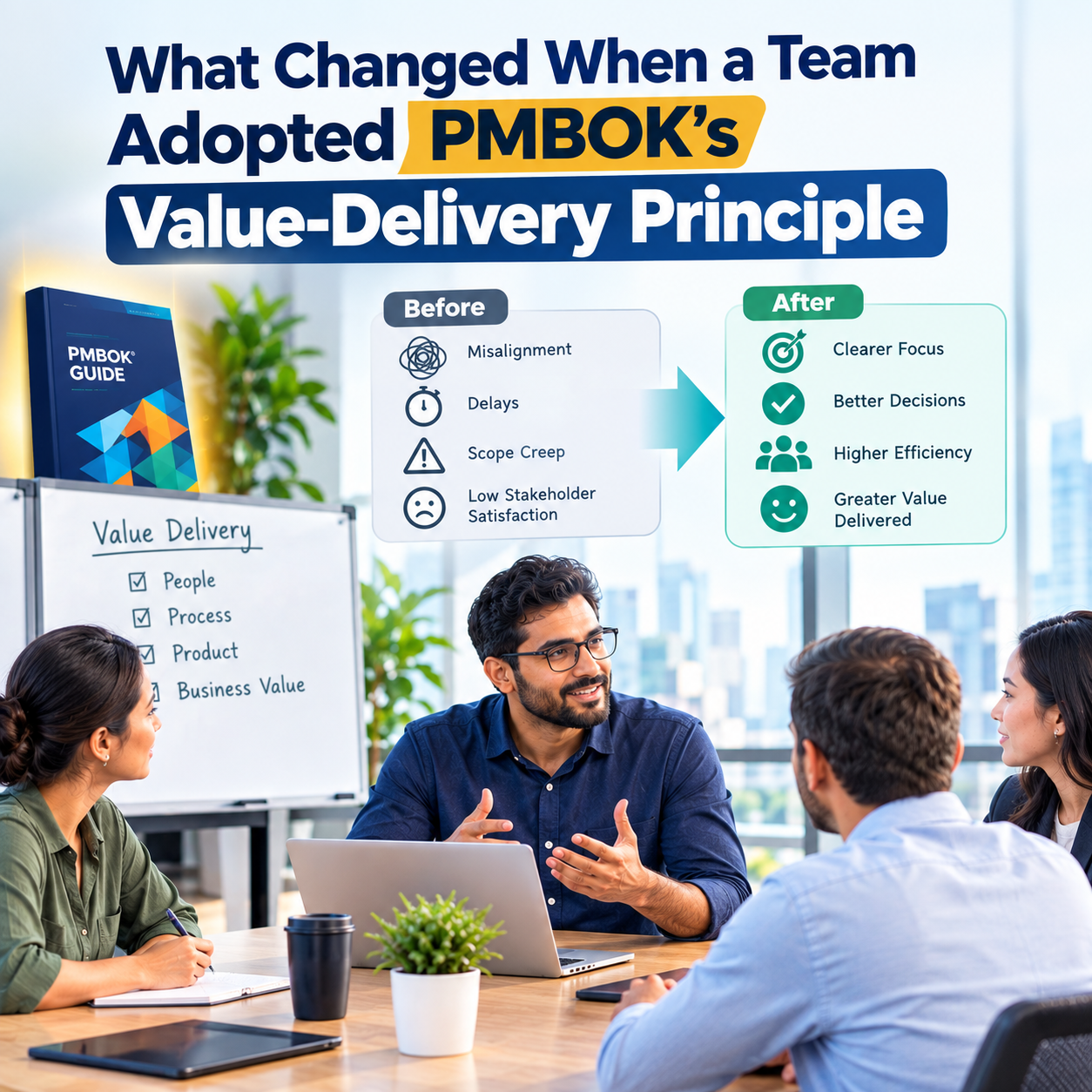
The PMBOK value delivery principle quietly reshaped how a mid-sized software team approached every project decision, shifting focus away from hitting scope checklists and toward actually measuring whether their work moved the business forward. This case study tracks that shift over two quarters, and the measurable difference it made.
Most teams know the PMBOK value delivery principle exists as one of the twelve guiding principles in the seventh edition, but few apply it deliberately in daily decision-making. This case shows what changes when a team stops treating it as exam content and starts using it as an actual operating filter.
Background: A Team Delivering Output Without Value Delivery
The team in question — a nine-person product development group inside a mid-sized fintech company — had a strong track record of hitting deadlines and completing scope. On paper, every project metric looked healthy: on-time delivery, scope completion, budget adherence.
But leadership had started noticing a disconnect. Features were shipping on schedule, yet customer adoption of new functionality remained flat, and the sales team increasingly complained that recent releases weren't solving the problems clients actually cared about. This is a common, often invisible failure mode: strong project management best practices around execution, paired with weak project value delivery at the outcome level.
Diagnosing the Gap: Output vs. Project Outcomes and Value
The project manager leading this team, newly reoriented around PMBOK's seventh edition principles, ran a structured review comparing what had been delivered against what business outcomes had actually improved. The findings were stark: of the last six major releases, only two showed any measurable link to a business metric leadership cared about — the rest had shipped completely on scope, yet moved nothing meaningful.
This gap between project outcomes and value versus simple task completion is exactly what the PMBOK value delivery principle is designed to catch — and exactly what traditional scope-and-schedule tracking tends to miss entirely.
Applying PMBOK Principles: Reframing How Work Gets Selected
The team's first structural change applied core PMBOK principles to how new work entered the pipeline. Previously, feature requests were prioritized largely by stakeholder seniority and squeaky-wheel urgency. The new process required every proposed feature to answer a simple question before approval: what specific business or customer outcome does this deliver, and how will we measure it?
This single change, rooted in value-driven project management thinking, immediately filtered out several planned features that, on honest reflection, had no clear connection to any measurable outcome — they existed because someone had asked for them, not because they'd move a meaningful metric.
Redefining Success Metrics Around Value Delivery in Project Management
Traditional project tracking had measured success through scope completion, schedule adherence, and budget variance — all execution metrics, none of them outcome metrics. Applying value delivery in project management meant introducing a parallel set of outcome-based metrics tracked alongside the traditional ones.
For each major initiative, the team began defining:
A specific target outcome — a measurable customer or business result, not a feature description
A baseline measurement taken before the work began
A post-delivery measurement window, typically four to six weeks after release
An explicit owner accountable for tracking whether the outcome actually materialized
This structure meant that shipping a feature on time was no longer treated as project success on its own — success required evidence the intended value had actually been delivered.
PMBOK Value Delivery in Practice: A Concrete Example
One clear example involved a planned onboarding flow redesign, originally scoped based on internal assumptions about user confusion. Applying PMBOK value delivery thinking, the team first defined the actual target outcome — reducing onboarding drop-off rate by a specific measurable amount — and only then designed the solution around that specific, measurable goal.
The resulting redesign looked meaningfully different from what would have been built under the old process, because every design decision was filtered through "does this move the drop-off metric" rather than "does this address the general complaint." Post-launch measurement confirmed a significant drop-off reduction, directly attributable to the redesign — a result the team could confidently report, rather than assume.
Delivering Project Value Under Business Pressure
Not every situation allowed for ideal, unhurried value measurement. Delivering project value under real business pressure — tight deadlines, competing stakeholder demands, incomplete data — required the team to make judgment calls about what "good enough" outcome evidence looked like, rather than insisting on perfect measurement before proceeding.
This pragmatic application matters, because rigid insistence on perfect value proof can become its own obstacle to shipping anything. The team settled on a practical standard: a clear hypothesis about value, a lightweight but real measurement plan, and honest post-launch review — imperfect, but far more rigorous than the assumption-driven process it replaced.
Results After Two Quarters
By the end of the second quarter under this new approach, three of five major releases showed clear, measurable connections to target business outcomes — up from roughly one in three under the previous process. Sales team complaints about irrelevant features dropped noticeably, and for the first time, the product roadmap included explicit outcome targets alongside feature descriptions in every planning document.
Perhaps more importantly, the team reported that decision-making felt less political. Debates over what to prioritize shifted from stakeholder seniority toward evidence of likely value, a change several team members specifically credited to having a shared, principle-based framework to point to during disagreements.
PMBOK Project Management Lessons From This Case
A few lessons from this case generalize well beyond this specific team's context:
Execution metrics and value metrics measure different things, and tracking only the former hides serious gaps
Defining outcomes before designing solutions produces meaningfully different, more targeted work
A shared, principle-based framework reduces political prioritization debates by giving teams a neutral standard to apply
Imperfect but honest value measurement beats no measurement, even under real business time pressure
None of these require exotic tools. They require applying a PMBOK principle deliberately, as an operating filter, rather than leaving it as exam-only theory.
Why This Matters for PMP Aspirants and Practicing Project Managers
Many PMP aspirants memorize the twelve PMBOK principles for the exam without ever seeing how one, applied deliberately, can reshape a team's entire approach to prioritization and success measurement. This case demonstrates exactly that kind of translation — from abstract principle to concrete, measurable practice change.
This is precisely the kind of applied, scenario-based coaching I work through with mentees, helping teams move PMBOK theory from certification content into genuine operating discipline. If you're working to apply value-focused thinking in your own team, what a PMP coach actually helps with extends well beyond exam preparation into exactly this kind of practical application.
Leading a Value-Focused Shift With Confidence
Reframing how a team prioritizes work, pushing back on politically driven feature requests, and holding a team accountable to outcome measurement rather than just delivery dates all require the same psychological presence and professional authority that separates project managers who successfully shift team culture from those whose good intentions never translate into real change.
If you're looking to apply PMBOK principles like value delivery more deliberately within your own team, this is exactly the kind of practical, principle-driven coaching I offer at rjvisakh.com.
FAQs
What is the PMBOK value delivery principle?
It's one of PMBOK's twelve guiding principles, emphasizing that project success should be measured by the actual value and outcomes delivered, not just by scope completion and schedule adherence.
How is value delivery different from traditional project success metrics?
Traditional metrics track execution — on-time, on-budget, on-scope. Value delivery tracks whether the completed work actually produced a measurable business or customer outcome.
Can value delivery be measured for every type of project?
Most projects can define some form of measurable outcome, even if imperfect. The key is setting a clear hypothesis and honest measurement plan rather than skipping measurement entirely.
Does focusing on value delivery slow down project execution?
It can add upfront planning time to define outcomes clearly, but often improves overall efficiency by filtering out low-value work before resources are committed to it.
How can a team start applying the PMBOK value delivery principle practically?
Start by requiring every proposed initiative to define a specific, measurable target outcome before approval, then track that outcome after delivery rather than only measuring scope completion.
Ready to lead your team toward real value delivery? Talk to Visakh RJ →
Visakh RJ | PMP Coach · Speaker · Mindset Alchemist
📍 Mumbai, India | 📞 +91 62825 40905