
The Soft Skill No PMP Course Teaches: Managing Up Without Authority
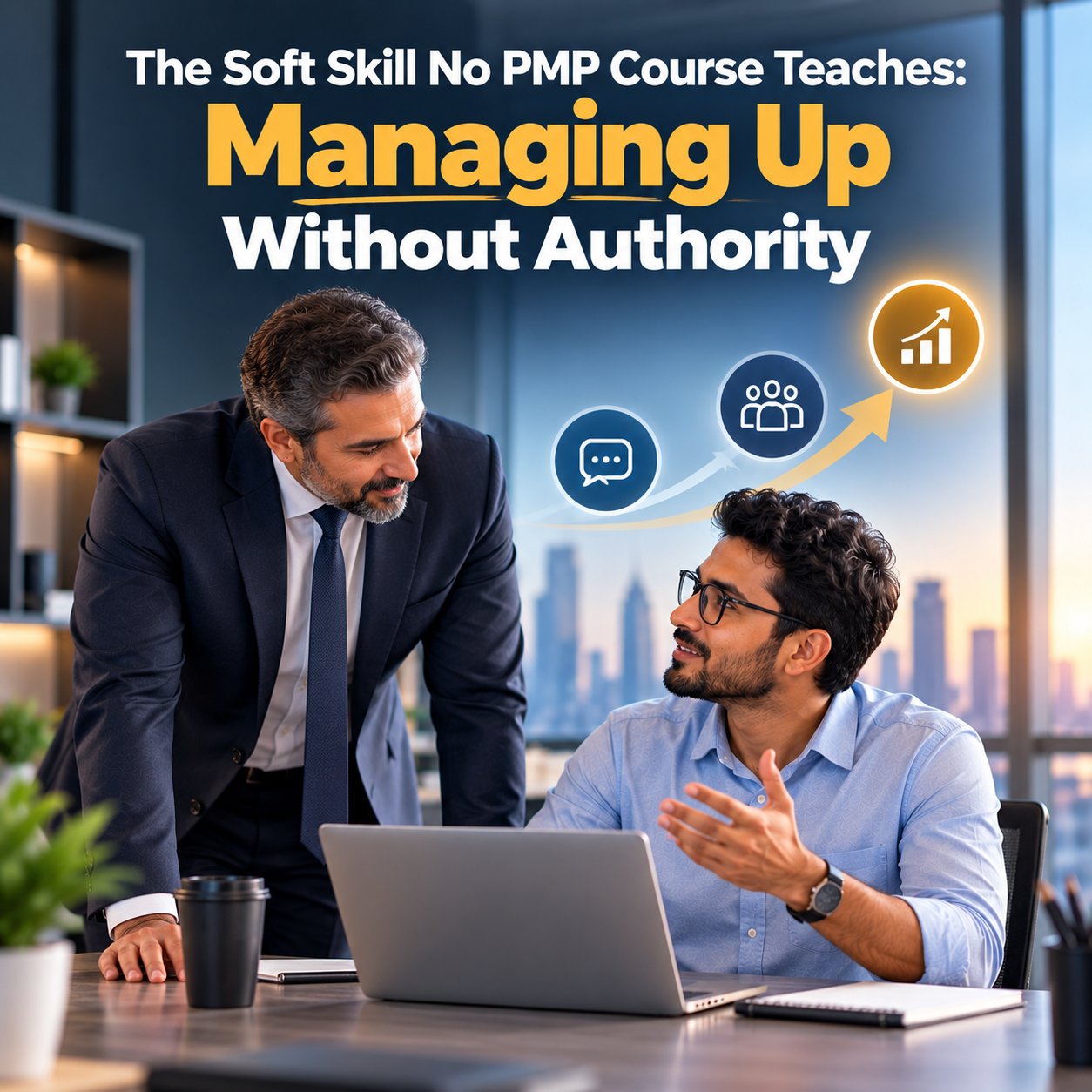
Managing up without authority is arguably the single most important skill separating project managers who consistently get executive buy-in from those who struggle to move decisions forward — and it's a skill almost no PMP course covers in any practical depth. You can pass the exam knowing every process group cold and still freeze the first time you need to push back on a director's unrealistic timeline.
This gap exists because managing up without authority doesn't fit neatly into a testable framework. It's relational, situational, and built through practice rather than memorization — which is exactly why so many capable, certified project managers still struggle with it in their first few years of real leadership.
Why Managing Up in Project Management Gets Overlooked
Managing up in project management requires influencing people who outrank you — sponsors, department heads, executives — without the formal authority to direct their actions. PMP training covers stakeholder management as a documented process: identify, analyze, engage, monitor. What it doesn't cover is the actual conversation skill needed when a senior stakeholder disagrees with your recommendation in the room, in real time.
This gap matters because project managers spend enormous amounts of time managing lateral and upward relationships, yet most PMP soft skills development happens through trial and error rather than deliberate practice.
Managing Up Without Authority: What It Actually Requires
Managing up without authority isn't about manipulation or workplace politics in the negative sense. It's about earning enough credibility and trust that senior stakeholders genuinely want your input, rather than merely tolerating it because your title requires them to.
This requires a specific combination of skills that most project management soft skills training treats as separate topics, when in practice they work together constantly:
Clear, confident communication that doesn't hedge every statement into meaninglessness
Selective pushback, knowing which disagreements are worth raising and which aren't
Data-backed recommendations, so pushback reads as informed judgment rather than opinion
Relationship investment before you need it, not scrambling to build trust mid-crisis
Influencing Without Authority: The Core Mechanics
Influencing without authority works fundamentally differently than directive leadership. Where a manager can simply assign a task, a project manager coordinating across departments has to earn cooperation through credibility, clear reasoning, and relationship capital built over time.
Building Credibility Before You Need It
The most effective project managers invest in relationships with senior stakeholders long before there's a disagreement to navigate. Regular, low-stakes updates — a quick heads-up on progress, a brief flag of an emerging risk — build a track record of reliability that makes a future pushback conversation far easier to have.
Framing Pushback as Informed Judgment, Not Opposition
When you do need to challenge a senior stakeholder's direction, framing matters enormously. "I don't think that will work" reads as opposition. "Based on the current resource constraints, here's what I'm seeing, and here's an alternative that gets us closer to the same goal" reads as informed partnership. This distinction is central to effective influence skills for project managers operating without formal authority.
Stakeholder Management Skills for Senior-Level Conversations
Stakeholder management skills designed for peer-level or junior stakeholder conversations often fail entirely when applied to executives. Senior stakeholders typically want brevity, business impact framing, and confidence — not process detail or excessive caveats.
Adjusting Communication Style by Seniority
A useful practice is deliberately shortening and simplifying communication as you move up the organizational chart. What takes five minutes to explain to your project team should typically compress to thirty seconds of business-impact framing for an executive sponsor. This isn't about withholding information — it's about respecting how senior stakeholders actually process and act on information.
Reading the Room in Executive Settings
Executive stakeholder management often requires picking up on unspoken cues — a raised eyebrow, a shift in tone, a question that signals skepticism rather than curiosity. Learning to read and respond to these signals in real time is a skill built almost entirely through repeated, deliberate practice rather than study.
Leadership Without Authority: A Practical Scenario
Consider a project manager who believes a proposed launch date, set by a senior executive under pressure from a client, is unrealistic given current team capacity. Leadership without authority in this situation doesn't mean simply agreeing to avoid conflict, nor does it mean flatly refusing the date.
A more effective approach: present the specific capacity data, propose two realistic alternatives with tradeoffs clearly outlined, and let the executive make an informed decision rather than being told what to do. This respects the executive's authority while still exercising genuine influence over the outcome — the essence of managing up effectively.
Project Manager Communication Skills That Support Managing Up
Strong project manager communication skills underpin every aspect of managing up successfully. A few habits consistently separate project managers who influence effectively from those who struggle:
Lead with the recommendation, not a lengthy buildup — executives want the conclusion first, context second
Quantify impact wherever possible, since numbers carry more weight than general statements in senior conversations
Offer options, not just problems, giving decision-makers something concrete to react to
Follow up in writing after verbal agreements, ensuring alignment doesn't quietly drift afterward
Why This Skill Compounds Over a Career
Project managers who master managing up without authority early tend to be trusted with increasingly complex, higher-visibility projects, because senior leadership learns they can raise concerns constructively rather than either staying silent or creating friction. This compounding trust effect is one of the most underrated career accelerants in project management — far more influential long-term than technical certification alone.
This kind of composed, credible influence draws directly on the psychological presence and professional authority that separates project managers who get heard from those who get talked over, regardless of how technically sound their recommendations are.
Building This Skill Deliberately
Most project managers develop managing-up skills slowly, through years of uncomfortable trial and error, often making avoidable mistakes with senior stakeholders along the way. Deliberate coaching and scenario practice can compress that learning curve significantly, building confidence and judgment before high-stakes situations arise rather than after a costly misstep.
This kind of applied, scenario-based coaching is exactly what I work through with mentees, helping project managers develop the influence and communication instincts that no PMP course curriculum covers. If you're navigating a specific senior stakeholder relationship, or preparing for a step up in responsibility, what a PMP coach actually helps with extends well beyond exam preparation into exactly this kind of practical skill-building.
Making Managing Up a Deliberate Practice
Managing up without authority isn't a talent some people simply have and others don't — it's a learnable skill built through deliberate practice, honest feedback, and repeated exposure to exactly the kind of high-stakes conversations most PMP courses never simulate.
If you're ready to build this skill deliberately rather than through years of trial and error, this is exactly the kind of coaching I offer at rjvisakh.com — turning influence theory into practiced, confident execution with senior stakeholders.
FAQs
What does "managing up" actually mean in project management?
It means effectively influencing, communicating with, and occasionally pushing back on senior stakeholders or executives who have more organizational authority than you do.
Can managing up without authority be learned, or is it a natural trait?
It's a learnable skill built through deliberate practice, feedback, and repeated exposure to real stakeholder conversations, not an innate personality trait some people simply have.
How do I push back on an executive's decision without seeming insubordinate?
Frame pushback as informed judgment backed by specific data, and offer alternative options rather than simply stating disagreement or refusing the request outright.
Why doesn't PMP certification cover managing up in more depth?
The PMP exam focuses on testable, documented processes. Managing up is relational and situational, making it difficult to teach through structured, memorizable content.
How can I start building this skill if I'm early in my project management career?
Start by investing in relationships with senior stakeholders before you need to challenge them, and practice framing recommendations concisely with clear business impact.
Ready to master influence without formal authority? Talk to Visakh RJ →
Visakh RJ | PMP Coach · Speaker · Mindset Alchemist
📍 Mumbai, India | 📞 +91 62825 40905