
Reading the Room: Nonverbal Signals in Project Status Meetings
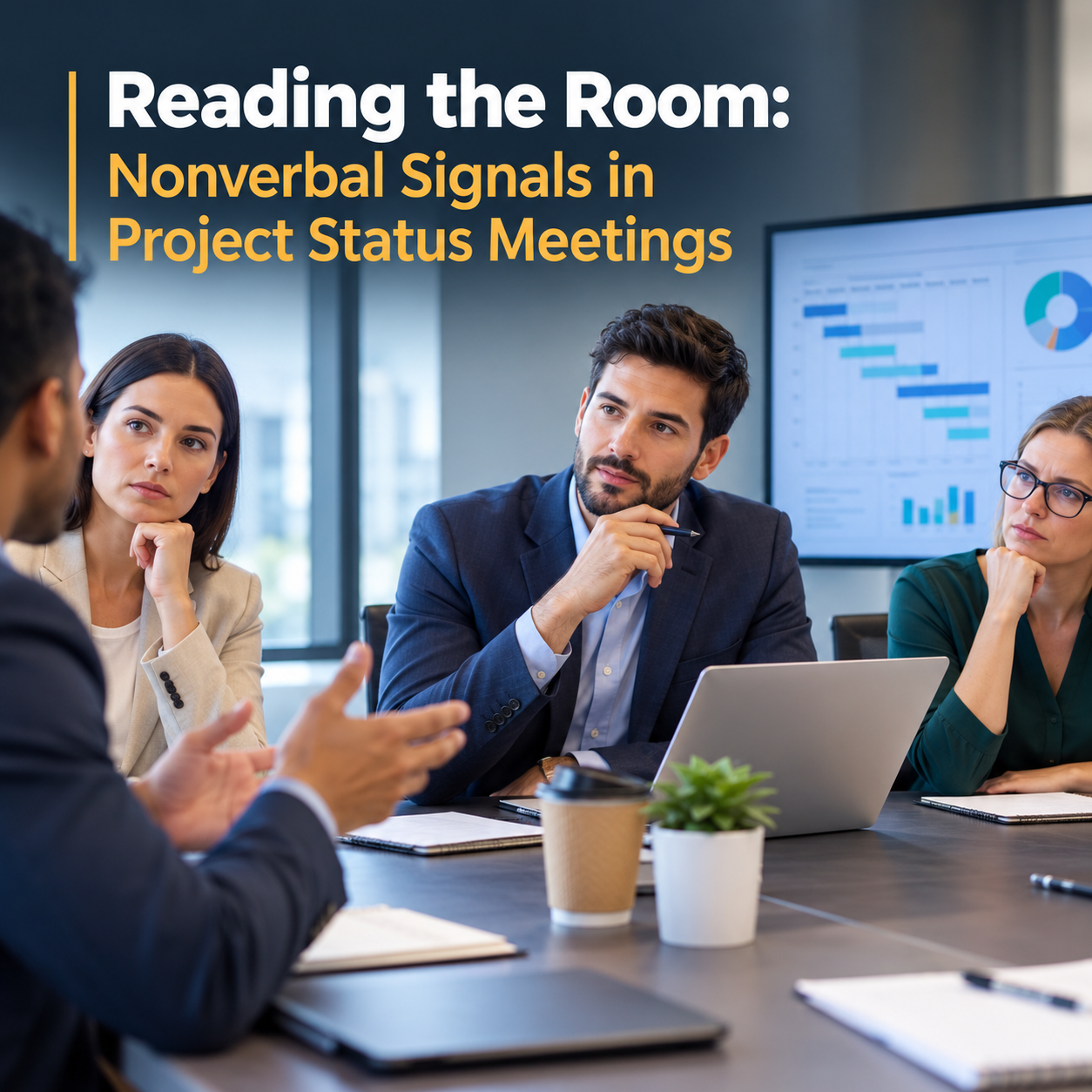
Nonverbal signals in project meetings often communicate more than what's actually being said out loud, yet most project managers spend their status meetings focused entirely on verbal updates while missing the body language, tone shifts, and silence that frequently signal the real story behind a project's health. Learning to read these cues transforms status meetings from routine reporting sessions into genuine opportunities for early risk detection.
This guide explores how nonverbal signals in project meetings reveal stakeholder concerns, team stress, and emerging risks well before anyone explicitly states them out loud, and how project managers can develop the awareness to catch these signals consistently.
Why Nonverbal Communication in Project Management Matters
Nonverbal Communication in Project Management often reveals concerns that stakeholders aren't yet ready, or willing, to voice directly. A sponsor who hesitates before answering, a team member who avoids eye contact when discussing a specific deliverable, or a sudden shift in the room's energy when a particular topic arises — these signals frequently surface problems well before they're formally reported through official channels.
Project managers who only track what's explicitly said in status meetings miss a significant layer of information that experienced leaders learn to read almost instinctively over time.
Reading the Room in Meetings: What to Watch For
Reading the Room in Meetings requires attention to several distinct categories of nonverbal signals, each potentially indicating something different about stakeholder sentiment or project risk.
Facial Expressions and Micro-Reactions
Brief facial reactions — a flash of concern, a skeptical raised eyebrow, a forced smile that doesn't reach the eyes — often happen quickly enough that people don't consciously register giving them away, making these micro-reactions particularly reliable indicators of genuine sentiment compared to carefully composed verbal responses.
Posture and Physical Engagement
A stakeholder who leans back, crosses their arms, or angles their body away from the discussion often signals disengagement or skepticism, even while verbally saying the project sounds fine. Conversely, leaning forward and maintaining open posture typically indicates genuine engagement and interest in the topic being discussed.
Silence and Pauses
Unusual silence after a status update, or a noticeably longer pause before someone responds to a direct question, frequently signals hesitation or concern that the person hasn't yet decided how to voice directly. These pauses are worth noting and sometimes worth gently following up on.
Body Language in Meetings: Common Patterns to Recognize
Body Language in Meetings follows recognizable patterns that, once learned, become easier to spot consistently across different stakeholders and meeting contexts.
Fidgeting or restlessness often indicates impatience, disagreement, or anxiety about an upcoming topic
Note-taking intensity shifts — someone who suddenly starts writing more actively may be documenting a concern they're not voicing aloud
Glances between attendees can signal unspoken agreement or concern being silently communicated between team members
Checking phones or devices during specific discussion points may indicate disengagement from that particular topic, worth noting if it happens consistently
Nonverbal Cues in Business Meetings: Cultural Considerations
Nonverbal Cues in Business Meetings can vary significantly across cultural contexts, which matters considerably for project managers working with diverse, multinational stakeholder groups common in global project environments. Direct eye contact, for example, signals confidence and engagement in some cultural contexts while potentially reading as confrontational or disrespectful in others.
Project managers working across culturally diverse teams should approach nonverbal interpretation with appropriate humility, recognizing that a single cue might mean different things depending on a stakeholder's cultural background, rather than applying universal assumptions to every situation.
Project Status Meeting Communication: Combining Verbal and Nonverbal Signals
Effective Project Status Meeting Communication requires synthesizing both verbal content and nonverbal signals together, rather than relying exclusively on either one in isolation. A stakeholder saying "this sounds fine" while displaying clear signs of tension or hesitation represents a meaningful disconnect worth gently exploring rather than simply accepting the verbal statement at face value.
A Practical Example
Consider a status meeting where a sponsor verbally approves a revised timeline but crosses their arms, avoids extended eye contact, and responds with notably shorter answers than usual. A project manager attentive to these signals might follow up privately after the meeting: "I wanted to check in — the revised timeline seemed to land a bit differently than expected. Is there anything specific you're weighing?" This kind of gentle, direct follow-up often surfaces concerns that would otherwise remain unspoken until they eventually surface as a larger problem.
Developing Stakeholder Communication Skills Through Observation
Building genuine Stakeholder Communication Skills around nonverbal awareness requires deliberate practice, since most people naturally focus their attention on content rather than physical and behavioral cues during conversation.
A useful practice involves periodically pausing during meetings to consciously observe the room — not just listening to what's being said, but genuinely noticing posture, expression, and engagement level across all participants, rather than focusing attention entirely on whoever is currently speaking.
Effective Project Status Meetings: Structuring for Better Observation
Effective Project Status Meetings benefit from structural choices that make nonverbal observation genuinely easier. Smaller, more frequent check-ins often reveal clearer signals than large, infrequent all-hands updates, where individual reactions become harder to track across a crowded room.
Building in brief pauses after presenting significant updates, rather than immediately moving to the next agenda item, also gives attendees genuine space to react, creating more opportunity to observe authentic responses rather than rushed, performative ones.
Stakeholder Engagement in Projects: Using Nonverbal Awareness Proactively
Stakeholder Engagement in Projects improves significantly when project managers use nonverbal awareness proactively, rather than only reactively noticing concerning signals after they've already escalated into larger problems. Regularly checking in with stakeholders who've displayed subtle signs of concern, well before those concerns become formal complaints or escalations, builds a reputation for genuine attentiveness that strengthens overall stakeholder trust over time.
This kind of attentive, perceptive leadership draws directly on the psychological presence and professional authority that distinguishes project managers who genuinely read and respond to their stakeholders from those who simply push through status updates without noticing the room's actual reaction.
Project Management Soft Skills: Why This Matters Beyond Status Meetings
Developing genuine Project Management Soft Skills around nonverbal awareness extends well beyond status meetings alone, informing how project managers navigate difficult client conversations, team conflict, and executive presentations throughout their broader leadership responsibilities.
This kind of nuanced interpersonal awareness connects closely to the skills explored in standup facilitation and stakeholder engagement techniques, since reading a room effectively applies across nearly every meeting format a project manager leads, not just formal status updates.
Project Manager Communication Skills: Building This Awareness Deliberately
Most project managers develop Project Manager Communication Skills around nonverbal reading gradually, through years of accumulated meeting experience and occasional missed signals that later prove to have been significant. Deliberate coaching and scenario practice can meaningfully compress this learning curve, building genuine observational skill faster than unguided trial and error alone.
This is precisely the kind of applied, interpersonal coaching I work through with mentees, helping project managers develop the kind of perceptive, attentive leadership presence that strengthens stakeholder trust and catches risks early. If you're looking to sharpen this specific skill, it's exactly the practical, scenario-based coaching I offer at rjvisakh.com.
FAQs
Can nonverbal signals really predict project risks before they're formally reported?
Yes, often. Stakeholder hesitation, disengagement, or tension frequently surface nonverbally before concerns are explicitly voiced through formal status reporting channels.
How do I avoid misreading nonverbal signals in a diverse, multicultural team?
Approach interpretation with humility, recognizing cultural variation in body language norms, and verify observations through gentle follow-up conversation rather than assuming universal meaning.
Should I address a nonverbal concern immediately during the meeting?
Not always. A private, gentle follow-up after the meeting often works better than putting someone on the spot in front of the full group during the discussion itself.
Is reading nonverbal cues a skill that can actually be learned?
Yes. While some people have natural intuition, deliberate observation practice and coaching can significantly improve this skill for most project managers over time.
How does nonverbal awareness improve stakeholder trust long-term?
Proactively addressing concerns stakeholders haven't yet voiced demonstrates genuine attentiveness, building stronger trust than only responding after issues formally escalate.
Ready to lead meetings with genuine stakeholder awareness? Talk to Visakh RJ →
Visakh RJ | PMP Coach · Speaker · Mindset Alchemist
📍 Mumbai, India | 📞 +91 62825 40905