
PMP Exam Eligibility 2026: Do You Qualify? Full Checklist
Introduction
Thinking about getting PMP certified but unsure if you even qualify? You're not alone. Every year, thousands of professionals start researching the PMP exam only to get confused by PMI's eligibility rules around degrees, experience hours, and training requirements.
This guide breaks down PMP exam eligibility 2026 in simple terms, so you know exactly where you stand before you spend time or money on the application process. Whether you're an aspiring project manager, a working professional, or a recent graduate, this checklist will help you confirm your eligibility in minutes.
What Is PMP Certification and Why Eligibility Matters
The Project Management Professional (PMP) credential, issued by PMI (Project Management Institute), is one of the most recognized project management certifications globally. But before you can even sit for the exam, PMI requires you to meet specific PMP eligibility requirements related to education, professional experience, and project management training.
Skipping this step can lead to application rejection or audit delays — so understanding the PMP exam eligibility checklist upfront saves you time and frustration.
PMP Exam Eligibility Checklist 2026
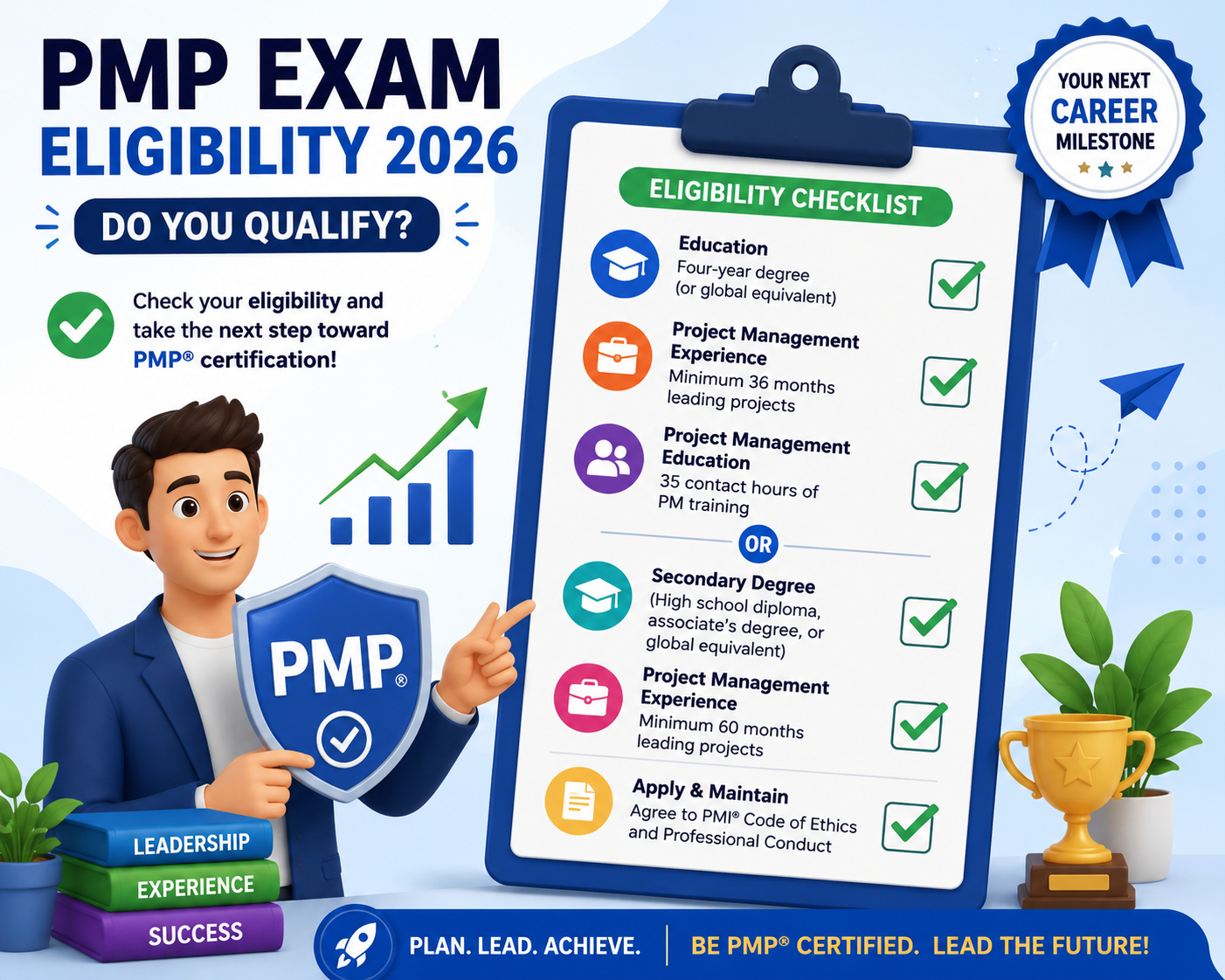
PMI offers two main eligibility pathways based on your educational background. Below is the PMP certification requirements 2026 breakdown:
Pathway 1: Four-Year Degree Holders
A bachelor's degree (or global equivalent)
36 months of project leadership experience within the last 8 years
35 hours of project management education or training (or CAPM certification)
Pathway 2: Secondary Degree Holders (No Bachelor's Degree)
This is the most searched pathway for people asking about PMP eligibility without degree:
A high school diploma, associate's degree, or global equivalent
60 months of project leadership experience within the last 8 years
35 hours of project management education or training (or CAPM certification)
PMI's Official Eligibility Criteria Summary
Four-Year DegreeSecondary DegreeExperience Required36 months60 monthsEducation/Training35 contact hours35 contact hoursTimeframeLast 8 yearsLast 8 years
This table reflects PMI's standard PMI PMP eligibility criteria, but requirements can be updated by PMI periodically, so it's always smart to cross-check with official PMI guidelines or consult an experienced trainer before applying.
Understanding the PMP Exam Prerequisites in Detail
1. Experience Hours Requirement
The PMP experience hours requirement isn't about job titles — it's about demonstrated project leadership. PMI looks for experience in:
Initiating projects
Planning project scope, schedule, and budget
Executing and monitoring project tasks
Closing projects formally
Even if your job title isn't "Project Manager," you may still qualify if you've led project tasks as part of your role.
2. Contact Hours Requirement
The PMP contact hours requirement refers to 35 hours of formal project management education. This can be fulfilled through:
An accredited PMP prep course
A CAPM certification (which can also waive some hour requirements)
University-level project management courses
This is exactly where working with an experienced mentor matters. If you're looking for structured, exam-focused training, explore PMP coaching programs in India designed to help you meet this requirement efficiently while preparing for the exam itself.
How to Qualify for PMP Exam: Step-by-Step
Identify which pathway applies to you (degree vs. no degree)
Calculate your total months of verifiable project experience
Complete your 35 contact hours of PM education
Document your experience using PMI's required format
Submit your application through PMI's online portal
Prepare for a possible audit (PMI randomly audits applications)
If you're unsure how to document your experience correctly, working with a certified coach can significantly reduce errors. Learn more about how PMP coaching works and what to expect from a structured preparation journey.
PMP Eligibility for Specific Groups
PMP Eligibility for Fresh Graduates
Recent graduates often ask about PMP eligibility for fresh graduates since they may lack the required experience hours. In most cases, fresh graduates won't meet the 36–60 month experience requirement immediately, but can start preparing through CAPM certification or relevant internships that count toward future eligibility.
PMP Eligibility for Non-Project Managers
A common myth is that only people with "Project Manager" in their title can apply. In reality, PMP eligibility for non-project managers is very much possible if you've handled tasks like budgeting, scheduling, team coordination, or stakeholder communication — even informally.
Career Changers and Mid-Career Professionals
If you're switching industries, your prior leadership or coordination experience may still count, as long as it aligns with PMI's process groups.
Do I Qualify for PMP Certification? Quick Self-Check
Ask yourself:
Do I have a degree (bachelor's or secondary)?
Have I led project-related tasks for the required number of months?
Have I completed or can I complete 35 hours of PM training?
If you answered yes to all three, you likely meet the PMP exam eligibility 2026 criteria. If you're unsure about how your experience translates into PMI's format, it's worth getting a professional eligibility review before applying.
PMP Application Process 2026: What Happens After Eligibility Check
Once you confirm eligibility:
Create your PMI account
Fill out your experience and education details
Submit the application
Pay the exam fee (PMI member or non-member rate)
Schedule your exam once approved
The PMP application process 2026 typically takes a few days for approval unless selected for audit, which can extend the timeline by several weeks.
Why Work With a PMP Coach Before Applying
Many candidates get their applications rejected or delayed simply because of incorrect experience documentation. Working with a mentor who understands PMI's exact expectations can help you avoid common mistakes and prepare strategically for both the application and the exam itself.
Ready to confirm your eligibility and start your PMP journey the right way? Get personalized PMP coaching guidance here and take the first step toward certification.
Frequently Asked Questions
1. Can I apply for PMP without a degree?
Yes. Under PMI's secondary degree pathway, you can qualify with 60 months of project leadership experience and 35 contact hours of training, even without a bachelor's degree.
2. How many years of experience do I need for PMP in 2026?
You need 36 months if you hold a four-year degree, or 60 months if you hold only a secondary degree, both within the last 8 years.
3. Does CAPM certification help with PMP eligibility?
Yes. CAPM certification can fulfill the 35-hour education requirement and is often recommended for those without formal PM training.
4. What happens if PMI audits my PMP application?
You'll need to provide supporting documents like experience verification forms signed by supervisors. A coach can help ensure your documentation is audit-ready.
5. Can non-project managers apply for PMP certification?
Yes, as long as you've performed project leadership tasks such as planning, budgeting, or coordinating teams, regardless of your official job title.
Conclusion
Understanding PMP exam eligibility 2026 doesn't have to be confusing. By matching your education and experience against PMI's two pathways, you can quickly determine whether you qualify — and if not, what steps to take next.
Still unsure if you qualify? Talk to an experienced PMP coach today and get a clear, personalized eligibility roadmap.