
How Certified PMs Actually Run a Kickoff Meeting (Not What the Textbook Says)
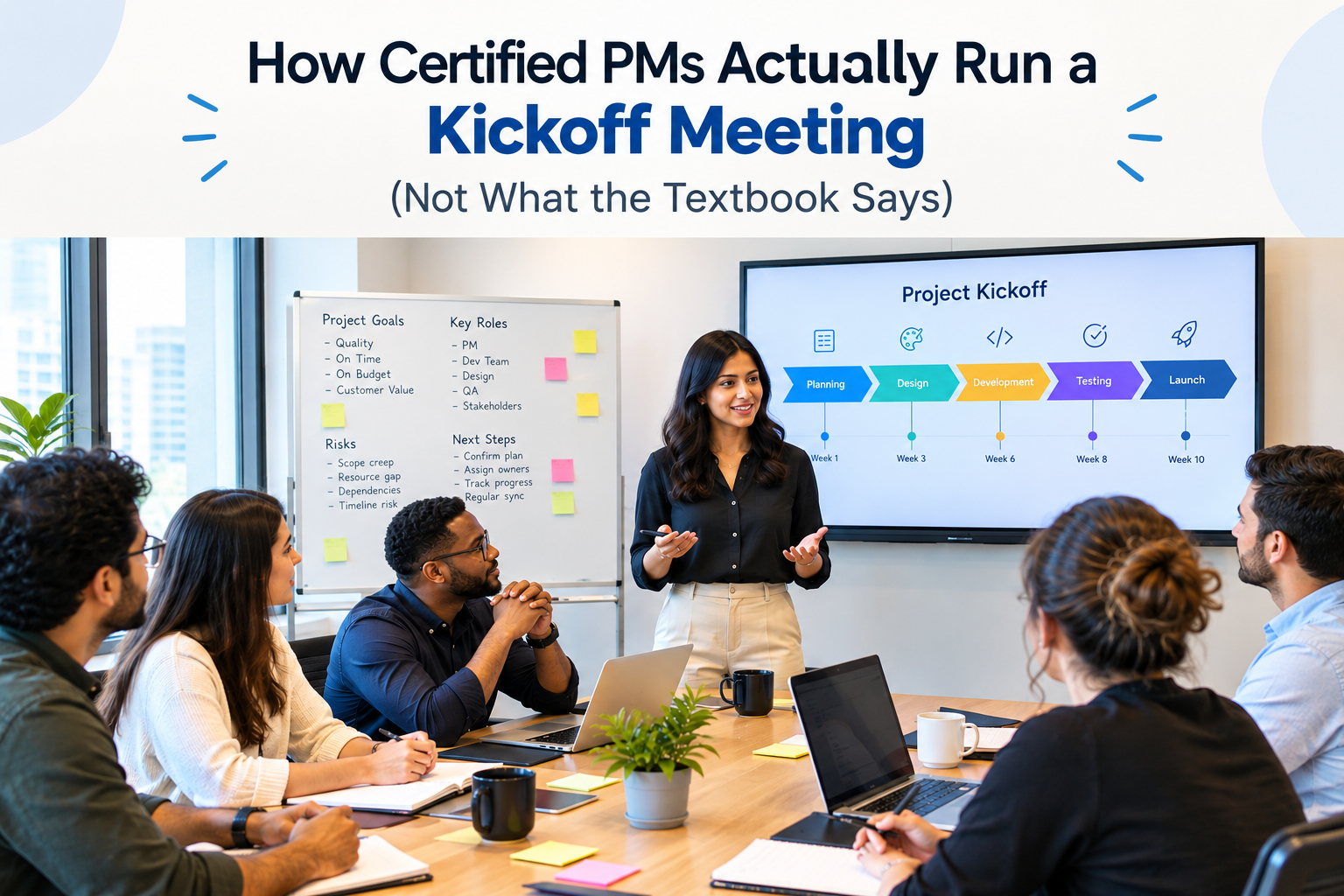
How to run a project kickoff meeting looks completely different in a PMBOK diagram than it does in an actual conference room with a skeptical sponsor, a distracted team, and a deadline nobody's fully agreed on yet. This guide breaks down what certified PMs actually do differently from the textbook version — the real agenda, the mistakes that quietly derail projects in week one, and what experience teaches that no exam question ever will.
Why Textbook Kickoff Meetings Fall Short in Practice
Most PMP study material frames the kickoff meeting as a clean, linear event: introduce the team, review the charter, confirm scope, done. In reality, understanding how to run a project kickoff meeting well means recognizing that this meeting is where unspoken tensions — unclear authority, competing priorities, stakeholder skepticism — surface for the first time, whether you plan for them or not.
Certified PMs who've run dozens of these meetings know the textbook agenda is a starting skeleton, not a script. The real skill is reading the room and adjusting in real time.
Kickoff Meeting vs Project Charter: A Common Confusion
Before running the meeting itself, it's worth clarifying the kickoff meeting vs project charter distinction, since new PMs often conflate the two. The charter is a formal document authorizing the project and naming the PM; the kickoff meeting is where that authority actually gets felt by the team and stakeholders in the room. A charter can exist on paper while a team still doesn't believe the project has real backing — the kickoff is where that belief gets built or lost.
What to Cover in a Kickoff Meeting: The Real Agenda
Understanding what to cover in a kickoff meeting beyond the standard checklist means prioritizing based on what's actually at risk on a given project, not following a rigid template regardless of context. A practical, experience-based agenda:
Open with the "why," not the "what." Before scope or timelines, connect the project to a business outcome stakeholders actually care about — this is what gets buy-in, not a bullet list of deliverables.
Name the elephant in the room. If there's known tension — a tight deadline, a controversial scope decision, a team merger — address it directly rather than pretending it doesn't exist.
Clarify decision-making authority explicitly. Who can approve scope changes? Who breaks ties? Ambiguity here causes more delays than almost anything else in week one.
Confirm communication cadence, not just channels. Don't just say "we'll use Slack" — specify how often, for what, and who's expected to respond within what window.
Leave room for real questions, even uncomfortable ones — a kickoff where nobody pushes back usually means people are saving their doubts for later, when they're more expensive to resolve.
PMP Kickoff Meeting Best Practices Experienced PMs Follow
A few PMP kickoff meeting best practices separate seasoned PMs from newly certified ones running their first real kickoff:
Meet key stakeholders individually before the group kickoff, so the group meeting isn't the first time you're hearing concerns — surprises in a group setting are harder to manage gracefully
Keep the meeting shorter than instinct suggests — 45-60 minutes forces prioritization; 90-minute kickoffs often drift into low-value detail that could be handled offline
Assign visible next steps before the meeting ends, not as a follow-up email days later, so momentum doesn't stall immediately after everyone leaves the room
Read body language, not just verbal agreement — a quiet team member nodding along isn't the same as genuine buy-in
Project Kickoff Meeting Mistakes to Avoid
Even certified, experienced PMs make project kickoff meeting mistakes to avoid, often repeating the same few patterns:
Over-relying on the slide deck instead of genuine conversation — a kickoff that feels like a presentation rather than a discussion misses the actual purpose of the meeting
Skipping the "why" for the "what" — jumping straight into scope and timeline without connecting the project to a reason the team actually cares about
Treating the agenda as fixed regardless of what surfaces in the room — rigid adherence to a plan when real tension emerges signals poor facilitation, not discipline
Failing to address known risks upfront — avoiding an obvious elephant in the room doesn't make it disappear; it just delays the conversation to a worse moment
How to Start a Project as a Project Manager: Beyond the Kickoff
Understanding how to start a project as a project manager extends beyond the single kickoff meeting itself. The kickoff is one moment in a broader early-project sequence: stakeholder mapping, individual pre-meetings, charter review, and the kickoff itself, followed immediately by reinforcing whatever commitments were made in that room. PMs who treat the kickoff as an isolated event, disconnected from this broader sequence, often see momentum fade within the first two weeks.
Real-World Project Management Practices vs Exam Answers
One of the more uncomfortable truths for newly certified PMs: real-world project management practices sometimes diverge from what scores well on the PMP exam. The exam rewards structured, textbook-correct answers; real projects reward judgment calls that account for office politics, unspoken hierarchy, and stakeholders who say one thing in the meeting and mean another privately. Recognizing this gap — rather than being surprised by it — is itself part of the transition from certified to genuinely experienced.
Building a Project Kickoff Meeting Checklist That Actually Works
A practical project kickoff meeting checklist should be built around your specific project's risk profile, not a generic template pulled from a textbook:
Stakeholder list confirmed, with authority levels clarified
Individual pre-meeting conversations completed with key players
Project "why" articulated in language the team actually connects with
Known tensions or risks identified and ready to address directly
Communication cadence and escalation path defined clearly
Next steps assigned with names and dates before the meeting ends
Project Kickoff Meeting Agenda: A Realistic Template
A realistic project kickoff meeting agenda for a 45-60 minute session:
0-5 min: Project "why" and business context
5-15 min: Team introductions and roles (kept brief — save depth for one-on-ones)
15-30 min: Scope, timeline, and known constraints, addressed directly including tensions
30-45 min: Communication cadence, decision authority, and open questions
Final 5 min: Confirmed next steps with owners and dates
Project Manager Kickoff Meeting Tips for Certified PMs
A few final project manager kickoff meeting tips worth internalizing: your certification teaches you the framework, but running a genuinely effective kickoff is a skill built through repetition and honest post-meeting reflection — what landed, what fell flat, what you'd say differently next time.
The Bottom Line
Understanding how to run a project kickoff meeting the way certified, experienced PMs actually do it means moving past the clean textbook version and toward something messier but more honest — reading the room, naming real tensions, and building genuine buy-in rather than just checking boxes. The exam teaches the skeleton; real projects teach you how to put muscle on it.
Frequently Asked Questions
Q1: How long should a project kickoff meeting last?
Most experienced PMs keep kickoff meetings to 45-60 minutes, since longer sessions often drift into low-value detail that could be handled in smaller follow-up conversations.
Q2: What's the difference between a kickoff meeting and reviewing the project charter?
The charter formally authorizes the project on paper; the kickoff meeting is where that authority and direction actually get communicated and felt by the team and stakeholders in real time.
Q3: Should I address known project risks or tensions during the kickoff?
Yes — avoiding an obvious tension doesn't make it disappear, it just delays the conversation to a more expensive moment later in the project.
Q4: What's the biggest mistake new PMs make in their first kickoff meeting?
Over-relying on a slide deck instead of genuine conversation, which turns the meeting into a presentation rather than the discussion it's meant to be.
Q5: Does the PMP exam actually prepare you for running a real kickoff meeting?
It teaches the structural framework, but real kickoff meetings require judgment calls — reading stakeholder dynamics and office politics — that experience teaches far better than exam preparation alone.
Ready to build real-world project management skills beyond exam theory? Explore PMP coaching with Visakh RJ in Mumbai, or read real student testimonials from candidates who've built genuine project leadership skills. Browse the PMP blog for more practical, real-world project management guidance.
Start Your PMP Journey — Enquire on WhatsApp →
Visakh RJ — PMP Coach · Speaker · Mindset Alchemist
📞 +91 62825 40905
📍 Mumbai, India