
Case Study: How a First-Time Manager Rescued a Failing IT Rollout Using PMP Frameworks
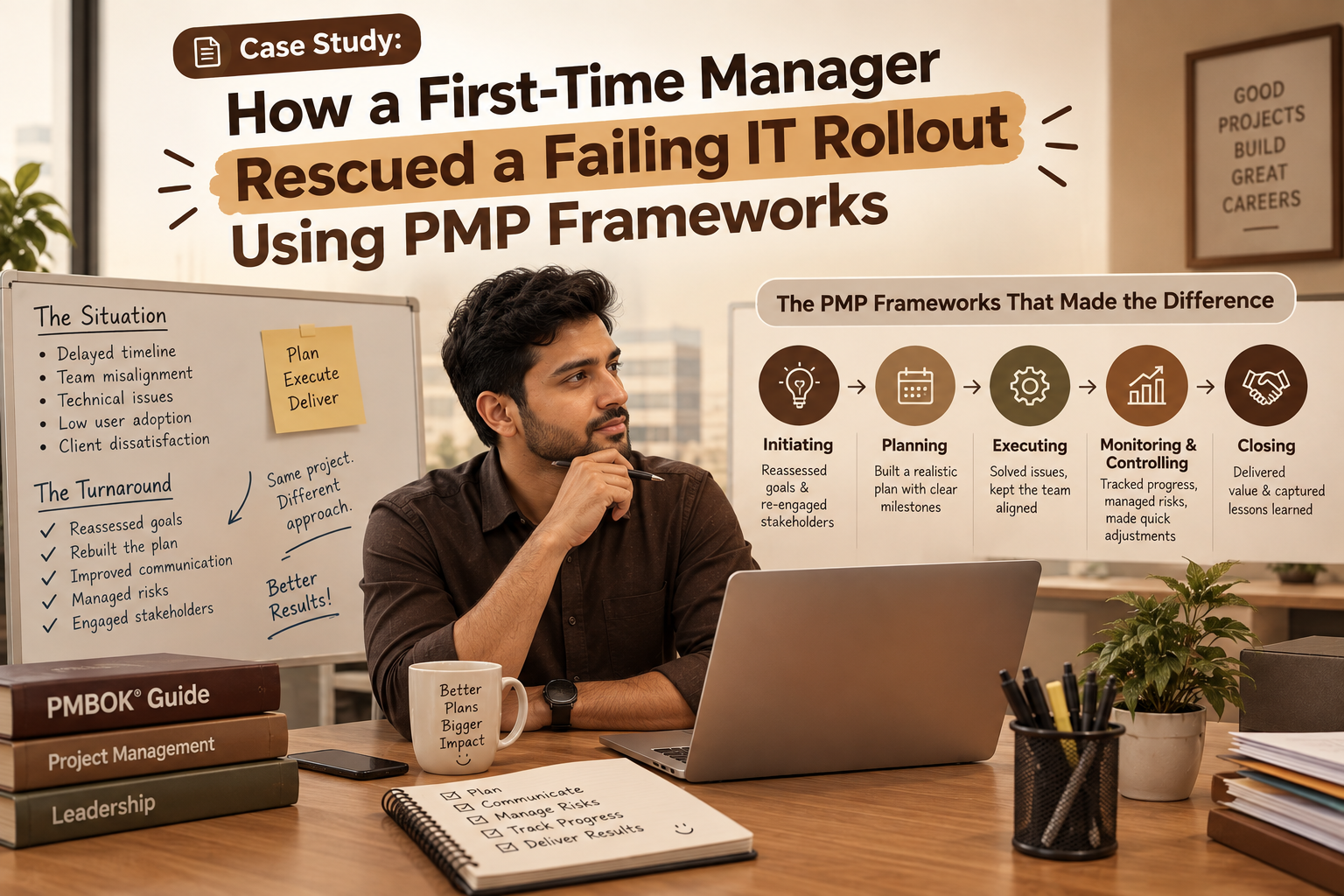
This PMP frameworks for IT rollout case study follows a first-time project manager who inherited a troubled implementation twelve weeks behind schedule, over budget, and losing the client's confidence fast. Within four months, the project was back on track, delivered successfully, and the client extended the contract for a second phase.
What makes this PMP frameworks for IT rollout case study worth studying isn't dramatic heroics — it's the disciplined, methodical application of standard PMBOK tools that most newly certified project managers know in theory but rarely see applied under real pressure. This is exactly that application, step by step.
Background: A Textbook Failing IT Project
The situation had the classic signs of a project heading toward failure. A mid-sized IT rollout for a financial services client had missed three consecutive milestones. The original project manager had left the company mid-project, and a first-time project manager — recently PMP-certified but with no prior lead experience — was handed the file with minimal transition notes.
This kind of scenario is common in new project manager challenges everywhere: inheriting a project already in crisis, with limited context, strained client trust, and a team that's lost confidence in the plan. It's precisely where a structured PMP frameworks for IT rollout case study becomes most valuable — showing what actually works when theory meets a genuinely messy situation.
Step One: Diagnosing the Failure Using PMP Frameworks
Before making any changes, the new project manager applied a fundamental principle from PMBOK framework application example thinking: diagnose before you act. Rather than immediately proposing a new schedule to reassure the client, the first two weeks were spent purely on assessment.
This diagnostic phase, central to any credible how to fix a failing IT project approach, involved three parallel activities:
Reviewing the original project charter and scope baseline to identify where reality had drifted from the plan
Interviewing the core team individually to surface issues nobody had raised formally, including a vendor integration nobody had flagged as high-risk
Auditing the risk register, which turned out to be six weeks out of date and missing three risks that had already materialized
This is where a PMP framework real-world example proves its worth — the tools exist precisely for this kind of structured diagnosis, rather than reactive firefighting.
Step Two: Rebuilding the Risk Register and Communication Plan
The audit revealed the real root cause: a third-party API integration had been underestimated at the planning stage, and no one had escalated the growing delay until it was already critical. This is a textbook example used in many project management case study IT discussions — technical risk hiding in plain sight because nobody owned it clearly.
Applying project recovery strategies PMP methodology, the new manager took two immediate actions:
Rebuilt the risk register from scratch, assigning a named owner and mitigation plan to every open risk, not just documenting them
Restructured the communication plan, moving from monthly client updates to a weekly quick-sync specifically because trust needed rebuilding through visible transparency, not just eventual results
Step Three: Resetting Expectations With the Client
Rather than presenting an overly optimistic recovery timeline to placate the client, the manager applied a principle central to any strong turnaround troubled IT project effort: deliver bad news early, paired immediately with a credible plan.
The client meeting that followed didn't hide the twelve-week slip. It presented a revised, realistic schedule built from actual team capacity data, backed by the newly rebuilt risk register showing exactly what was being done to prevent further delays. This transparency, uncomfortable in the moment, became the turning point that rebuilt client confidence far faster than another missed promise would have.
Step Four: Applying Scope Control and Change Management
Scope creep had quietly contributed to the original delays — the team had been absorbing small, unofficial change requests without formal documentation or timeline adjustment. Part of this PMP frameworks for IT rollout case study involved reintroducing strict change control: every new request now went through a formal impact assessment before approval.
This single process change reduced unplanned scope additions by roughly 70% over the following two months, giving the team the stability needed to actually hit the newly committed milestones.
Results: What This IT Rollout Project Management Case Study Demonstrates
Four months after the recovery effort began, the project delivered successfully, three weeks ahead of the revised (not original) schedule. The client not only accepted the outcome but extended the engagement for a follow-on phase — a strong signal that the recovery process had rebuilt genuine trust, not just delivered a technical fix.
This IT rollout project management case study demonstrates something PMP training often teaches abstractly but rarely shows in practice: structured frameworks work precisely because they force discipline during the moments when panic and reactive decision-making are most tempting.
Project Management Lessons Learned Case Study Summary
A few project management lessons learned case study takeaways stand out from this recovery:
Diagnosis before action prevents wasted effort on the wrong fixes
A living risk register, actively maintained, catches problems before they become crises
Transparent, frequent client communication rebuilds trust faster than optimistic promises
Formal scope control protects schedule stability even under pressure to accommodate "small" requests
None of these are exotic techniques. They're standard PMBOK tools, applied with discipline rather than treated as exam-only theory.
Why This Matters for First-Time Project Managers
This first-time project manager case study matters because it reflects a common reality: many newly certified professionals are handed difficult, already-struggling projects as their first real leadership test, not a clean, well-planned rollout. Knowing how to apply PMP frameworks under that kind of pressure is a skill built through guided practice, not just exam study.
I work through scenarios exactly like this one with mentees, translating PMBOK theory into the kind of structured, confident decision-making shown in this case study. If you're navigating a similar situation, what a PMP coach actually helps with goes well beyond exam prep into exactly this kind of real-world application.
Building the Instincts This Case Study Required
The composure shown throughout this recovery — presenting hard news calmly, rebuilding trust methodically, leading a team that had lost confidence — draws directly from the kind of psychological presence and professional authority that separates project managers who freeze under pressure from those who lead through it.
If you're a first-time or early-career project manager preparing for a similarly high-stakes situation, this kind of structured coaching is exactly what I offer at rjvisakh.com — turning PMBOK frameworks into practiced, confident leadership.
FAQs
Can PMP frameworks really rescue a failing IT project?
Yes, when applied methodically. Structured risk management, scope control, and transparent communication are proven tools for diagnosing and recovering troubled projects, not just exam concepts.
What's the first step when inheriting a failing project?
Diagnose before acting. Review the original scope baseline, interview the team individually, and audit the risk register before proposing any changes to timeline or approach.
How do you rebuild client trust after missed deadlines?
Deliver honest updates early, paired with a credible, data-backed recovery plan. Transparency, even when uncomfortable, rebuilds trust faster than another overly optimistic promise.
Is scope creep a common cause of IT project failure?
Very common. Small, unofficial change requests accumulate without formal impact assessment, quietly eroding timelines until the cumulative effect becomes a major delay.
How can a first-time project manager prepare for this kind of situation?
Structured coaching and scenario-based practice help build the confidence and instincts needed to apply PMBOK frameworks under real pressure, beyond what exam study alone provides.
Ready to lead through your first high-stakes project? Talk to Visakh RJ →
Visakh RJ | PMP Coach · Speaker · Mindset Alchemist
📍 Mumbai, India | 📞 +91 62825 40905