
Business Environment 8% to 26%: Why PMI Tripled This Domain in 2026
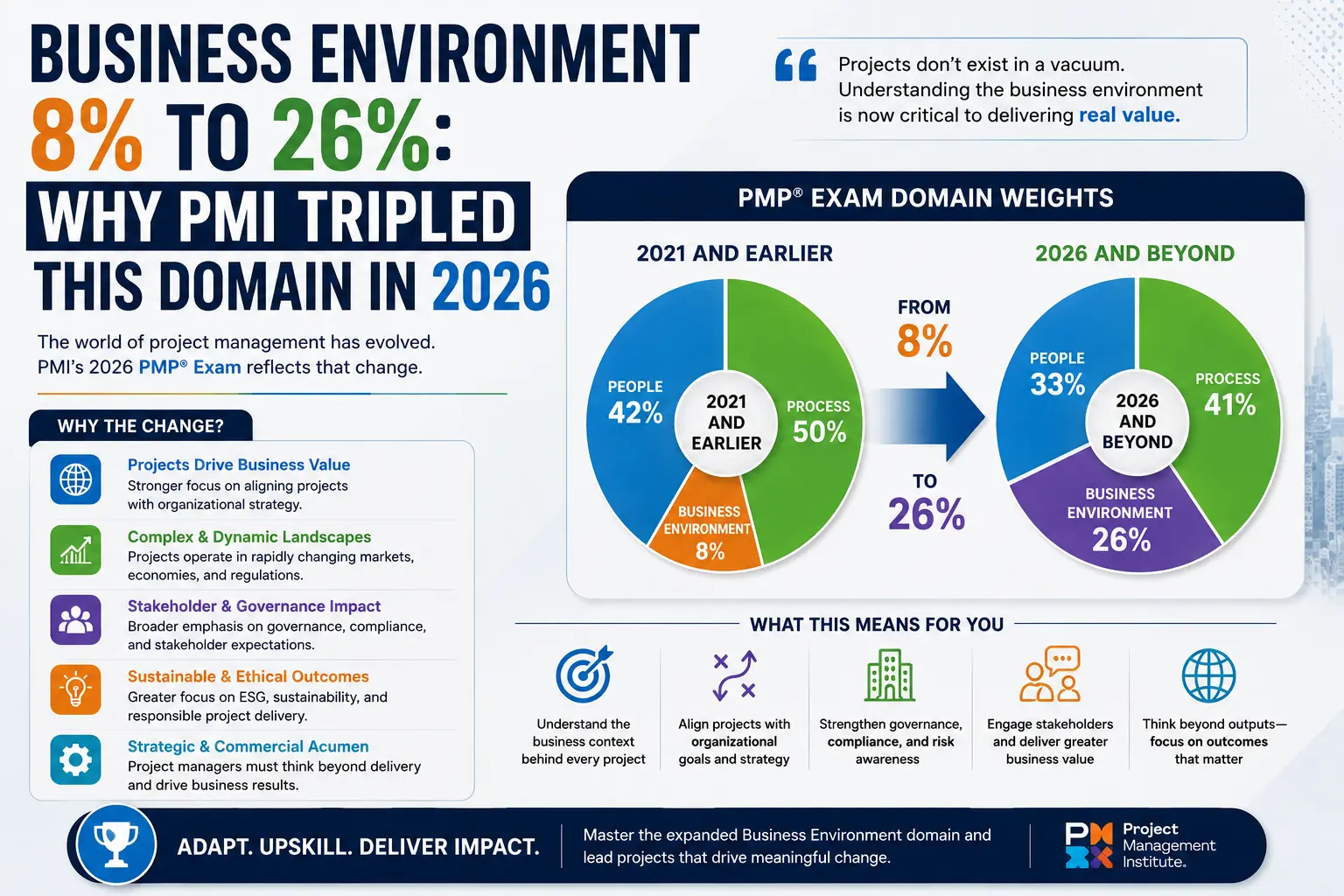
Of all the PMP 2026 changes, none is more dramatic than a single domain nearly tripling in size overnight. Business Environment, long treated as the smallest and most skippable section of the PMP exam, has jumped from 8% to 26% of total exam weight. That is not a rounding adjustment. It is PMI fundamentally redefining what it means to be a competent project manager in 2026.
For candidates and organizations planning PMP training in India, this single number should reshape your entire study strategy. This article unpacks exactly why PMI made this call, what now lives inside the PMP Business Environment Domain 2026, and how to study it properly instead of treating it as an afterthought the way candidates could get away with in the past.
Why This Number Matters More Than It Looks
An 18-percentage-point increase might sound abstract until you convert it into actual exam questions. Out of 180 total questions, Business Environment now accounts for roughly 47 questions, up from roughly 14 under the previous Examination Content Outline. That is more than three times the exposure, and it means a domain candidates used to allocate five to ten percent of their study time toward now demands closer to a quarter of total prep hours.
Ignore this shift and you are studying for an exam that no longer exists. Overweight the domains you are comfortable with, typically Process and People, and you will walk into the exam under-prepared for nearly half of the Business Environment questions you encounter.
Why PMI Increased Business Environment Weight
The decision did not come from a committee guessing at trends. It came out of PMI Job Task Analysis Business Environment research, a large-scale global effort where PMI surveys thousands of practicing project managers to determine what the role actually requires today, not what it required five or ten years ago.
That research pointed to a consistent pattern: project managers are now expected to operate as business decision-makers, not just delivery leads. PMI's own reframing of project success moved away from schedule, budget, and scope as the sole measures, toward a broader definition built around stakeholder value and business outcomes. A domain testing governance, compliance, and value delivery had to grow to reflect that reality, and Business Environment absorbed most of that growth.
What Actually Lives Inside the Business Environment Domain Now
This is where most study plans fall short, because PMP Business Environment Topics 2026 cover considerably more ground than the domain used to. Based on PMI's published Examination Content Outline, the domain's task count itself grew from 4 tasks to 8, even as the exam's total task count shrank overall. Broadly, the domain now spans:
Organizational governance and how project decisions align with it
Compliance, including regulatory requirements and sustainability-related compliance
Risk at the organizational and strategic level, beyond project-level risk registers
Continuous improvement and process maturity
Organizational change management
External environment factors, including market and technology shifts
Benefits realization and value-based delivery
Strategic alignment between project outcomes and business objectives
Notice how many of these topics barely existed in older PMP study guides. Governance and compliance used to be a few bullet points. Now they are a core pillar of the exam. For a broader walkthrough of every domain and task in the updated blueprint, see the full library of PMP 2026 exam content breakdowns on the blog.
PMP Exam Governance and Compliance: What to Actually Know
Governance and compliance questions on the new exam are not asking you to recite regulations. They are testing whether you can recognize when a governance structure is being bypassed, when a compliance requirement should influence a project decision, and how to escalate appropriately when the two conflict with delivery pressure.
Expect scenario questions where a stakeholder pushes for a shortcut that technically violates a compliance requirement, and you are asked to identify the correct response. This is applied judgment, not memorization, which is consistent with how the rest of the 2026 exam is structured.
Business Value Delivery on the PMP Exam
Business Value Delivery PMP Exam content is arguably the philosophical center of the entire Business Environment domain. PMI wants candidates to demonstrate they understand why a project exists in the first place, not just how to execute it. That means being able to reason through:
Whether a project's outputs are actually translating into the benefits the business case promised
How to measure and communicate value realization to stakeholders who care about outcomes, not deliverables
When to recommend adjusting or even stopping a project because the value case has changed
This ties directly into strategic alignment, another heavily tested concept, which asks whether a project manager can connect day-to-day project decisions back to the organization's broader strategic goals.
Strategic Alignment: The Thread Running Through the Whole Domain
If there is one unifying theme across the entire Business Environment domain, it is Strategic Alignment PMP Exam 2026 thinking. PMI is testing whether project managers can see beyond their own project charter and understand how their work fits into the organization's larger strategy, market position, and long-term goals.
This is a meaningful shift from purely operational project management. A project manager who can build a flawless schedule but cannot explain why the project matters to the business is exactly the gap PMI is now testing for, and exactly the gap this domain weight increase was designed to close.
A Practical Business Environment Study Guide
Given the scale of this shift, a scattered approach to studying Business Environment will not hold up. Here is a more structured way to approach it, forming a working PMP Business Environment Study Guide:
Do not study Business Environment as a standalone chapter at the end of your prep. Integrate it throughout, since scenario questions increasingly blend it with People and Process content.
Build real familiarity with governance frameworks, not just definitions. Practice identifying governance breaches inside scenario questions.
Get comfortable with benefits realization and value delivery concepts specifically, since this is one of the more abstract areas candidates historically under-prepared for.
Layer in agile and hybrid context, since roughly 60% of exam questions across all domains now test agile or hybrid approaches, including within Business Environment.
Use practice question accuracy, not just the domain weight, to guide your final study hours. If you are consistently missing Business Environment scenarios, allocate more time there regardless of the 26% baseline.
For related reading on how agile and hybrid concepts weave through this and the other domains, and a full breakdown of all three domain weights side by side, browse the PMP 2026 series on the blog.
What This Means for PMP Candidates and Corporate Learning Programs in India
For individual candidates, the takeaway is straightforward: legacy study materials built around the old 8% weighting will leave a real gap in your preparation. For organizations running corporate PMP training or project management upskilling programs, this PMP 2026 Domain Weight Increase is also a signal that curriculum needs to be rebuilt around the new Examination Content Outline rather than updated PMBOK 7-era slides with a new cover page.
If your organization is evaluating PMP certification training or broader project management consulting support ahead of this transition, that curriculum-level rebuild is worth confirming directly with your training provider before committing budget to a program still teaching the old domain split. You can review the training approach on the rjvisakh.com.
Frequently Asked Questions
Why did Business Environment go from 8% to 26% on the PMP exam? PMI's Job Task Analysis found that today's project managers are expected to connect project decisions to governance, compliance, and business value far more than in the past. The domain weight increase reflects that shift in real-world job responsibility, not a change in exam difficulty for its own sake.
What topics are now covered in the Business Environment domain? The domain covers organizational governance, compliance including sustainability and regulatory considerations, strategic-level risk, continuous improvement, organizational change, external environment factors, benefits realization, and strategic alignment between projects and business goals.
How many questions on the PMP exam now come from Business Environment? Out of 180 total questions, roughly 47 now come from Business Environment, based on its 26% weighting, compared to roughly 14 questions under the previous 8% weighting.
Is Business Environment harder to study than People or Process? Not necessarily harder, but less familiar to many candidates, since older study materials gave it minimal coverage. Concepts like value realization and strategic alignment are more abstract than process mechanics, which can make them feel harder without adequate practice.
Does this domain weight change affect the PMP certification itself? No. The certification you receive is identical regardless of which exam version you sit. What changes is the distribution of questions you will face and the depth of Business Environment knowledge required to pass.
Closing Thoughts
The move from Business Environment 8% to 26% is not a minor exam tweak. It is PMI redefining the job of a project manager to include governance, compliance, and strategic value delivery as core competencies, not supporting knowledge. Candidates and organizations that treat this domain seriously, rather than skimming it the way older exam versions allowed, will be far better positioned heading into the July 2026 transition.
If you want structured guidance on building a study plan around the new domain weights, or if your organization needs corporate PMP training aligned to the updated Examination Content Outline, you can explore the training approach on the homepage or reach out through the contact page to discuss your specific timeline.