
Bridging the Gap Between PMBOK Theory and Messy Real Projects
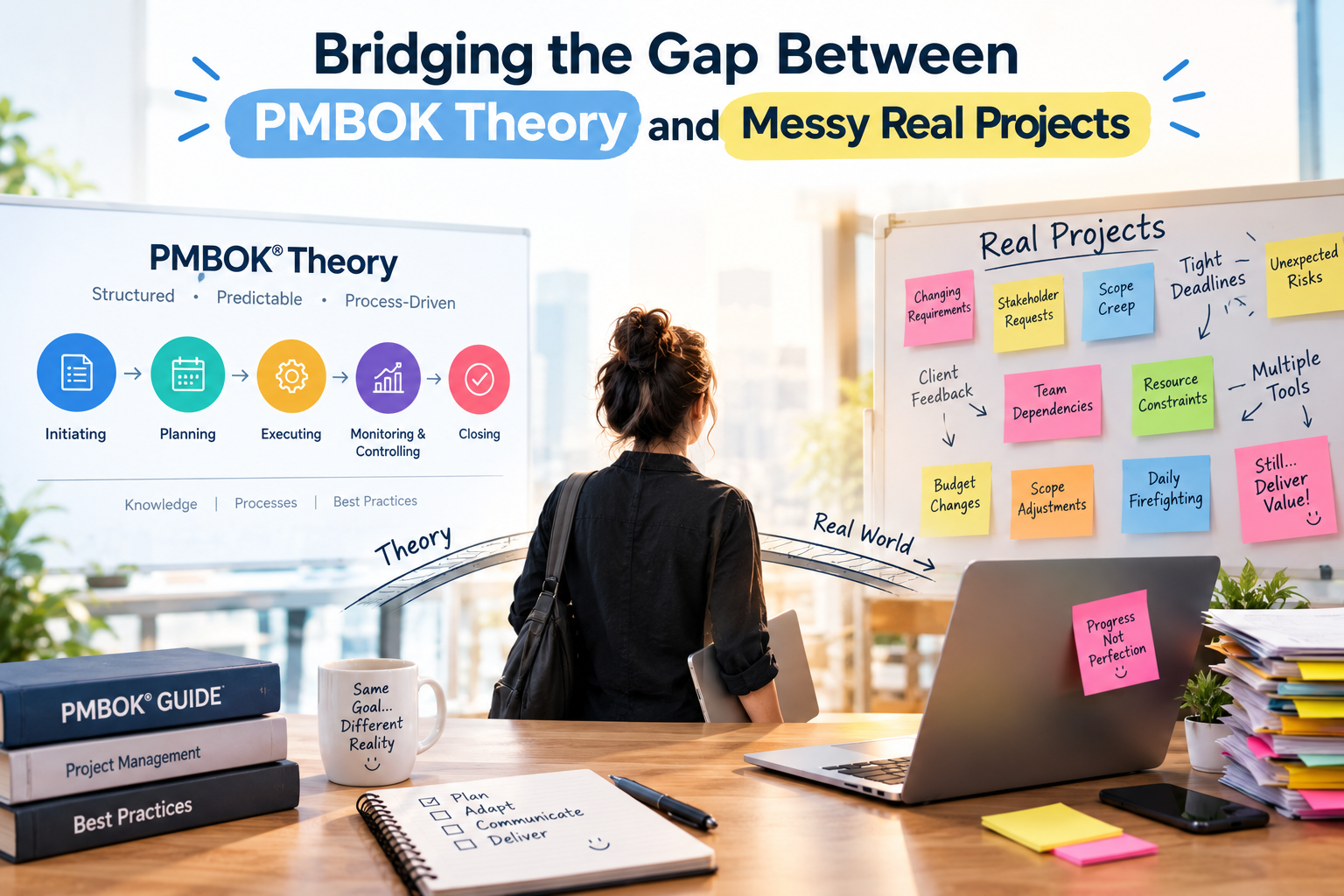
PMBOK theory vs real world project management is a tension every certified PM eventually confronts — the framework that got you through the exam doesn't always map cleanly onto a project with shifting stakeholders, unclear priorities, and deadlines set before anyone scoped the work. This guide looks honestly at where PMBOK holds up, where it doesn't, and how experienced PMs actually bridge that gap on real, messy projects.
Why PMBOK Theory Struggles Against Real World Complexity
PMBOK gives you a structured vocabulary and a defensible process — invaluable for passing the exam and communicating with stakeholders in a shared language. But PMBOK theory vs real world project management friction shows up the moment a project doesn't follow a clean, linear path, which is to say: almost immediately, on almost every real project.
The framework assumes reasonably stable scope, cooperative stakeholders, and predictable resource availability. Real projects rarely offer all three at once, and that's exactly where newly certified PMs often feel blindsided.
PMBOK Framework Limitations Worth Understanding Early
A few genuine PMBOK framework limitations are worth naming honestly, rather than discovering them mid-project:
It assumes rational stakeholder behavior. In practice, stakeholders often have unstated agendas, political considerations, or simply change their minds — none of which the framework directly accounts for.
It treats risk as knowable and listable. Real projects frequently face risks nobody identified in advance, because they emerge from dynamics the framework's structured risk register doesn't anticipate.
It underweights interpersonal and organizational politics. PMBOK covers stakeholder management conceptually, but the actual skill of navigating office politics is something the framework gestures at without teaching directly.
It can encourage over-documentation. Following every process to the letter on a fast-moving project sometimes slows delivery more than it protects it.
PMP Theory vs Practice: What Actually Changes Once You're Certified
The shift from PMP theory vs practice becomes obvious within the first few real projects after certification. The exam rewards selecting the textbook-correct answer among plausible options; real projects reward judgment calls that weigh trade-offs the exam never forces you to confront — like when following the "correct" process would actually damage a stakeholder relationship more than a pragmatic shortcut would.
This isn't a knock against PMBOK itself — it's a reminder that certification teaches the vocabulary and structure, while practice teaches the judgment.
Applying PMBOK in Real Projects: What Actually Works
Rather than discarding the framework, experienced PMs get better at applying PMBOK in real projects selectively — using the parts that add genuine value while adapting or skipping parts that don't fit the situation.
Use the risk register, but treat it as a living document, not a one-time exercise. Real risks emerge continuously; revisiting and updating it regularly matters more than the initial thoroughness of the first draft.
Use the communication plan, but stay flexible on format. A formal communication plan matters, but rigid adherence to a stated cadence when stakeholders clearly need something different signals poor judgment, not discipline.
Use the change control process, but don't let it become a bottleneck. Formal change control protects scope, but overly bureaucratic implementation on fast-moving projects can quietly kill momentum and stakeholder trust.
PMBOK vs Agile in Real Projects: A Practical Middle Ground
Understanding PMBOK vs agile real projects dynamics matters increasingly, since most real projects today blend predictive and adaptive approaches rather than following either framework purely. PMBOK's structured planning tools work well for defining overall project direction and stakeholder alignment, while Agile's iterative approach handles the reality that detailed requirements often can't be fully known upfront. Experienced PMs increasingly treat this as a genuine hybrid skill, not an either-or choice — a shift reflected directly in how modern exam content weights Agile and hybrid approaches alongside predictive methods.
Real World Project Management Challenges Textbooks Underplay
A few real world project management challenges rarely get the attention they deserve in formal training:
Stakeholders who say yes in meetings and no in practice — verbal agreement doesn't always translate into actual support once resources or priorities compete
Scope that shifts without anyone formally approving the change — informal scope creep is far more common than the dramatic, clearly-flagged changes textbooks describe
Team members reporting to multiple, competing priorities — matrix organization tension that PMBOK acknowledges conceptually but doesn't equip you to actually navigate
Deadlines set before scoping was complete — a common real-world starting point that no amount of careful planning fully resolves after the fact
Project Management Best Practices vs Reality: Closing the Gap
Bridging project management best practices vs reality isn't about abandoning structure — it's about applying structure with judgment rather than rigid literalism. A few practical habits help:
Treat every framework tool as a starting template, not a fixed requirement — adapt based on what the specific project and stakeholders actually need
Build relationships before you need them — the trust that gets a scope conversation resolved quickly is built in the weeks before the crisis, not during it
Document decisions, not just processes — a clear record of why a judgment call was made protects you more than proof you followed every step in order
Debrief honestly after each project — what the framework predicted correctly, what it missed, and what you'd adjust next time
Lessons Learned in Real Project Management
Some of the most valuable lessons learned in real project management come from projects that didn't go according to plan. A PM who's navigated a stakeholder conflict that no risk register predicted, or a scope negotiation that succeeded through relationship trust rather than formal process, carries judgment no exam question can fully substitute for. This is exactly why structured mentorship — learning from someone who's navigated these situations directly — accelerates the transition from certified to genuinely effective.
PMP Certification Real World Application: What It Actually Prepares You For
Understanding PMP certification real world application honestly means recognizing what certification does and doesn't guarantee. It prepares you with a shared vocabulary, a structured toolkit, and credibility with employers and stakeholders. It doesn't automatically prepare you for the judgment calls, political navigation, and adaptive thinking that separate a technically correct PM from a genuinely trusted one. That gap closes through experience, reflection, and — for many PMs — mentorship from someone who's already closed it themselves.
Project Management for Messy Projects: A Realistic Mindset
Ultimately, project management for messy projects requires accepting that messiness is the normal condition, not the exception. PMs who approach every project expecting textbook conditions burn out fighting reality; those who expect complexity and build in flexibility from the start navigate it far more effectively. If you're navigating the specific challenge of running a project's opening phase amid this complexity, our guide on how certified PMs actually run a kickoff meeting covers exactly this tension in practice.
The Bottom Line
PMBOK theory vs real world project management isn't a contradiction to resolve once and move past — it's an ongoing tension every PM learns to navigate with experience. The framework gives you structure and vocabulary; real projects teach you judgment. The PMs who thrive long-term are the ones who use PMBOK as a foundation while developing the practical wisdom to adapt it when reality doesn't cooperate.
Frequently Asked Questions
Q1: Does PMBOK actually apply to real projects, or is it purely theoretical?
PMBOK provides genuinely useful structure and vocabulary for real projects, but it requires judgment to apply well — rigid, literal adherence often causes more problems than it solves on complex, unpredictable projects.
Q2: Should PMP-certified PMs abandon PMBOK once they're working on real projects?
No — the framework remains valuable as a foundation, but experienced PMs learn to apply it selectively and flexibly rather than following every process rigidly regardless of context.
Q3: How does PMBOK relate to Agile in real-world projects?
Most real projects today blend predictive and Agile approaches, using PMBOK's structured planning for overall direction while incorporating Agile's iterative flexibility where requirements can't be fully known upfront.
Q4: What's the biggest gap between PMP theory and actual project experience?
Judgment calls involving stakeholder politics, informal scope changes, and competing priorities — situations the exam tests conceptually but doesn't fully prepare you to navigate in practice.
Q5: How can new PMs bridge the gap between certification and real-world competence?
Structured mentorship from experienced PMs, honest post-project reflection, and treating every framework tool as adaptable rather than fixed all help close this gap faster than experience alone.
Ready to build practical judgment beyond exam theory? Explore PMP coaching with Visakh RJ in Mumbai, or read real student testimonials from candidates who've built genuine project leadership skills. Browse the PMP blog for more real-world project management guidance.
Start Your PMP Journey — Enquire on WhatsApp →
Visakh RJ — PMP Coach · Speaker · Mindset Alchemist
📞 +91 62825 40905
📍 Mumbai, India